
Gaza: Return of War, or a New Form of Guardianship?
As the first stage of the ceasefire draws to a close, will Gaza slide into a subtle form of international guardianship?
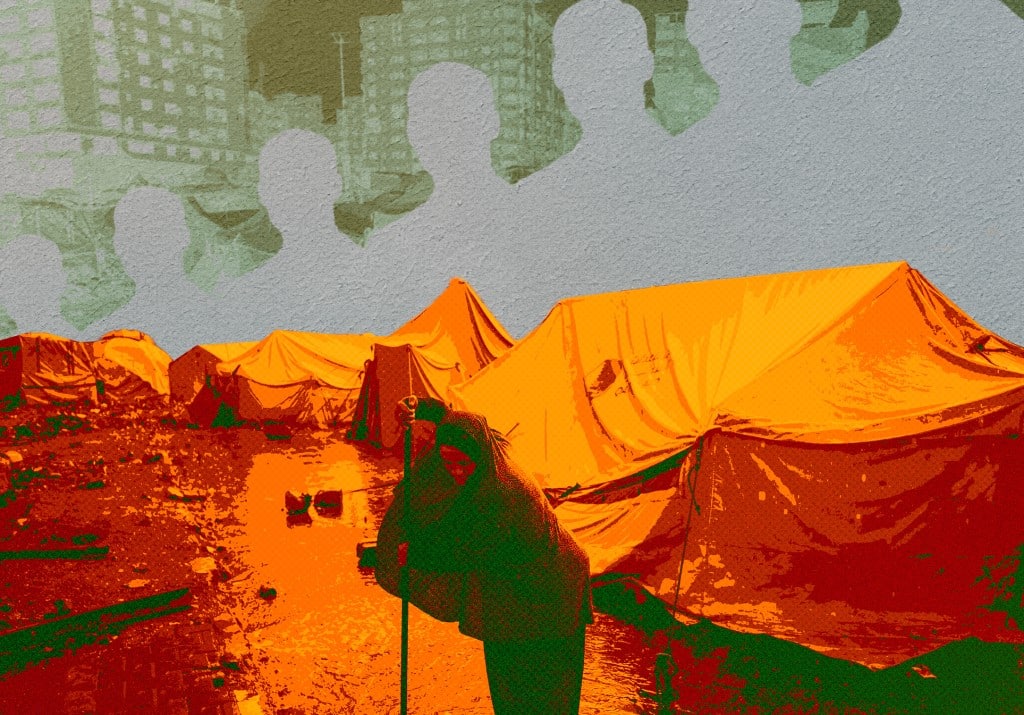
In Gaza, after the last bodies were handed over to Israel and faced with the announcement of a possible “phase two” of the US-sponsored ceasefire, residents are torn between fear and uncertainty.
In the silent alleys where dust mixes with the overly bright winter sun, everyone whispers the same question, almost mechanically: “After the last body, what awaits us? A return to war? Or this famous ‘phase two’ that no one understands?”
A stark, direct question that echoes through shelters, bread lines, and collapsed schools. A question that hangs like smoke above the broken rooftops.
A “phase two” surrounded by gray areas
Already, the truce seems less like a pause than a fragile breath.
Maha, 53, displaced for the third time, sums it up wearily: “We’re trying to live… but at any moment, the war could return and change everything again.”
For several weeks now, when the next phase of the truce is discussed, the same words have been repeated in makeshift cafes, shelters, and lines for water: a reorganization of the Gaza Strip, shared management with the State of Israel, security controlled from outside — or, for some, a form of international tutelage camouflaged by humanitarian language.
Sarah’s family is raising money to leave Gaza. You can donate here.
In the camps, in the streets, even at the barbershops where men wait in silence, the same echoes can be heard. This “phase two” is as worrying as it is intriguing. There is a diffuse fear, an almost palpable doubt in people’s eyes, as if everyone were trying to understand what this change could really mean for their daily lives.
Youssef, a professor whose university is now nothing more than a concrete skeleton, sighs. “The risk is not just the resumption of war. The risk is that we are sliding towards external control, installed slowly and quietly. “
In this climate of uncertainty, a statement from the US has added a new level of ambiguity. An official in Washington has indicated that the international force being considered for Gaza could become a reality as early as the beginning of next year.
No details have been provided: neither the exact mandate, nor the duration, nor how this presence would affect the lives of the inhabitants. But for many, this raises another question: would this force guarantee security or mark a new form of interference?
Om Ahmad, who is stuffing a few salvaged items into a plastic bag, simply says: “We hear talk of an international force, but we don’t understand what that means for us. We just want to know where we’re going.”
Daily life, more urgent than political scenarios
Amid the ruins, residents talk less about diplomacy than about survival: bread, water, schools that have disappeared, medicines that are impossible to find, homes wiped out in a single night. What dominates is neither geopolitics nor international announcements, but a simple and brutal question: how to live tomorrow?
Mahmoud, 42, looks at what remains of his neighbourhood of Shati, which has been completely destroyed. Where there used to be a bakery, a primary school, and his brother’s apartment, there is now nothing but a long stretch of gray dust.
“We wonder if the war will come back, yes, of course. But to be honest, we mainly wonder how we will survive until tomorrow. We don’t even know where to find clean water for our children,” he says, pointing to an endless queue leading to a reservoir.
Around him, life is being rebuilt in fragments: women gather pieces of wood for cooking, children fill yellow cans that are too heavy for them to carry, and a silent resilience fills the air. But every hour is filled with doubts and old suffering, as if fear and uncertainty were part of the city’s very memory.
Here, debates about “the next phase” or “international supervision” sometimes seem to belong to a distant world. The inhabitants live in an overwhelming present, where every moment carries the weight of mistrust and anxiety accumulated over the years.
And now?
Despite everything, as the last bodies are returned, one question remains, heavy as a windless sky: is Gaza moving towards a fragile calm… or towards a form of guardianship that is quietly taking hold?
Between the threat of renewed strikes and the more diffuse threat of imposed restructuring, Gazans live in the same state of waiting as they have for years: waiting for a future they have never been allowed to choose.
Did you like this article? Share it with a friend!
Author

Related Articles
Je pense sans cesse aux femmes incarcérées
La pauvreté des femmes est criminalisée au lieu d’être reconnue comme une urgence sociale.
Gaza: What Does the Second Phase of the Ceasefire Really Mean?
How Israel is undermining the truce by extending the “yellow line.”

Canadians Cash In While America Burns
It’s easy to sit in judgement of the U.S., but Canada has enabled, and even profited from, the rise of American fascism.
Comments (0)
There are no comments on this article.