
Gaza: What Does the Second Phase of the Ceasefire Really Mean?
How Israel is undermining the truce by extending the “yellow line.”
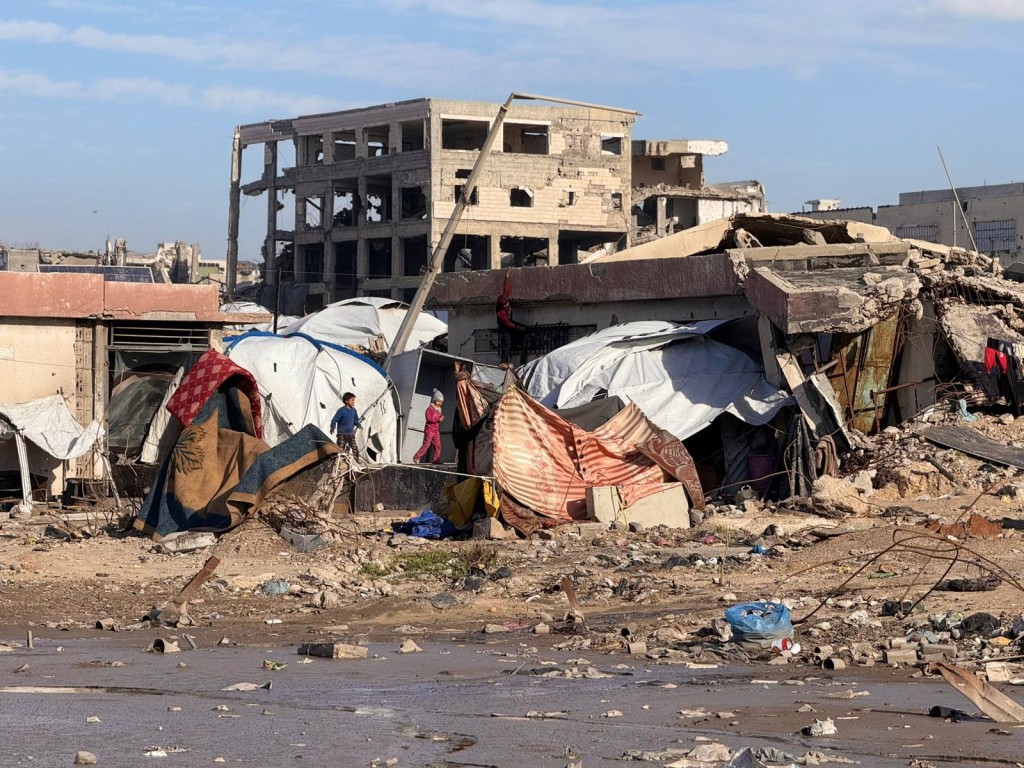
Displaced Palestinian families shelter in tents amid widespread destruction across the Gaza Strip (January 2026). PHOTO: UNRWA
No one really understands what is going on.
Since dawn on January 17, Gaza has been under incessant bombardment. The city is collapsing once again, and fear is spreading through the streets and the tents of the displaced. Explosions are hitting everywhere: schools, houses, tents; nothing is spared. Everything seems to be targeted, as if the aim were to erase all traces of life.
Residents are fleeing, children are screaming, and shelters are nothing more than a distant dream.
A “ceasefire”? These are just empty words here.
The war never really stopped: it was just taking a breather, and now it’s back, more brutal than ever. Every moment feels like it could be the last, while the world looks on, powerless.
Sarah’s family is raising money to leave Gaza. You can donate here.
Since the ceasefire came into effect on October 10, the Gaza Health Ministry reports that more than 440 Palestinians have been killed, the vast majority of them civilians, despite the truce.
Even after the announcement of the ceasefire, life in Gaza remains unbearable. Recent rains have turned the streets into muddy swamps, flooding partially destroyed homes and making survival even more precarious than under the bombardments themselves.
Strong winds and storms have torn dozens of tents from displacement camps, leaving entire families exposed to the cold and rain. Many houses already damaged by bombing have partially collapsed under the force of the gusts, further exacerbating the misery of the inhabitants. Some refugees have been forced to seek temporary shelter by the sea, where weather conditions remain extreme, and gusts of wind and rain make the situation even more dangerous.
According to local authorities, more than 35 children have died in recent weeks, not from bombs, but from the cold and unsanitary conditions in these makeshift shelters. Among the latest tragic cases, seven-month-old Shaza Abu Jarad died from the freezing cold, leaving her family devastated.
The second phase of the ceasefire: diplomatic promises versus reality
While Gaza struggles to survive the bombs and bad weather, the international community is preparing a second phase of the ceasefire, which includes the establishment of an international committee or authority to manage Gaza.
On paper, this committee would be responsible for coordinating humanitarian aid, overseeing essential services, and organizing the reconstruction of destroyed infrastructure.
But on the ground, there is deep skepticism. For many residents, this initiative seems completely disconnected from reality: decisions are made without their participation, and vital needs — reconstruction work, the installation of caravans for displaced families, and the supply of food and medicine — remain largely neglected.
The council’s decisions appear to be more symbolic than practical, while Gazans continue to suffer.
Ahmed, a teacher in Gaza City, sums up this concern. “Governing without involving us means deciding our lives without asking our opinion. There is talk of committees and plans, but we are just trying to survive each day.”
As families continue to suffer from cold weather, storms, and precarious living conditions, the promises of the “second phase” seem increasingly abstract.
In this context, the “Peace Council,” responsible for overseeing aid and reconstruction, faces significant constraints. Israeli Prime Minister Benjamin Netanyahu strictly limits its members’ access to Gaza, allowing only highly supervised and monitored visits, which greatly reduces their ability to intervene effectively.
The council’s decisions therefore appear more symbolic than practical, while Gazans continue to suffer daily misery and insecurity.
Fatal incidents near the yellow line
Israel unexpectedly moved yellow concrete blocks beyond the line defined on maps to separate Gaza into two zones, with the eastern zone remaining officially under Israeli control. This caused great confusion among Palestinians and left some residents “trapped” inside the yellow line.
Ahmed, a young resident of Hayy al-Tuffah, says: “We now live inside the yellow line, but behind these concrete blocks, without knowing what our fate will be.”
“At night, the atmosphere is terrifying: we hear explosions, soldiers advancing, gunfire, the constant buzzing of drones, and we are exposed to direct fire.”
A “ceasefire”? These are just empty words here.
Since the expansion of the “yellow line,” violent incidents have multiplied. According to local reports, at least twelve civilians have been killed for approaching the yellow line in recent weeks, while dozens more have been injured or forcibly displaced.
Residents also report violations of their freedom of movement, with soldiers controlling every street and access point, turning the line into an area that is virtually impossible to cross without risking death.
Among the victims was 17-year-old Zaher Nasser Shamiyeh, who was killed near the yellow blocks in the Jabaliya refugee camp in northern Gaza. His father recounts with horror: “Israeli forces opened fire on him before a tank hit him on December 10. The tank blew his body to pieces… He had entered the ‘safe’ zone west of the yellow line and they crushed him.”
***
In Gaza, there is no real truce.
Residents are trapped between bombings, direct fire, and freezing storms, while every step outside their shelter can be fatal. Children are dying of cold, families are trapped behind concrete blocks, and teenagers like Zaher Nasser Shamiyeh are losing their lives in unbearable circumstances.
The yellow line is not just a border on a map: it has become a death trap, where daily life boils down to survival, fearing every moment and counting the losses.
With every explosion, every gust of wind, every child’s cry, the reality far exceeds any statistics or news reports.
Gaza continues to burn, not only under the bombs, but under the indifference of the world and the injustice that befalls its inhabitants.
Did you like this article? Share it with a friend!
Author

Comments (7)
Leave a comment
Related Articles
Parlons de violence étatique
En 2026, les prestations d’assistance sociale demeurent largement inférieures au minimum reconnu pour vivre au Québec.
Is Israel Preparing a Legal Framework to Execute Palestinian Prisoners?
Since October 7, 2023, prison conditions for Palestinian detainees have seriously deteriorated.

SAAQclic : quand l’État ne sait plus « faire » ni « faire faire »
SAAQclic dépasse le simple scandale administratif. Il révèle quelque chose de plus profond, soit l’érosion graduelle de la capacité de l’État à agir par lui-même et à encadrer efficacement les actions qu’il délègue.
Thank you for trying to bring light to this horrific situation. The comment about freeing Gaza from Hamas illustrates the kind of challenges we face: huge numbers of people in western society simply do not think that Palestinians are human beings.
@Adam What…? Can you explain your reasoning as to how you went from a person commenting that Hamas needs to go, to the person thinking that Palestinians are subhuman? How can you possibly make that leap in logic?
Person: “Trump is terrible for America, he needs to be removed from power ASAP”
You, probably: “You clearly do not think that Americans are human beings.”
Do you see how stupid you sound?
FREE GAZA FROM HAMAS !!!
Why dozens of articles about Gaza but zero about Iran?
Let’s start by getting the IDF to stop bombing civilians, aid trucks and hospitals….
Worth reading the article before commenting buddy.
Sorry Mark. That reply was meant for the comment above. I agree that we should be covering Iran though it’s important work to keep up with the genocide in Gaza as long as the the crisis continues to be omitted from the mainstream media conversation.
@Olive lmao are you kidding me? The mainstream media has been absolutely obsessed with this war for over 2 years. Thousands of articles and videos. Tens of thousands even. Non-stop coverage, day after day after day. NY Times, BBC, Al Jazeera, CBC, CTV, Guardian, NBC, Fox News, NPR, CNN, every outlet, left or right, in every Western country (and beyond). Less “mainstream” outlets too like VOX, Democracy Now, Politico, Axios, Jacobin, the list is literally endless. What kind of fantasy world are you living in?