
Le Devoir De-Indexing Investigation Spurs Transparency Concerns
Did Le Devoir bury one of its own investigations at the request of a charitable organization with ties to one of Quebec’s richest men?

Editor’s Note: Marie-Élaine Guay has previously freelanced for Le Devoir.
Did Le Devoir bury one of its own investigations at the request of a foundation linked to one of Quebec’s richest men?
In February 2025, Le Devoir published a series of four investigative articles devoted to the Jasmin Roy Sophie Desmarais Foundation and its governance. The articles, written by journalists from the daily newspaper, addressed the grey areas between personal interests and charity, accusations of intimidation and aggressive behaviour targeting Jasmin Roy, as well as cases of alleged favouritism at the Ministry of Education. One of the articles, entitled “Jasmin Roy, from bullied to bully,” raised questions about Jasmin Roy’s behaviour, which was described as “disrespectful,” “aggressive,” and “harassing” by several people who had worked with him.
In an interview with Sophie Durocher on QUB radio on April 8, 2025, Jasmin Roy responded to the series of articles in Le Devoir by stating that, during his exchanges with journalists, he felt “intimidated” and “harassed,” referring to “interrogations” and repeated requests over a period of about a month. He maintains that, following communications deemed serious, the foundation hired an outside firm to verify the allegations, and that he withdrew from the board of directors so as not to influence the process. Roy also mentioned the possibility of legal action, saying that the organization was “considering all options” and that “many options” remained “on the table,” “even with Le Devoir.”
A few months later, in mid-November 2025, the Jasmin Roy Sophie Desmarais Foundation changed its name to the Fondation Isabelle et Luc Poirier. Luc Poirier, a businessman and long-time member of the board of directors, became one of its new faces.
According to the foundation’s press release on December 1, 2025, Jasmin Roy, founder and CEO, “will retain his role to ensure a smooth transition and continue his work on the life mission he has set for himself, alongside Isabelle Gauvin and Luc Poirier, in a spirit of innovation and openness.”
Support your local indie journalists
At some point between February and November 2025, Le Devoir‘s investigation entitled “Jasmin Roy, from bullied to bully” ceased to be indexed by search engines. A keyword search on Google or Bing yields no results, even though the text remains accessible on the newspaper’s website. Examination of the page’s source code reveals the presence of the “noindex” tag, an instruction that prevents search engines from indexing the content and makes it invisible to the general public without a direct link. No public statement specifies the reason for this deindexing.
Deindexing is the deliberate removal of an entry from the search results generated by a search engine.
On Saturday, Dec. 13 of this year, Le Devoir published an advertorial highlighting the mission of the Fondation Isabelle et Luc Poirier, presented as an organization dedicated to promoting well-being and kindness. On its social media accounts, the foundation thanked the newspaper for “graciously publishing” the article. Under the post, a reader wrote: “They didn’t publish it graciously, it’s paid advertising content. There’s nothing wrong with that, but you should just call a spade a spade.” The foundation replied, “It was free!” However, the screenshot attached to the post clearly shows the words ”advertorial” at the top and bottom of the page. At the time of writing, the comments quoted above, as well as several others raising questions about the links between the foundation and Le Devoir, were deleted from the original post.
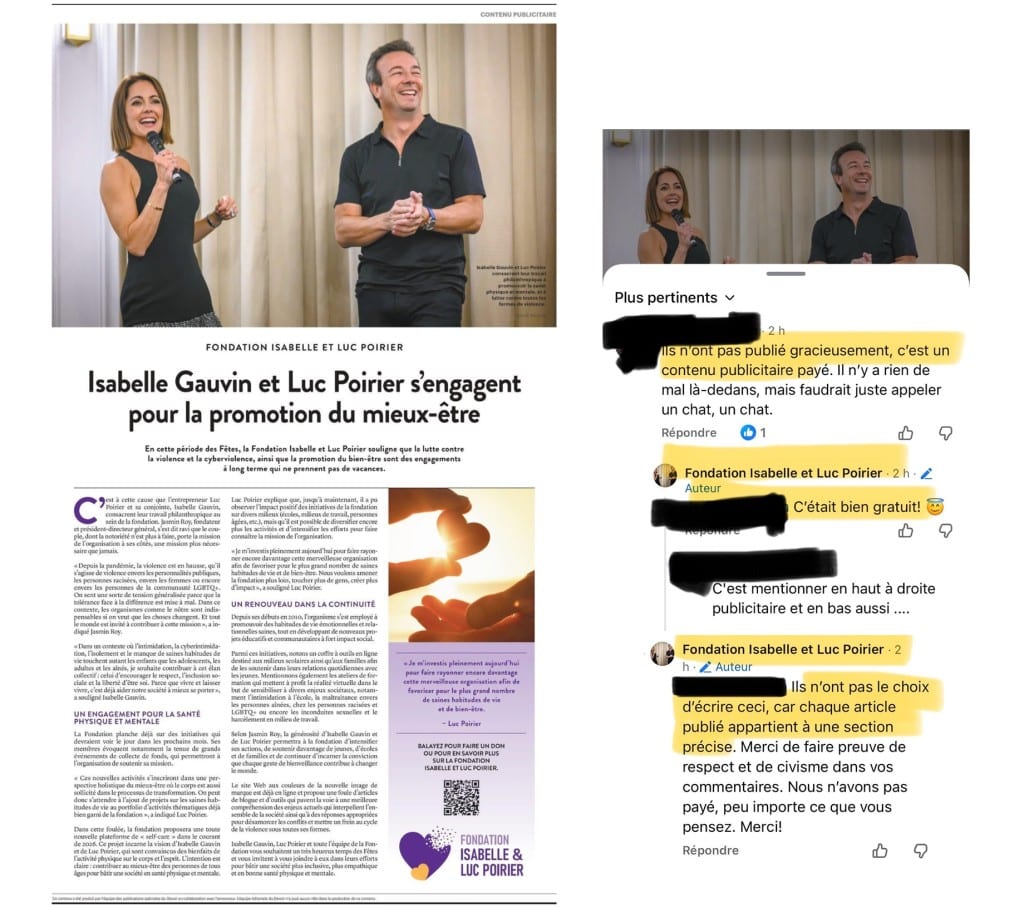
Social media post of Fondation Isabelle et Luc Poirier’s article published by Le Devoir and comments from users.
In this context, the de-indexing of an investigation followed by the publication of an advertorial — with a market value of around $10,000 — favourable to the same organization, raises issues of transparency and editorial independence. A media outlet’s responsibility is not limited to producing information; it also consists of preserving access, traceability, and clarity. In a climate of growing mistrust of media institutions, such editorial choices must be examined.
The timing of the de-indexing of the investigation and the publication of the advertorial raises questions about the possibility of an undisclosed settlement or agreement between the two parties. According to our information, the Fondation Jasmin Roy had previously sent a formal defamation notice to Le Devoir following the series. However, there is no public information to confirm the nature of this relationship.
When contacted by The Rover, the union representing Le Devoir employees said it was “concerned about the publication of the Fondation Isabelle et Luc Poirier (formerly the Fondation Jasmin Roy Sophie Desmarais).”
The union confirmed that it had “taken action with the employer in this matter,” but was unable to comment further at this stage, according to its vice president, Isabelle Porter.
The Rover consulted Jean-Hugues Roy, a professor at UQAM’s School of Media and a specialist in digital technologies, journalism, and disinformation, to better understand the practice of de-indexing.
After analyzing all the articles published by Le Devoir in 2025, he found that only 0.64 per cent of them contained the noindex tag, or 135 articles out of more than 25,000, including 25 signed by Le Devoir journalists. In his view, de-indexing a news article remains an extremely unusual practice, generally reserved for content imported from other media outlets, like The New York Times, and not for original investigations produced by the editorial staff.
In his view, the use of the noindex tag in this context is unusual.
“I mean, if you’ve made a mistake, it can happen that the media gets sued and that removing an article is part of the agreement.
We don’t do that, remove an article (without justification). Journalists in the past have fought for this. In short, owners don’t interfere with editorial content. That’s a principle that journalists have defended for generations.
In a way, putting a noindex on an article means not trusting your troops.”
The expert also performed the same exercise for La Presse. In its case, he found that the only articles that were de-indexed were from content imported from third-party media outlets, notably the Washington Post and Bloomberg, and not from in-house investigations.
The Fédération professionnelle des journalistes du Québec points out that “information of public interest must circulate freely and at all times” and that journalists “serve the public interest and not personal or private interests.” Le Devoir is a member of the Quebec Press Council, whose editor-in-chief, Marie-Andrée Chouinard, sits on the board of directors. Article 6.1 of the Council’s Code of Ethics stipulates that “the news media shall not, under any circumstances, allow their commercial, political, ideological, or other interests to take precedence over the legitimate interest of the public in quality information.”
In this context, the de-indexing of an investigation followed by the publication of an advertorial — with a market value of around $10,000 — favourable to the same organization, raises issues of transparency and editorial independence. A media outlet’s responsibility is not limited to producing information; it also consists of preserving access, traceability, and clarity. In a climate of growing mistrust of media institutions, such editorial choices must be examined.
Le Devoir and the Fondation Isabelle et Luc Poirier did not respond to our requests for interviews or to a series of written questions sent as part of this investigation.
The journalists credited for the original investigation declined to comment and referred us to their union.
Among the questions that remained unanswered were those concerning the reasons for the de-indexing of the article “Jasmin Roy: From Bullied to Bully,” whether legal action was taken following its publication, and the exact nature of the exchanges that preceded the publication of the December 2025 advertorial.
The Rover also asked who at Le Devoir has the authority to decide to de-index an original investigation and what internal process is used to make such a decision.
Questions also remain about potential financial ties between the newspaper and certain individuals associated with the foundation, including whether Sophie Desmarais is, or has been, a major donor to Le Devoir, and what guarantees of editorial independence apply in such situations.
In October 2023, Le Devoir obtained registered journalism organization (RJO) status. As such, and in the interest of transparency, the question of disclosing the identity of its major donors also arises, as is the case for other organizations benefiting from this status.
Finally, we asked whether Le Devoir recognizes that this type of sequence is likely to set a precedent, in which powerful or well-connected actors would seek to limit the visibility of critical reporting.
Concerns remain that this episode could be perceived as capitulation to influential interests.
Did you like this article? Share it with a friend!
Authors


Comments (1)
Leave a comment
Related Articles

« Je veux juste qu’on me croie »
Victime d’une agression sexuelle alors qu’elle travaillait pour le gouvernement provincial, une femme lutte avec Québec depuis cinq ans.
Hundreds of Migrant Workers Compensated After Fraudulent Recruitment Scheme
The multinational Newrest and the Montreal agency Trésor must pay $2.1 million to migrants tricked into working without authorization under the false promise of obtaining a valid work permit in Canada.

Bill 94 Put Their Teaching Degrees on Hold
Two Muslim women who wear the hijab discuss the moment they learned they could no longer complete their education degrees in Quebec.
Thanks for doing this kind of important journalism so well with the relatively limited resources you have. Bravo!