
McGill Law Faculty Union Is On Strike
The Administration has tried to decertify the union, avoided key issues, and is stalling negotiations, union members say.
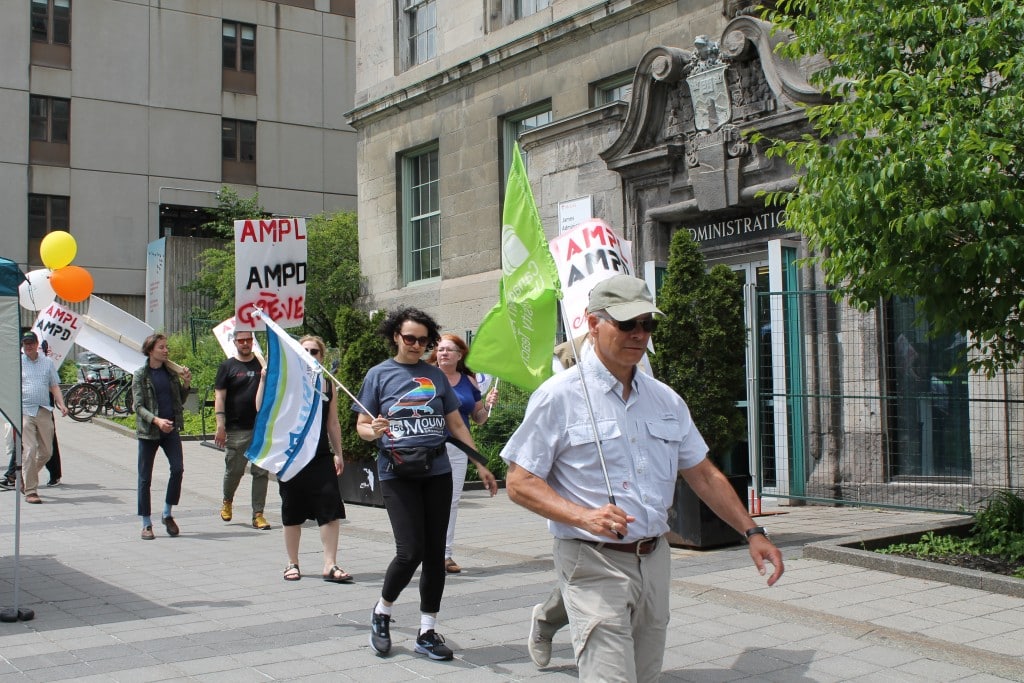
McGill University’s Law Faculty union picketed the university’s administration building as part of strike actions on May 31, 2024. PHOTO: Gavin Sewell
For the first time in the school’s 250-year history, law teachers at McGill University have unionized.
With other faculties following suit, the university’s administration is pushing back, trying to decertify the union and stall negotiations. The law faculty has blocked Canada Post mail delivery and occasionally trash pickup as part of an increasingly bitter six-week strike. Teachers have refused to grade this year’s final exams, throwing the students’ diplomas and future employment into question.
Multiple conflicts were in the air on May 31, the day of Convocation, as the Association of McGill Professors of Law (AMPL) assembled on the picket line. Families photographed graduates on campus — some including, others excluding the Palestine encampment from their photos. A woman in a blue and white dress alternated between heckling pro-Palestinian speakers and berating a bored security guard to “throw Hamas off campus.”
The AMPL picket in front of the James administration building was subdued by comparison, but the static energy of dissent was palpable everywhere.
Support Independent Journalism.
Union membership has increased in Quebec over the last four years, with gains largely among lower-wage, less-educated sectors. The striking prods circling the admin building with flags, signs, and bull-horned shouts of, ‘Sol—sol—sol, Solidarité!’ showed the same defiance and energy as their working-class union sisters and brothers.
“I understand the value of unions because I come from a working-class family,” said the first striker who spoke to me. “People who understand that you can’t just fight for yourself.”
But what are the implications for the broader union movement and intersectional power when higher-income workers unionize and strike?
“I’m only surprised we weren’t striking earlier,” said a younger teacher who wished to remain anonymous for fear of professional reprisals. “Last winter we decided not to disrupt the students’ term. We gave McGill the benefit of the doubt to negotiate in good faith and they just dragged their feet.”
After 18 months of negotiations, the union of 45 teachers began an unlimited strike on April 24. Law students’ transcripts have no grades for the winter term, meaning this year’s graduates received incomplete diplomas.
Administrators issued diplomas anyway, claiming they’d evaluated the semester’s work themselves.
In an open letter, AMPL said the students’ diplomas are invalid and that McGill violated its own policies by issuing the degrees. The university website tells law students that grades will be added once the strike ends. The Bar of Associations of both Quebec and Ontario have stated McGill law graduates would be allowed to register for admission despite incomplete degrees.
“What they’ve done in terms of giving diplomas to the students is deeply troubling,” said Madeleine Pastinelli, a sociologist at the University of Laval and president of the Quebec Federation of University Professors (FQPPU). “To act like the judgment of their own professors is superfluous, I’d never have believed the administration of a university like McGill would do that. ”
Not only does issuing the diplomas violate school policy, AMPL claims, but it also breaks the recently adopted Act of Academic Freedom in a University Environment.
The province of Quebec responded that AMPL may file complaints but that the Ministry of Education won’t intervene in a labour dispute. Since the start of the strike, there’s been no meeting between the union and administration specifically about the questions of diplomas.
“It’s a shocking route to take. Everyone’s affected — students, staff, the community and McGill’s reputation,” remarked Associate Professor Priya S. Gupta as we circled the quad. “Our president sees himself as the CEO of a company. Its reputation matters. Instead, he puts the university’s reputation and our graduates’ transcripts in jeopardy.”

AMPL union members blocked mail delivery to McGill University as part of strike actions on May 31, 2024. PHOTO: Gavin Sewell
With this much potential disruption to their futures, which side are the law students on?
“We’ve been in close contact with the students since the beginning and they’ve been overwhelmingly in support of us.” said Kirsten Anker, an Associate Professor and Vice President of AMPL.
“There’s clearly a link with the other protests happening on the campus and the administration’s inability to come to the table and talk in a reasonable way. Students are in a precarious position, though. They can’t say much against the dean because he’s going to be signing recommendation letters for them.”
One day before the filing deadline, McGill appealed the Tribunal administratif du travail (TAT)’s decision to certify AMPL — a rare approach and unlikely to succeed since the TAT’s pro-union ruling was an unusually long 20 pages.
“We’ve seen a perfect playbook of obstructionist bad-faith negotiation and union-busting tactics,” said Gupta as we walked down the hill to block mail delivery. The striking faculty formed up in front of the Canada Mail truck, the driver got out and after a short talk with the strikers returned to his truck, letters in hand, refusing to cross a picket line.
“Meetings cancelled at the last minute, or they came totally unprepared to negotiate on a particular proposal. They’d say they needed to go in the other room to talk about something, a few hours would pass, lunchtime rolls around and very little gets done. But they could claim they’d met with us for a certain number of days — just without any real bargaining.”
With its $1.5 billion endowment, McGill administration can afford the long and expensive litigation they’ve initiated, however unlikely to succeed. AMPL is getting solidarity and financial support from both the Canadian Association of University Teachers (CAUT) and La Fédération québécoise des professeures et professeurs d’université (FQPPU).
“I find the administration’s resistance surprising in a context where almost all the other universities in Quebec are unionized,” said Pastinelli. “The rest of McGill’s workforce is unionized — it’s not something from another planet and profs at other universities feel it’s absurd.”
Nationwide, nearly 80 per cent of university professors are in unions. The disruption and potential damage to McGill’s reputation beg the question — why is the administration so resistant?
“One reason they take an aggressive line with us is the professors of education of arts have also filed for union certification,” said Evan Fox-Decent, the President of AMPL and Canada Research Chair in Cosmopolitan Law and Justice. “If we get a collective agreement it will be hard for McGill to argue that individual faculties aren’t viable negotiating partners. Also, the judicial review is set for December and it’s almost certain that the university wants to at least take that shot before making a deal.”
McGill administration didn’t respond to requests for comment for this article.
Their public rationale for fighting AMPL’s certification is the “vast consequences” for McGill if AMPL maintains its union status.
Media relations officer Frederique Mazerolle’s communique to the university newspaper reads, “Given the far-reaching impacts of this decision on McGill’s operations as a whole, the administration has a duty to see this process through to the end to ensure all impacts have been thoroughly considered and that they are, where relevant, incorporated into the application of the correct legal test. While the university continues to seek resolution to its concerns about the TAT decision, McGill is fully committed to negotiating with the new union.”
Said Pastinelli, “I think the goal of the administration is probably to scare other facultiesEveryone understands this collective agreement would function as a model for unionizing all the professors — they’re taking delay tactics.”
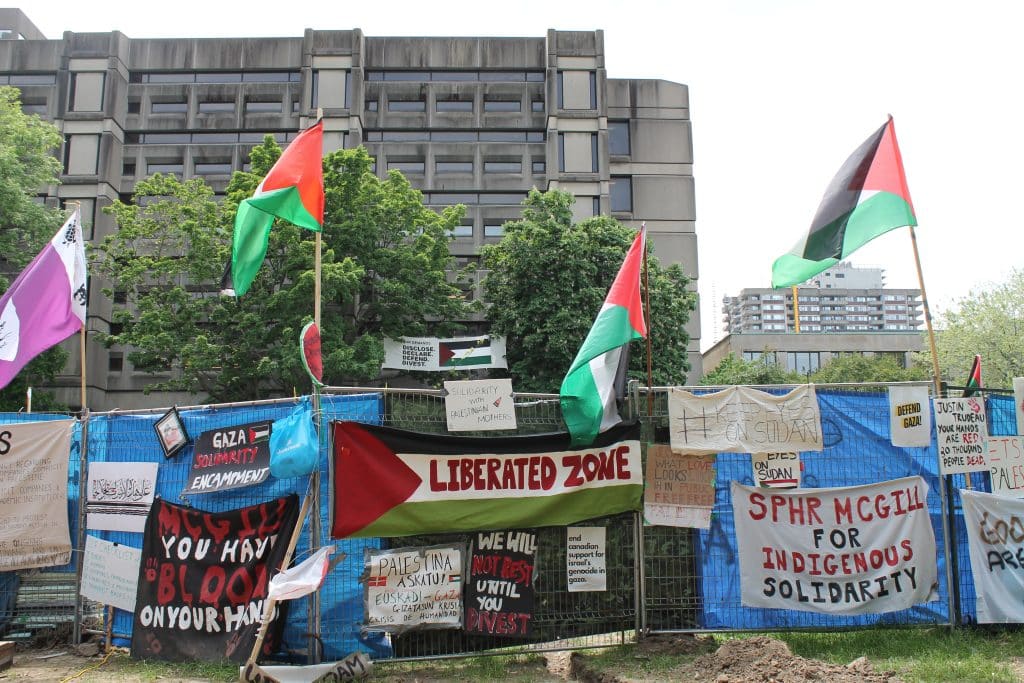
The pro-Palestinian student encampment at McGill University was just one demonstration of dissent at the university on May 31, 2024. The other was a picket line formed by striking law professors. PHOTO: Gavin Sewell
But delay to what end, considering McGill’s capacity to pay high salaries and non-profit status?
“The university recently sent a memo saying they weren’t going to cut our salaries — because under the current regime, they could cut our salaries at any time and did during the recession of 2008,” Fox-Decent laughed.
The law faculty are higher-income workers — last year’s average salary of a McGill full-professor was $175,000 compared to Montreal’s median household income of $62,000. The university’s also an outlier, since pay is negotiated individually whereas most Quebec universities negotiate faculty wages collectively with a fixed formula.
“The administration keeps trying to reduce our demands to salary but it’s far more about governance and control over working conditions,” explained Gupta. “Most administrations would welcome faculty taking on more administrative work and decision-making without having to unionize and put that in a legal agreement. McGill thinks decision-making should be top-down, not democratic.”
Between 2014 and 2023 salaries of executive and management staff at McGill rose 260 per cent compared with a 147 per cent increase for professors during the same period. Managerial salaries now represent 14 per cent of total wages for the institution as opposed to 8 per cent 10 years ago.
“If the struggle of the McGill professors was only about salaries, there probably wouldn’t be the same sense of solidarity,” Castelli theorized.
“But it’s not about that: AMPL is fighting for more transparency, control, and equality against the arbitrary actions by management that we’re seeing more at many universities. That’s mobilized profs all over. Colleagues from small universities are willing to pay dues and contribute to the McGill struggle because of the broader power issues.”
Is undermining a tradition of self-management — considered a radical notion in most workplace contexts — a possible motivation for the upper administration’s hard anti-union stance?
“The Provost Christopher Manfredi’s background was as an advisor to the Reform Party of Canada — a party brought into existence because the conservative party wasn’t right-wing enough. That mentality sets the agenda for our bargaining partners,” said Fox-Decent.
“I get the feeling they also have personal histories with unionization that makes them hostile,” Anker pointed out. “We’re asking for more participation — that’s clearly not something they want.
“Going on strike changes things — not just the bargaining process but building the community. We’re spending more time together talking about real things we care about in a way that hasn’t happened before. We’ve built incredible solidarity among our colleagues.”
The speeches pillorying the admins wrapped up and everyone applauded.
“The question now isn’t if we’re going to end the strike, just if we might suspend it to come back in the fall,” said Fox-Decent “Otherwise, we’ll have 800 students who have come to McGill to study law deprived of that because the administration won’t sit down and negotiate seriously.”
As the picket wound down, I slipped off campus through a sidegate past a dumpster filled with graduation programs. The softer rendering of McGill’s martlet logo made the pile look like a flock of blood-soaked doves.
Gowned students loitered with proud parents on adjoining streets, a major rite of passage towards their future lives completed. The freedom to control our own lives is a universal need. The graduates, encampment protesters, and AMPL strikers were all pushing for power over institutions that shape our society and our futures.
McGill’s administration may have done the union movement a favour with its resistance and stonewalling.
“Participating in union struggles is starting to become a way of life for us — a good way to pay it forward is to help others,” Anker said as I packed my cameras.
How this mobilization of angry, newly pro-union lawyers ripples through the labour movement remains to be seen, but judging by the energy and solidarity of AMPL and its supporters, there’s every reason to be optimistic.
Comments (1)
Leave a comment
Related Articles

As Media Habits Change, Montreal’s Christmas Fund Takes a Hit
The Montreal Gazette’s Christmas Fund has supported struggling families across the city since 1967. But as newspaper readership declines and consumer habits shift, shrinking donations mean this year’s cheques may have to be cut.

Le Devoir de transparence
Après avoir exposé des témoignages d’intimidation, Le Devoir a déréférencé sa propre enquête sur Jasmin Roy. Quelques mois plus tard, le journal offre une vitrine publicitaire à la fondation Isabelle et Luc Poirier, lui ayant succédé.
Le Devoir De-Indexing Investigation Spurs Transparency Concerns
Did Le Devoir bury one of its own investigations at the request of a charitable organization with ties to one of Quebec’s richest men?
AMPL profs are not fully striking as they continue to attend academic conferences and publish academic work. The only thing they are not doing is the work that isn’t personally advantageous to their careers, namely teaching and student supervision.