
Why Did Divestment Negotiations at McGill Fail?
While the McGill administration has painted the encampment’s demands as unreasonable, pro-Palestinian protesters are adamant that more can be done to make divestment happen faster.

Protestors gathered in support of the pro-Palestinian student encampment on McGill University campus after private security officers cleared out the encampment on July 10, 2024. PHOTO: William Wilson
On July 10 at 4:30 a.m., protesters at the pro-Palestinian encampment on McGill campus woke up to a wall of riot cops and private security officers hired by McGill administration surrounding the entire perimeter of the school.
Over the course of 10 hours, the officers worked to get protesters out of the area and dismantle the encampment. An encampment member who was present throughout the day said the officers were using intimidation tactics to coerce the protesters and the students into leaving the camp, like threatening to arrest them.
“The private security officers had a canine unit, and they kept telling the protesters at the camp that if they did not leave, they would get arrested. And they also told the protesters that things will get violent if they do not leave,” said the SPHR spokesperson who wished to remain anonymous.
The grounds where the encampment stood for over two months were reduced to a pile of wooden pallets, banners and signs on the ground, and tents ripped apart.
After an incident like this, it would be hard to believe that the McGill administration intends to meet the demands of the encampment, or to divest from Israeli companies that are fueling the genocide happening in Gaza. Yet, a member of the McGill administration says the divestment process is underway.
But places like McGill work like molasses, explains the administration member who wished to remain anonymous.
Support Local Investigative Reporting.
Despite the latest events, the admin member wanted to highlight that McGill is still going ahead with the divestment process.
The latest proposal given to the encampment in June is being put forward in the next Board of Governors meeting. If the board agrees with the points, they will relay it to the Committee on Sustainability and Social Responsibility (CSSR) who will make a decision by December.
“But if you’re 25 years old, living in an encampment, December just sounds like a ridiculous proposition,” says the admin member.
It is a long process which the student protestors has expressed deep frustration about — not because staying in the encampment for longer was an issue but considering that time is of the essence when thousands of Palestinians continue to die in a genocide.
“It seems almost dystopic to keep trying to shed light and convince the administration that we should not send weapons to a genocide or not help them manufacture these weapons. It’s kind of insane to me,” says Zeyad Abisaab, general coordinator for the Solidarity for Palestinian Human Rights (SPHR).
Time and time again, the encampment has called for “commitments not committees,” but McGill’s administration says they cannot change their bureaucratic system for divestment.
“The divestment is in process, nowhere near as fast as somebody living in the encampment wants, but it’s much faster than McGill’s normal process,” says the admin member. “I think that was seen as acting in bad faith, because the encampment probably thought McGill could if it wanted to.”
Both the administration as well as the members of the encampment have described the other as acting in bad faith. The administration gave up trying to negotiate with the encampment after their last proposal was rejected, deeming the encampment as unwilling to engage in discussions. At the same time, the encampment said the administration has not made any real efforts to meet their demands in a concrete way.

Protestors had previously clashed with Montreal police officers in full riot gear on McGill University campus on June 6, 2024, when some protestors occupied the Administration Building to call for the university to divest from Israeli companies profiting from genocide. PHOTO: William Wilson
“The administration is the one that publicly closed off all negotiations, although the negotiations were never in good faith. I mean, while negotiations were happening, police were called multiple times on students, McGill was filing court orders again and filing injunctions against the students,” says the SPHR spokesperson.
The admin member explained that in the discussions they were involved in, the encampment protestors wanted money moved as soon as possible and when the administration said that they can’t do that, the encampment members “got up and left.”
They added that even when the offer was made to bring in a mediator, the encampment said, “if you don’t move money tomorrow, there’s no point talking.”
“I think [the encampment] saw the bad faith as delay tactics, and the university saw the bad faith as demanding something they saw as completely unreasonable and refusing to even discuss it,” says the admin member.
Divestment at McGill has historically been a lengthy process. The divestment from South African apartheid, for example, happened over the course of three years. And more recently when McGill’s board of governors voted to divest from fossil fuels at the end of last year it was a victory after over a decade of campaigning.
The admin member told The Rover that they agree with the demands of the encampment and the goal of divestment, because they’re right — McGill shouldn’t be investing in a genocide. When student protests were spreading across campus last fall, they said they supported them.
“I think there was meaning on both sides. They wanted to achieve something, but what that would look like was so different on both sides that it was never going to meet in the middle,” they said.
But in the last few months, they felt that the encampment’s goals were more about twisting McGill’s hand to change their procedures to achieve divestment as fast as possible — and that is not realistic.
“What [the encampment] really wasn’t happy about is that the divestment isn’t happening immediately. So what they’re demanding, in effect, is not divestment, because that’s happening. It’s about the way McGill is using its processes to achieve it,” says the admin member.
But the SPHR spokesperson said a key issue has been McGill admin’s public messaging and negotiations tactics: they seem to always shift the conversation to blame the encampment rather than discussing the main issue at hand.
“The movement obviously does not start and will not end with the encampments. The student movement is still going on strong, students are more motivated than ever to continue applying pressure on McGill, because clearly, it works,” says the SPHR spokesperson.
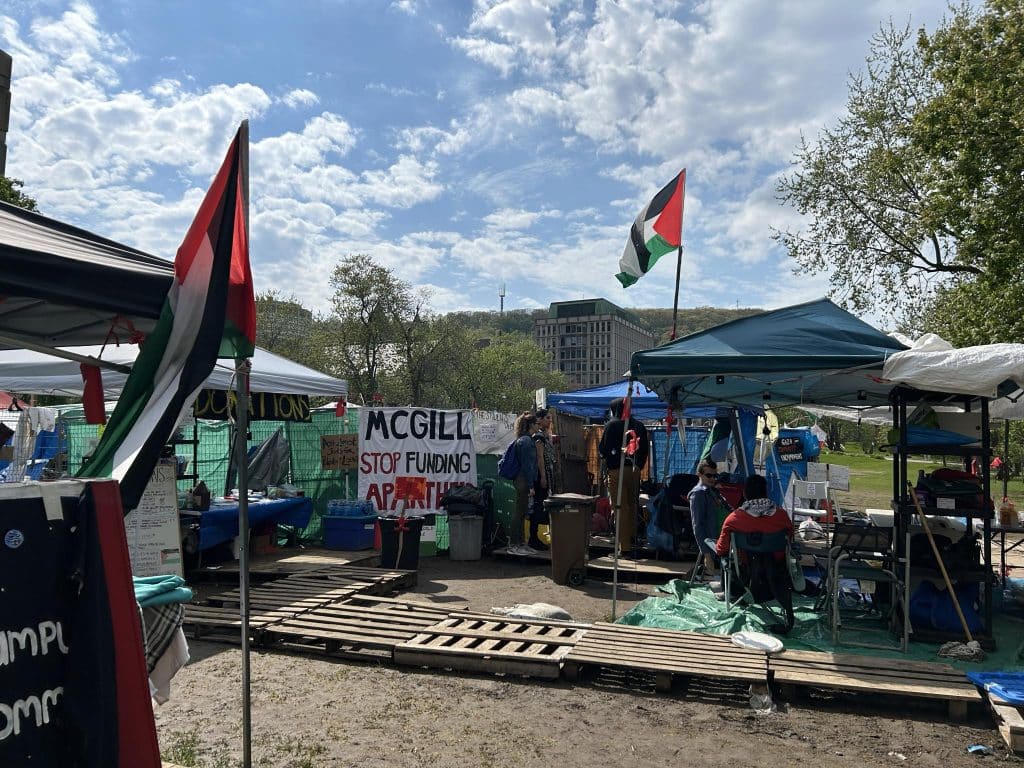
The McGill encampment on May 14, 2024. PHOTO: Chris Curtis
The most recent allegations which no doubt were a big factor in dismantling the encampment included concerns about outsiders, overdoses, and drug use. The encampment member said these allegations were completely baseless: everyone in the encampment was either a student from McGill or Concordia, the camp was manned 24/7, and there had never been an overdose or issue with substance use.
“My question to McGill and everybody who reads these allegations is, is it so hard to believe that students are just protesting a genocide? Is it so hard to believe that there was no ulterior motive to the camp? It was literally just a divestment campaign,” says the SPHR spokesperson.
Emily Hardie is a current member of Divest McGill, a student organization that has campaigned for 12 years to get McGill to divest from fossil fuel companies. After over a decade of student activism, McGill’s Board of Governors finally voted unanimously to divest from direct investment in fossil fuel companies by 2025. Through this long process, Hardie explains how the communication with McGill’s administration and Board of Governors has been nothing less than tedious.
“This whole thing about the bureaucratic structure [of McGill], I don’t think that’s an excuse whatsoever, especially considering the importance right now of having to divest. I think they can change, especially because the structure is hierarchical — they can change a lot of it very quickly,” says Hardie. “This is a tactic that I think is commonly used by the administration to seem like some things are impossible… like fossil fuel divestment was considered not even a possibility for such a long time.”
Hardie also points out that the Board of Governors is not made to accommodate concerns for divestment. “It’s not the function of this body to try to divest. The purpose is to maximize profits, which is completely contrary to divestment.”
While McGill’s administration has tried to show that their processes are democratic, Hardie says in fact, it’s a hierarchical and a fragile system because it’s not backed by the community and the power is within the hands of the few in the Board of Governors.
“I think it’s really important that universities in particular divest, because it means a lot when established universities, who demonstrate in their research, in their courses, of the importance of the climate crisis or of injustices, that we actually take that to heart and that our actions as a university are aligned to kind of the gravity of the situations which are informed by our research and the knowledge that we hold,” says Hardie.
Author

Comments (2)
Leave a comment
Related Articles
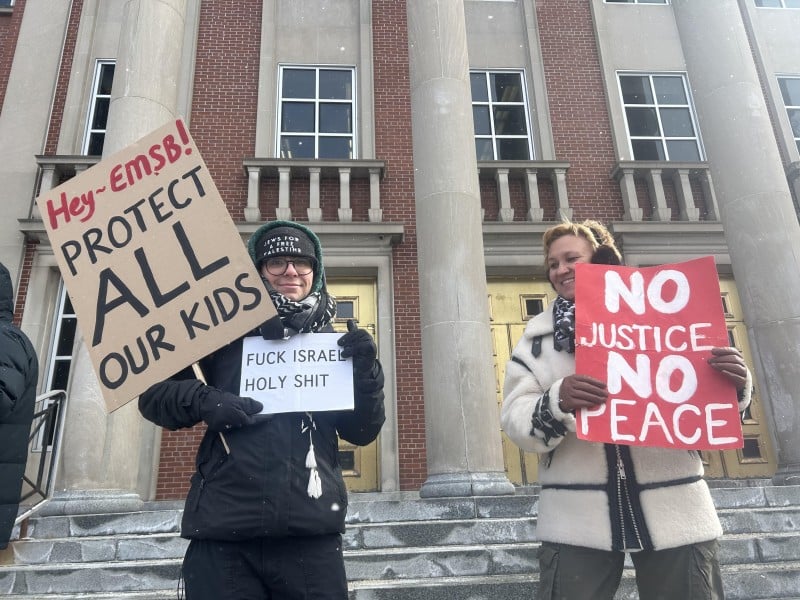
Ombudsman Rules in Favour of Student Suspended for “F*ck Israel” Post
The English Montreal School Board was ordered to retrain staff on its anti-bullying policy and students’ rights.

Will Bill 21 ‘Erase’ a Generation of Muslim Teachers from Quebec?
The legal battle over Quebec’s religious symbols ban has reached the Supreme Court in a case that will make Canadian history.

Nunavik Police Get a Pay Raise Amid Community Concerns
Inuit activists say the pay raise should match police efforts to rebuild trust with the communities.
Oh look, another article that’s basically just a regurgitation of SPHR propaganda, an organization that literally supports a literal officially-designated terrorist organization, which last I checked was a literal crime here in Canada. Release the hostages. Surrender. Stop killing Israeli civilians with indiscriminate bombs and drones. Then and only then will there be an end to this “gEnOcIde”.
the rover is so crap leftist activism propaganda LOOOL ‘ all the campers were from mcgill and concordia ‘ ahahahahahahahahahahahahahahaahha suuuuuuuuuurrrrrrrrrre