
Will Gaza Remain a Land of Camps?
When the temporary becomes a lasting policy.
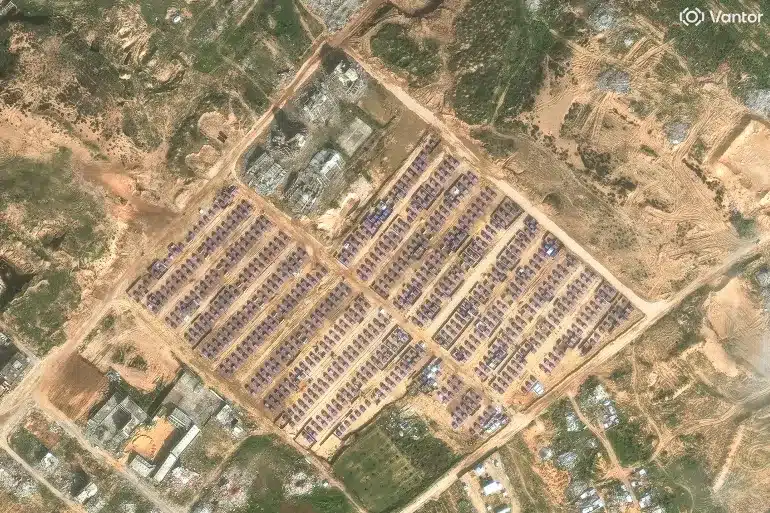
While Israel considers creating a vast camp for Palestinians in southern Gaza, other camps are already opening, such as the one recently set up in Netzarim. What was supposed to be a temporary policy seems to be becoming permanent, transforming Gaza into an archipelago of tents and rubble.
In the south of the Gaza Strip, the word “camp” no longer refers to an emergency situation: it has become a way of life. According to statements made by a retired Israeli general, Israel is planning to set up a huge camp to house displaced Palestinians. On the ground, this announcement comes as no surprise. Gaza already lives under a regime of makeshift camps, which have become the dominant form of housing for a population deprived of homes, schools, and civil structures.
Sarah’s family is raising money to leave Gaza. You can donate here.
Living and growing up in a state of constant waiting
In one of these camps in the south, Fatima lost her husband in the bombings. She now raises her five children alone, in a tent: “We are told that this is temporary, but nothing here feels like it is temporary,” she explains.
Her children have not been to school for months. Their days are spent waiting: waiting in long lines to fill a few water cans, waiting for the takiya, these improvised food distributions, waiting for the night to pass without further tragedy. “They no longer ask when they will go back to school, they only ask if there will be food today,” she says.
The issue of education comes up in almost every conversation. Teenagers wander between tents, with no clear prospects. Some look for work in dangerous areas, others sit with their phones turned off due to a lack of electricity.
“We talk about the future, but what future is there when you grow up in a camp?” said Ahmed, 19 years old.
Relocating instead of rebuilding
The recent opening of a camp in Netzarim, presented as an organized facility with Egyptian support, follows the same logic. Officially, this camp is intended to respond to the humanitarian emergency.
In reality, it confirms a significant trend: the mass displacement of the Palestinian population to enclosed spaces, which are temporary in theory but permanent in practice. In Netzarim, as elsewhere, tents replace houses, with no guarantee of return or reconstruction.
The opening of crossing points, heralded as progress, has not changed the daily reality. Aid arrives in insufficient quantities and intermittently. Drinking water remains scarce, and electricity is virtually non-existent. Many families have to travel long distances to recharge their phones or get a signal to send news to their loved ones.
The ceasefire, regularly mentioned in official speeches, has not changed the perception of the inhabitants. On the ground, fear remains constant, fueled by instability and a lack of clear prospects.
“Even when there are no attacks, we don’t feel safe. The ruins around us remind us of what can happen at any moment,” explains Mariam, who has been displaced for several months.
These camps are shaping a new geography of Gaza: a fragmented land where civilians move from one temporary site to another, with no prospect of return. The policy of camps seems to have replaced any thought of reconstruction, education, and civil life.
Gaza is not being rebuilt: it is being administered through displacement.
The issue at stake today goes beyond the humanitarian emergency. By increasing the number of camps in the south, in Netzarim, and elsewhere, Gaza risks becoming a permanent tent city. An entire generation is growing up without schools, without homes, without stability.
“We don’t want a better-organized camp. We want to go home,” says Ahmed.
Gaza cannot be reduced to a succession of camps, perceived as temporary but set up indefinitely. As long as the political response to the human disaster remains displacement rather than reconstruction, the Gaza Strip will continue to sink into a reality where survival replaces living and where the temporary becomes permanent.
Did you like this article? Share it with a friend!
Author

Comments (1)
Leave a comment
Related Articles
Eid in Gaza: Solidarity in the Face of Deprivation
The people of Gaza continue to help one another, sharing what little they have despite their own sorrow.
Ramadan in Gaza: The Month of Mercy Amid the Rubble
Since the start of the Israeli genocide, Palestinians across the Gaza Strip have struggled to rekindle the spirit of Ramadan.

Parlons de violence étatique
En 2026, les prestations d’assistance sociale demeurent largement inférieures au minimum reconnu pour vivre au Québec.
FREE GAZA FROM HAMAS