
In the Mind of Mathieu Caron, creator of Les Entrevues Atypiques
How a young man with autism captures the human experience through his unique interviewing style.
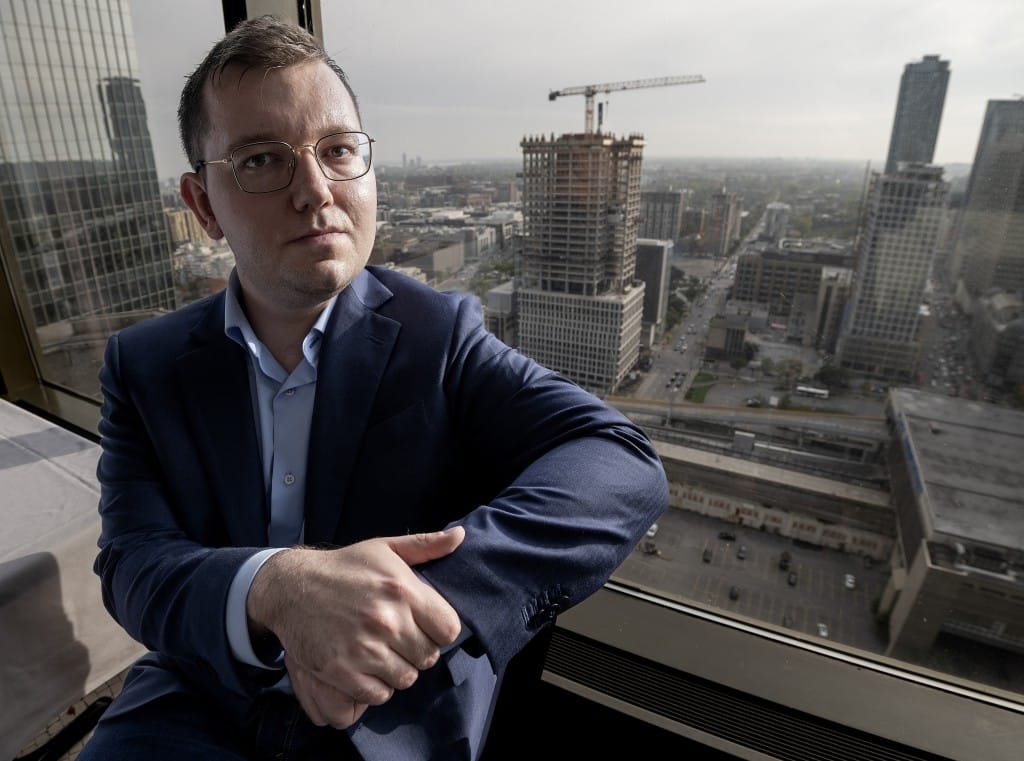
Mathieu Caron, creator of Les Entrevues Atypiques. PHOTO: Peter McCabe
When I meet him, he’s wearing a blue jacket.
That’s how I recognize him, seeing only the famous blue suit from Google images. He mentions, quite proudly, that the tailor who fitted him also works with NHL players.
I will learn throughout our long conversation that Mathieu Caron namedrops celebrities the way one would an old friend, out of habit, without really thinking about it. It’s not that he’s self-important or a snob, even. No, no. It’s matter-of-factly, without malice.
“You know, Marie-Pier, we’re all made of flesh and bones,” says Caron, a 24-year-old Sherbrooke native. And that’s what he uncovers for us in his project, Les Entrevues Atypiques (Atypical Interviews).
Having now interviewed many a celebrity, he says he always knew he was meant for a different path than that of his classmates.
Caron is autistic, has Tourette’s syndrome, and never finished high school, but this wasn’t going to stop him from making his mark. He would blossom into a multi-talented young adult, with his only limitation being the gap between reality and his imagination.
“I didn’t want to be spending my days playing video games and smoking pot like my classmates,” he confides.
That realization was a pivotal moment for Caron. That’s when he started interviewing people on camera, amidst the pandemic and the struggle of local businesses that needed to remind the world they still existed. All he had to his name was a pen and paper, his ambition and that calm yet firm coolness.
He would transcribe his interviews by hand without missing a beat or a nod of his head. This was time-consuming and ended up taking a toll on the muscles in his hand, so much so that he couldn’t write anymore. Pain was a catalyst — it’s what made Caron switch from handwriting to posting his interviews on YouTube. Even if he absolutely detested being on camera, he knew this was the way to go. It crystalized his Entrevues Atypiques.
The web series was a means to boost local business in Sherbrooke. Soon enough, he had done business with most of the city’s east end, and so it was only logical for him to expand.
Without a driver’s license, he would walk 20 minutes from his home to downtown almost everyday, he tells me, to connect with people and businesses. He would offer them a platform on his Entrevues Atypiques — the title is a play on “atypical,” a word often used to describe autistic people. Or any neurodivergent person for that matter.
He’s interviewed an impressive list of Canadian political figures; Québec solidaire’s Manon Massé, federal cabinet ministers Carolyn Bennet and Steven Guilbault, just to name a few, and a handful of celebrities from francophone television.
Support Independent Journalism.
His style is direct, dry and completely destabilizing. Caron asks his guests to introduce themselves in a simulation context, asking them to resort to their imagination and improvisation skills.
“Introduce yourself as if you just ran 5 kilometers in 25 minutes,” he asks federal minister Jean-Yves Duclos. To Member of Parliament Marci Ien: “Can you introduce yourself with an action movie that describes the last five years of your life?” and so on.
A pause, a smile, their heads tilted back with laughter. Witnessing their humanity, their vulnerability through Caron’s questions feels liberating. He’s letting us into their personal lives and even though they hold on to being logical and realistic, Caron telling minister Duclos to answer a question as if he was fishing in the countryside with Justin Trudeau is truly endearing.
He embraces his autism. It’s not something that he hides or dwells on. So many times, I’ve heard or read people talk about autistic people in a condescending way.
They aren’t trying to, but there is a tendency to infantilize them, and it’s something that I find problematic: being a journalist in spite of his condition or his success being explained by destiny, a magical and elusive thing. All things that have been written about Caron. He’s the romanticized and clichéd troubled genius. Just think of Rain Man, The Good Doctor, or The Big Bang Theory.
“What the media portrays is a small segment of the spectrum,” Lili Plourde, from the Fédération québécoise de l’autisme, tells me. “This, unfortunately, leaves no room for the complexities that make up autistic people’s lives and challenges.”
She goes on to explain how the stigma surrounding autism and the lack of support from Health and Social Services leaves many autistic folks on the fringes of society. “Many wind up in the streets […], people from youth centres call us because they don’t know how to deal with young autistic people’s problems. [Workers] need more training to intervene more effectively.”
According to the report “Surveillance du trouble du spectre de l’autisme au Québec,” statistics indicate that as folks with Autism Spectrum Disorder age, they have access to fewer mental health services. This is in part explained by an uneven distribution of educational and health services, especially in rural areas.
“Autism is the future of humanity,” he tells me, comparing it to a tree that grows old and tall – taller than the rest. “Difference is what makes the world a better place, one where ideas converge and words like ‘atypical’ lose their meaning.”
Mathieu Caron
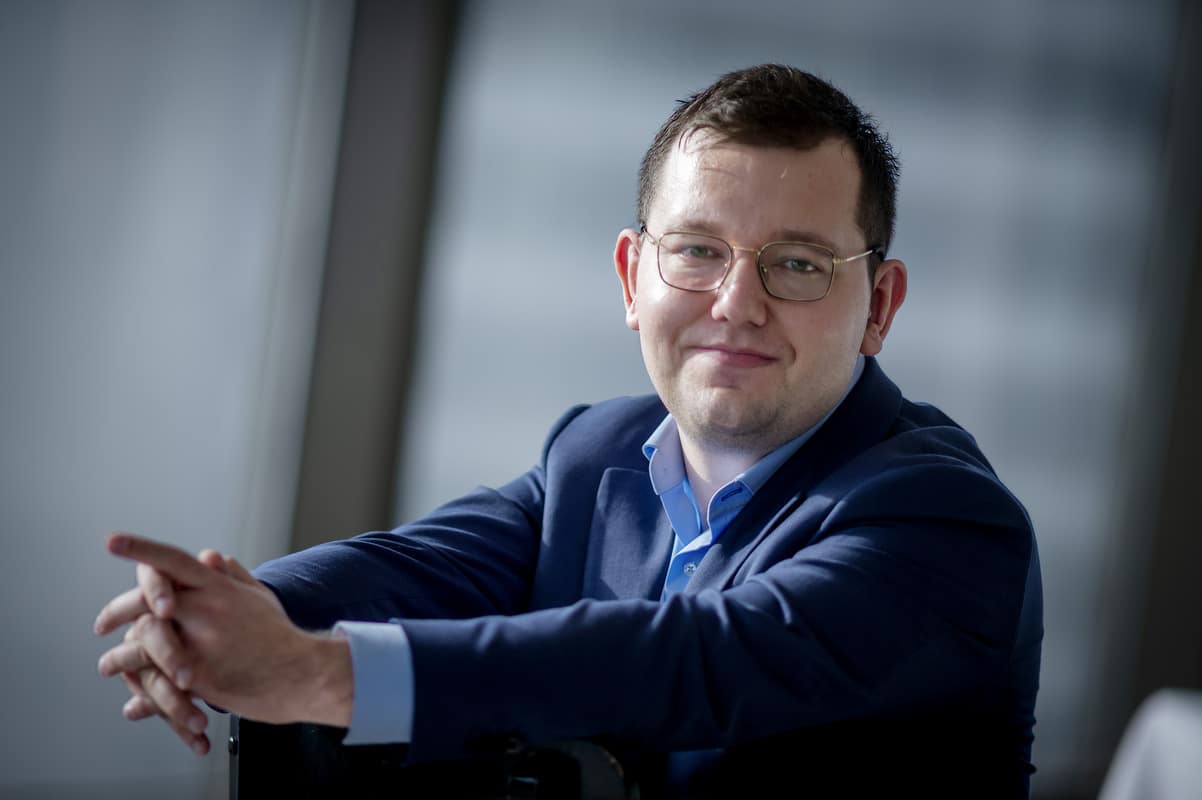
PHOTO: Peter McCabe
The challenge of launching a business from scratch is even more daunting when you consider Caron’s lack of a high school diploma or substantial business knowledge.
A few years back, during his IT course, Caron faced a moment that tested his resilience.
Faced with the concept of the binary code and not grasping it, he thought “The way it was being explained to me, it wasn’t so simple.”
Undeterred, he turned to YouTube for guidance, “then I called the teacher: ‘Mr. Taoufik! I learned by myself how to count with binary numbers!’” On top of this, Caron had previously skipped grades 6 through 9 to attend the IT course under Mr. Taoufik’s guidance. “When I got there, everyone had already gone through puberty; I found myself in an unknown universe,” he reflects.
Resilience is something that came early in Caron’s life, when contracting meningitis at 13 years old. He was in school back then. His grades dropped, forcing him to resume high school some 10 years later. “I thought I was going to die. Being weighed every morning, bedridden at the hospital […] in the intensive care unit for weeks… It was terrible, it traumatized me, but it made me stronger.”
On the phone with Luc Poirier, successful entrepreneur and ex-Occupation Double contestant, we talk about what it’s like to be 24 years old and having your own business: “I lost a lot of friends…”
He knew it was a time of living that go-for-broke life that comes with striking out on your own. Courage, determination: words he uses to describe Caron.
Poirier gets messaged daily on social platforms for interviews, endorsements and such. He can’t reply to everyone obviously, but he appreciated the hustle shown by Caron, who reached out to him on LinkedIn… and followed up. And followed up again.
This feels like a déjà vu: while writing this profile, I had to pause for a few weeks due to a serious back injury. Caron would follow up with me on the article and share updates of his other coming interviews. I felt a sense of urgency, a tactic to get me to publish the article sooner, even.
But I remembered that he’s not about that at all. He’s kind, patient, understanding of all things, sending me get-well messages full of empathy. He’s sharing this with me because he takes pride in his work and his own success. This makes me smile. He sends me pictures of himself at work and messages me: “I’ll send you more pictures I took with celebrities. Many more photos.”
For the last two years, Caron has been working in a local café in Sherbrooke’s East End, Géogène Micro-torréfacteur. The coffee shop prides itself on its ethical business model and social conscience. He also works part-time at the Sherbrooke’s University Centre-Culturel.
What are his next steps? Tapping into the anglo side, he tells me without skipping a beat. And make it all the way to the UN.
“Not just [to talk] about my project; I want to talk about all human beings on Earth. Because after all, we’re all human beings.”
Author
Related Articles

‘Everybody Who’s on the Stage Is Part of Your Community’: Ctrl+Alt Festival Returns for a Third Edition
Free festival stacked with queer, local performers to take over the Place du Village July 24-26.
Des travailleur·euses du sexe de Montréal feront la grève pendant le week-end de la F1
Cette dernière initiative de « whoreganization » s’inscrit dans le cadre de la lutte des travailleur·euses du sexe pour leurs droits du travail et la décriminalisation.
‘Society Is Built to Keep Us in the Gutter’: Sex Workers in Montreal to Strike During F1 Weekend
This latest “whoreganization” effort is part of sex workers’ fight for labour rights and decriminalization.
Comments (0)
There are no comments on this article.