
Quebec Munitions Expansion Raises Questions Over Supply Chains Linked to the IDF
The planned expansion of the General Dynamics facility in Salaberry-de-Valleyfield has drawn criticism over public-health risks and concerns that its products may ultimately support operations by the Israel Defense Forces through US supply chains.
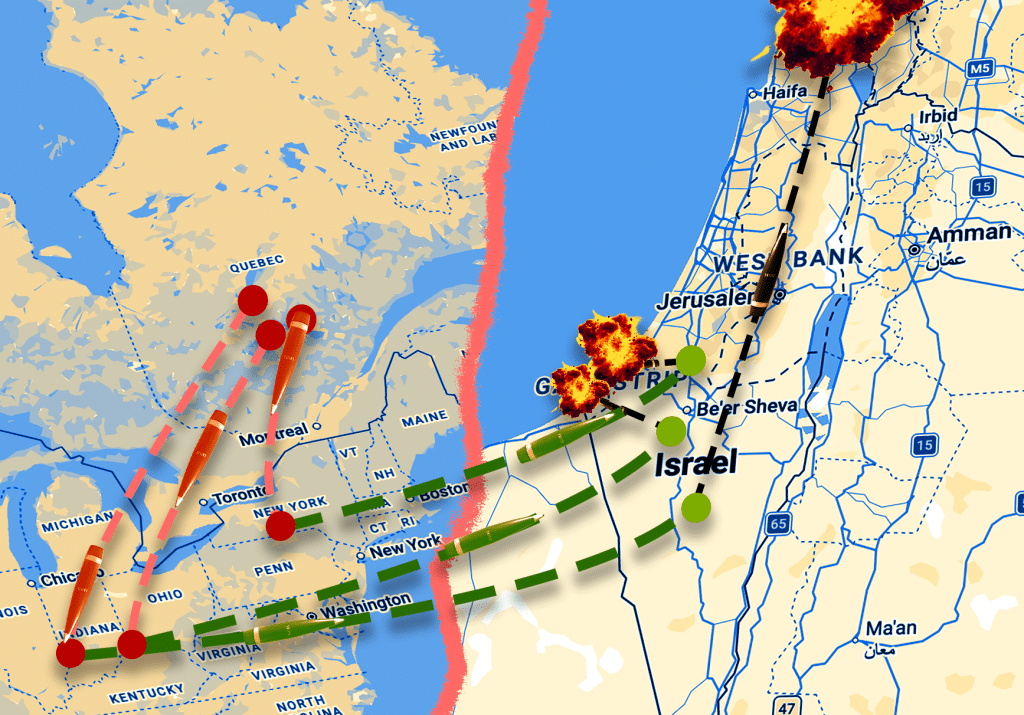
The planned $682-million expansion of a General Dynamics ordnance and tactical systems facility in Salaberry-de-Valleyfield is drawing mounting criticism from environmental groups, public-health advocates, and arms-control campaigners concerned about both its local impact and its role in international defence supply chains.
Funded entirely by the U.S. military, the expansion would dramatically increase the plant’s production capacity for artillery propellant used in 155 mm shells from roughly six million pounds to as much as 16 million pounds annually.
The proposed increase comes amid growing scrutiny of how Canadian-based defence manufacturing feeds into U.S. procurement systems and the extent to which those supply chains are later connected to conflicts abroad, including Israel’s war in Gaza.
Support your local indie journalists
Since the October 2025 ceasefire, more than 750 Palestinians have been killed in the Gaza Strip, according to the Palestinian Ministry of Health. Canada has required permits for military exports under the Export and Import Permits Act since 1947, but transfers to the United States have long been treated differently because of the two countries’ deeply integrated defence industries.
For decades, Canadian-made military components shipped to the U.S. entered American procurement systems with reduced reporting requirements and limited downstream tracking compared with exports to other countries.
While Canada strengthened its legal export-risk assessment regime after implementing the Arms Trade Treaty in 2019, transfers to the United States still operate under a special framework reflecting the scale of cross-border defence cooperation.
Critics say this arrangement creates what has been called the “U.S. loophole” because once Canadian-made components enter U.S. military supply chains, they can be incorporated into weapons systems later transferred abroad without Canada conducting end-use verification of their final destination. In practice, this means Ottawa may approve exports to the United States even when it may be required to deny a direct transfer to another country under its human-rights risk-assessment rules.
Lilah Woods, a Montreal-based activist with the International Jewish Anti-Zionist Network and a campaigner against the plant’s expansion, said the proposed project highlights what critics describe as a long-standing gap in Canada’s export-control regime.
“Our position is that Canada shouldn’t be sending anything to the United States at all,” Woods said. “General Dynamics is not being honest when they say their products aren’t going to Israel. It’s just total nonsense, because anything that goes to the U.S. can go directly to Israel, and once it’s over the border, it’s no longer subject to Canadian regulations at all.”
This is why proposed legislation, such as Bill C-233, introduced by New Democratic Party (NDP) MP Jenny Kwan, was tabled last year in an attempt to tighten oversight of these indirect export pathways, but the bill did not pass Parliament.
Bill C-233 was overwhelmingly defeated in March, with 295 MPs voting against it and just 22 in favour. Support came from six NDP MPs, one Green Party of Canada MP, and 15 Liberal MPs who broke with their party’s position. Support within Quebec’s federal delegation was especially limited: only four of the province’s 72 MPs backed the proposal, while the Conservatives and Bloc Québécois opposed it unanimously.
One of the MPs who supported the legislation was Alexandre Boulerice, the NDP member for Rosemont–La Petite-Patrie. He said the bill aimed to address what critics describe as a long-standing gap in Canada’s export-control regime. According to Boulerice, the legislation would have required exports to the United States to undergo the same verification procedures applied elsewhere.
“We’ve seen in recent months and years that some of the arms that are sold to the United States are transferred to the Israeli government,” Boulerice said. “The problem is that there’s a loophole in the law. The federal government has the responsibility to verify permits when selling arms to other countries.”
“We have a normal process that applies to every country in the world except the United States,” he said. “They have an exemption from federal Canadian law, meaning that if you sell arms to the United States, it’s automatically considered safe and acceptable without knowing exactly what they will do with those components.
“Within these permits should be the verification that these arms should not be used on civilian populations or within crimes against humanity. We saw that the production of products from this plant are going into F-35 fighter jets built in the United States, and after that, they were shipped to Israel for the Benjamin Netanyahu regime to bombard Gaza or Lebanon.”
Environmental concerns
A review by the Bureau d’audiences publiques sur l’environnement (BAPE) also identified significant environmental and safety concerns associated with the proposed expansion. These include the risk of chemical contamination, increased industrial water use, potential impacts on nearby terrestrial and aquatic habitats, and the possibility of hazardous materials reaching the adjacent river system.
The planned scale-up from roughly 2,700 tonnes of energetic materials annually to more than 10,000 tonnes would substantially increase industrial activity at the site, raising additional concerns about noise from explosives testing, odour emissions, and the need for stricter regulatory oversight and transparency.
The Rosemont–La Petite-Patrie MP was also sharply critical of the Bloc Québécois for supporting the expansion in Salaberry-de-Valleyfield, accusing the party of prioritizing job creation over environmental and humanitarian concerns.
“Sadly, Bill C-233 was shut down by the Bloc, the Conservatives, and the majority of Liberals, and I think it’s a shame,” he said. “We wanted to close that loophole, and sadly, the Bloc decided to vote against it in consideration for jobs in Salaberry, which I think is very wrong because I don’t think it’s a good idea to be complicit in genocide or crimes against humanity.”
“Some Liberals stood up to vote in favour, and I commend their courage, but the vote of the Bloc Québécois is a shame because it only sends the message that they will do whatever it takes to create jobs. I think there are far better ways to create good unionized employment than to support something like this.”
General Dynamics Ordnance and Tactical Systems–Canada Valleyfield Inc. was contacted by The Rover for comment, but directed any questions about the expansion to the United States Army.
Author
Comments (3)
Leave a comment
Related Articles

‘Everybody Who’s on the Stage Is Part of Your Community’: Ctrl+Alt Festival Returns for a Third Edition
Free festival stacked with queer, local performers to take over the Place du Village July 24-26.

Moving Day: A “Desperate” Struggle for a Growing Number of Montrealers
July 1 is now a race against time for families facing homelessness once their lease expires.

Quebec Workers Experienced a “Counter Revolution” Under Jean Boulet: Experts
The outgoing labour minister leaves behind a legacy of attacking the Constitutional right to strike.
Oh good, I was wondering when the next article about Jews was gonna go up. It’s been a couple of weeks since the last one, you guys are slowing down! You guys just can’t quit us 😉
Hello Michael, great selective reading! Let’s believe this is not about a Valleyfield corporation for your sake, since all you want is validation by writing that comment. Glad to be of service to you by giving you the attention you crave, cheers!
This article is a hit piece on a munitions factory that manufactures weapons and parts that may eventually find their way to Israel, which I must inform you, is the lone Jewish country in the world. I hope this helps in your reading comprehension.