
Faced with a ‘Time Bomb Budget,’ the STM Turns to Real Estate for Revenue
Montreal’s transit body wants more money for crumbling infrastructure, continues negotiations with maintenance workers.

It’s been a rough start to 2026 for Montreal’s transit body (STM).
The public transit body is dealing with a multibillion-dollar infrastructure budget shortfall and coming up on two years of negotiations with its maintenance workers.
Montreal’s metro system is 60 years old, with 46 per cent of its assets rated in poor condition. A large portion STM’s bus fleet is approaching its life span. Meanwhile, the STM is working on adding five more metro stops to the Blue Line and the province expects Montreal to have an all-electric bus fleet sooner rather than later. Some essential maintenance and major infrastructure projects have been stalled, cut or outsourced.
Dwindling transit funding at the provincial and federal levels has prompted STM leadership to look to real estate revenue as a solution.
Support your local indie journalists
“Real estate, that’s where we can make the most money”
In a Feb. 9 interview, STM Board President and Ensemble Montréal city councillor Aref Salem told La Presse, “Real estate, that’s where we can make the most money.”
The STM hopes to profit from 25,000 residential units to be built along its Blue Line extension. The transit body would not act as a landlord. Its corporate subsidiary, Transgesco, would partner with private contractors to develop housing on STM properties, and would capture a portion of the revenue generated from rents.
The STM has been generating revenue through Transgesco since 2004 via advertising on transit, in businesses at metro stations, and through official merchandise. Transgesco’s approximate annual revenues amount to around $30 million. Exact figures are not publicly reported.
Most of Transgesco’s revenue goes directly to the STM. Revenue from real estate will go through Montreal’s regional transit authority, ARTM, which sets the budget for Montreal transport services.
Back in 2018, Transgesco had attempted to build a mixed-use building on a parking lot near Frontenac metro in partnership with the city’s Société d’habitation et de développement de Montréal (SHDM). The project would have included 298 units, including commercial businesses, 60 social housing units and 109 affordable condos under the AccèsLogis program. But it never saw the light of day as AccèsLogis was cancelled by the provincial government, among other funding issues.
In 2024, the Quebec government passed legislation allowing public transit agencies to develop real estate holdings through partnerships with private developers — including residential property.
The STM has revived the project near Frontenac metro, without the involvement of the SHDM, and is waiting for Quebec’s transport ministry’s approval to build housing on the lot via a private partnership.
In tandem with the city, Transgesco has developed private partnerships to build residential units along the Blue Line extension.
Transgesco has a confirmed contract with real estate developer Groupe MACH to develop 6,000 to 8,000 units around the future Madeleine-Parent Station (previously named Langelier Station) along the Blue Line extension in the East End. A 2025 La Presse article stated that around 1,000 of those units would be social housing. The city’s website vaguely states that property around the Blue Line extension is an ideal location for mixed housing projects, including affordable housing.
So who will set the rents for the 24,000 remaining residential units? How much of this housing will be scooped up by large, for-profit real estate management companies? How many units will be “affordable”?
In an interview with The Rover, Justine Lord-Dufour, the head of STM’s public relations team, could not say.
“We’re innovating in Quebec. It’s been a while since we’ve had these legislative powers. We’re building the plane as we go,” said Lord-Dufour. “We definitely want to seize the opportunity of the Blue Line project. We don’t have details yet.”
In an email follow-up, she added that housing projects along the Blue Line plan to integrate affordable housing, but it is too early to identify how many affordable units will be built, or to confirm the identities of the future landlord(s).
This “rent plus property” model for transit revenue is used in other metropolises. Hong Kong’s Mass Transit Railway (MTR) Corporation has been lauded for its profitability, raking in billions of dollars through equity in rental housing built along its stations. In 2024, MTR made over $885 million CAD from rental property income.
But in the past 20 years, Hong Kong rents have exploded, with real wages stagnating, and public housing supply dwindling. In 2019, MTR was criticized for building exclusively private housing to maximize profits. Since then, MTR has participated in subsidized housing projects, in which the government pays a portion of private rentals, but rents remain high and public housing supply is low in Hong Kong.
Vacancy rates in Montreal’s rental market are increasing, but so are rents. Landlords on the island can set rent amounts without restrictions on buildings constructed five years ago or less. Newly built luxury dwellings in Montreal have a much higher vacancy rate (5.9 per cent) than “affordable” units, which had a vacancy rate of 1.5 per cent in 2025.
The type of housing that will be built on the STM’s real estate is still up in the air. But the transit body hopes its real estate ambitions could expand across the city.
“There are plenty of areas where metro stations could develop alongside housing, with time, and we could finance public transit that way,” said Lord-Dufour.
This housing won’t be built, let alone generate revenue, for years. In the meantime, the STM is asking the province to free up funding for fixing crumbling infrastructure and replacing aging metro cars and buses.
A ‘time bomb’ budget
It’s no wonder the STM is looking to the private sector for future funds.
According to the STM’s Ten-Year Capital Program and Capital Program 2026-2035, only $2.8 billion out of the $15.2 billion required for priority projects to maintain the current infrastructure and protect service has been approved.
The STM estimates that the investment deficit in metro infrastructure and assets amounts to $7 billion in 2026, projected to reach $9 billion in 2030.
In 2024, the ARTM sounded alarm bells to the province that its debt is mounting, expenses are increasing, and infrastructure is aging. Then-transport minister Geneviève Guilbeault said managing public transit was “not a mission of the state.”
The STM has to respect the budget set by the ARTM. In 2026, the transit agency managed to cut $56 million in its 2026 budget, achieving its obligation to cut $100 million in three years.
To deal with this shortfall, the STM has suspended some infrastructure projects and maintenance. It’s putting off updating some ventilation and electrical equipment. It’s extending the life of some metro car parts. It’s scrapped some preventative maintenance. It’s outsourced “transport adapté” — accessible transit for people with disabilities — to the private sector. The STM has suspended installing elevators in all stations indefinitely, holding up its promise to make all its stations accessible to everyone.
Falling behind on these projects and maintenance has led to service delays, station closures, escalator shutdowns, and other issues impacting clientele.
“It’s imperative that we invest more in our infrastructures, this cannot wait any longer,” pleads the organization in its 10-year plan, published in January 2026. “Each month of inaction aggravates the situation, making necessary repairs more difficult and, more importantly, the impact that these will have on the service, all while considering the increase in costs in the long term.”
Philippe Jacques of Trajectoire Québec, a public transit advocacy organization, called the STM’s 2026 budget a “time bomb.”
STM president Aref Salem says the city is doing all it can, and is looking to the feds and the province for more money.
The STM also indicated that by 2027, 40 per cent of its bus fleet will have surpassed its operational life. Until a few weeks ago, Quebec refused to provide subsidies for the purchase of much cheaper hybrid buses because of its goal to electrify 55 per cent of the fleet by 2030.
In early February, Quebec Transport Minister Jonatan Julien announced the government is extending this deadline and will reintroduce subsidies for the purchase of hybrid buses by 2028. While this news aligns with the STM’s climate commitments, the real test will come when the next provincial budget is tabled in the coming weeks.
The Association du transport urbain du Québec (ATUQ) filed a mémoire with the Government of Quebec ahead of the 2026 provincial budget, requesting predictable funding, investment in public transit infrastructure, and reducing administrative delays.
On average, it takes 11 months to get government approval to buy a bus, almost 36 months to confirm subsidies and years before infrastructure projects are approved by the government.
It can take up to 10 years for the final financial verification, which is done at the completion of a project. During that time, transit bodies are deprived of the last 10 per cent of their funding.
The STM filed its own mémoire during the pre-budgetary consultation period. The transit body indicated that funding delays have generated $129 million in interest fees.
“For modernizing projects like an elevator or renovating a station, we’ve had a lot of approval delays,” said Justine Lord-Dufour. “This makes it so that we build on the STM’s credit card, so we pay interest fees. There are millions of dollars available that aren’t used, and we’d like to use them now.”
Read the STM’s written submission to the Government of Quebec’s pre-budgetary consultations
As for federal funding, big-city mayors were alarmed to hear that the 2025 federal budget reduced the Canada Public Transit Fund (CPTF) from $30 billion to $25 billion over 10 years. However, the new $51-billion Build Communities Strong Fund could be used for public transit infrastructure projects, according to an email from Caleb Spassov of Housing, Infrastructure and Communities Canada. So far, the federal government has distributed $5 billion across Canada for transit. The STM wants to get federal funding as soon as possible to replace old metro cars. Quebec’s funding hasn’t been announced, but STM’s Lord-Dufour said the province is in talks with the feds to determine that amount.
Quebec’s transport ministry and Maha Clour, general director of Transgesco and project lead for the Blue Line extension, did not reply to The Rover‘s request for comment.
“The orientations of the STM are difficult to take for workers”
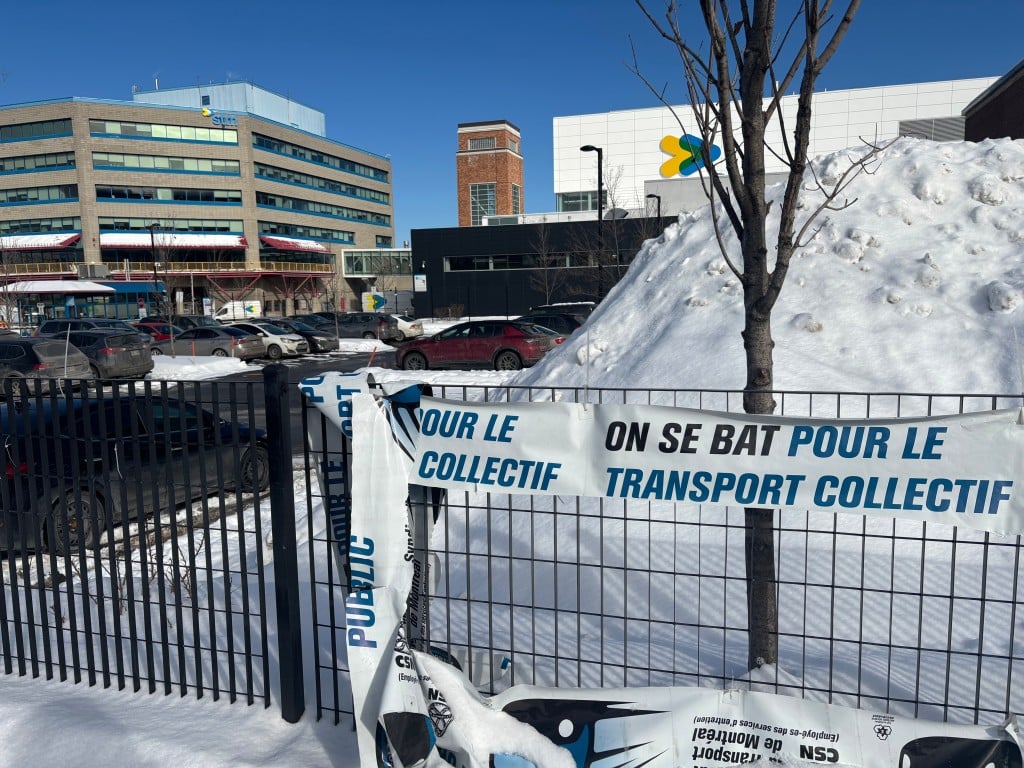
Another way the STM has attempted to reduce its spending: outsourcing some of its maintenance work.
While the STM’s major infrastructure projects are undertaken with the city and contractors, day-to-day maintenance is done by the STM’s own unionized workers, who still don’t have a new labour contract.
Outsourcing has been the main point of contention in maintenance workers’ collective agreement negotiations.
Maintenance workers’ union president Bruno Jeannotte is skeptical that outsourcing to the lowest bidder would lead to long-term savings.
“The STM is talking to us about savings (through outsourcing), but doesn’t have the numbers to justify the fact that there are savings,” said Jeannotte in a January interview with The Rover.
Jeannotte said the STM management wants “carte blanche” to outsource their work without including maintenance workers in the final say of its decisions.
“We’re proposing to the STM to put a committee in place, to learn to work together, to measure (costs) together,” said Jeannotte. “If we’re able to agree on (cost) standards, the way to calculate, we’ll agree on the results. But at the moment, we don’t know.”
The STM has stated that it is working on establishing a framework to decide what services could be subcontracted in collaboration with maintenance workers. Negotiations for the collective agreement are ongoing.
On Feb. 25, STM management and Jeannotte requested a new independent third party to assist with their negotiations. Workers have committed to not using any pressure tactics, including strikes, during the conciliation process.
According to the STM, management and maintenance workers have spent 22 months in negotiations, 120 days in mediation and 45 days in conciliations. In that time, the STM has offered contracts that included added pay for workers and “compromises.”
Negotiations stalled over the holidays — Jeannotte said that the STM refused to meet in person during that period. Meanwhile, maintenance workers were on an overtime strike, which ended Jan. 11. During holidays and off-hours, managers had to take over some of the maintenance workers’ duties, like cleaning staff bathrooms, metro stations, and transport centres. Some maintenance was delayed, leading to some buses showing up late or not showing up at all.
On Jan. 5, 2026, 100 buses were missing out of the 1,320 required to deliver full service. In an email, Lord-Dufour indicated that employee productivity was up 13 per cent during regular hours. But she also noted that the STM does rely on overtime hours to deliver full service.
The union opted for an overtime strike partially due to Quebec’s Law 14, adopted in November, which allows the Quebec government to intervene in strikes that affect the “well-being” of the public interest, essentially forcing workers back to work. Jeannotte estimates that overtime strikes could be a useful tool for workers to put pressure on management without affecting the general public in the wake of this legislation.
“We know that at the STM, they worked hard that month of the overtime strike. It had an impact at the negotiation table in the sense that the employer doesn’t want to relive a strike of that magnitude, even if it didn’t affect the public,” said Jeannotte.
Ultimately, Jeannotte said that government underfunding and resulting STM decisions have been hard on workers.
“Morale is not very good in the workplace,” said Jeannotte. “Certainly, strikes, the pressure tactics, mobilizing, that’s draining, for sure. But above all, I think that the direction of the STM is difficult to take for workers.”
“A lot of people have lost their jobs or seen their tasks reduced. (The fact that) the STM has abandoned accessible transit, which is essentially the ‘core business’ of the STM, transporting the most vulnerable people, that breaks our spirits.”
Comments (1)
Leave a comment
Related Articles

« Combien de mères avez-vous fait pleurer? »
À Montréal-Nord, la communauté se soulève contre la brutalité policière et le profilage racial.
“How Many Mothers Have You Made Cry?”
In Montréal-Nord, a community rises up against police brutality and racial profiling.

Blainville Teenager Takes Stablex Fight International
After concluding that local avenues had been exhausted, a 14-year-old Blainville resident has brought the fight over the Stablex hazardous waste expansion before the CEC, an international environmental body established by Canada, the United States, and Mexico.
great