
Editor’s Note: When the Comments Section Gets Out of Hand
As our Instagram follower count grows, so too does the number of problematic comments. What are we supposed to do about it?
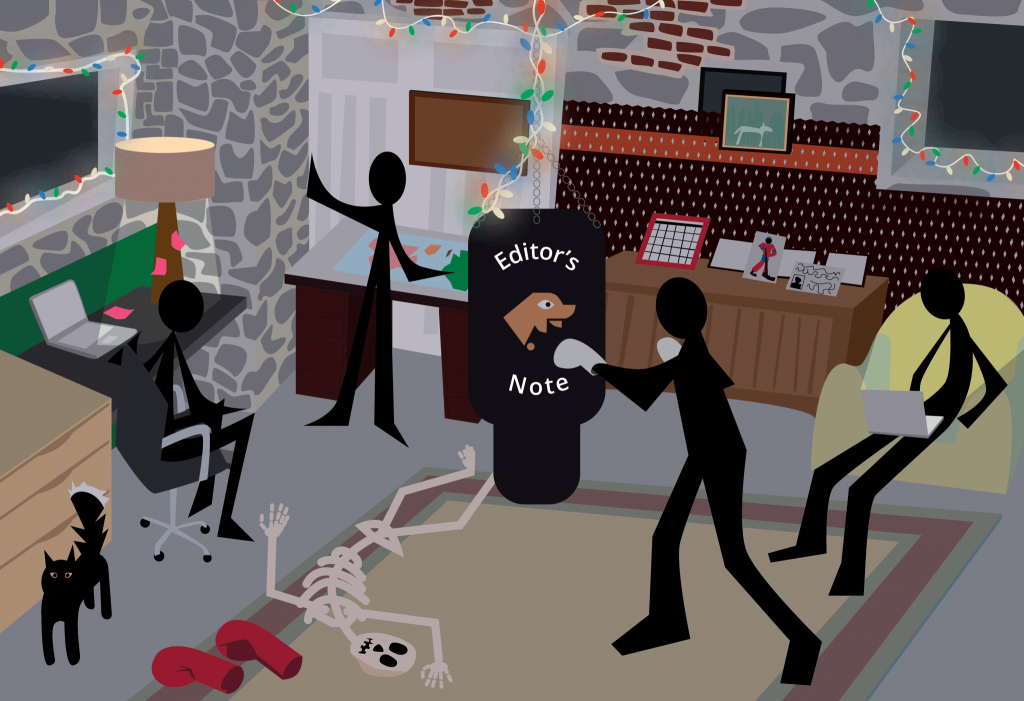
The Rover’s Instagram is starting to stress me out.
As I write these lines, we’ve just hit 26,000 followers. Chris’ reels frequently reach 30,000+ views, with about one in three going viral and exceeding 100,000 views. And, of course, virality is an honour reserved almost exclusively for the most contentious of topics.
More eyeballs on our content means more comments. More comments, unfortunately, means more shit to sift through.
Of course, it’s not all shit. A lot of the comments are fine, a simple reaction to the information, perhaps a connection made. Sometimes people disagree with something said, either in the video or in the comments, and express their disagreement with the apparent intent of contributing their perspective to the conversation. That’s all well and good.
But as our audience grows, I’m seeing more and more comments that aren’t okay. Hateful comments, misinformation, perhaps even disinformation, trolls, ad hominem attacks.
Support your local indie journalists
Up until now, I’ve managed to remain relatively hands-off, only occasionally responding to comments to correct misconceptions or add context to the discussion, and sometimes to do some tone-policing. But our recent viral satirical reel depicting aspiring Coalition Avenir Québec leader Bernard Drainville writing a letter to the 500 Muslim hijabi women who lost their teaching jobs with Bill 94 drew considerable engagement, to the point where I quickly became overwhelmed with not just the sheer volume of comments, but the divisive, confrontational nature of the discourse contained within them.
Called out
These concerns about moderating the discourse in the comments section started to take a concrete shape in December, after we published Chris’ op-ed about cyberbullying among the Parti Québécois’ (PQ) online supporters.
It starts with an anecdote about a wave of misinformed comments under a Facebook post by PQ member Gaspard Skoda. The post referred to the arrest of a man who had sent death threats to PQ Leader Paul St-Pierre Plamondon, but though the man arrested was a white francophone Quebecer, multiple comments referred to Muslims, radical Islamists, and called for deporting this man back to his home country.
Chris points out in his op-ed that “nowhere in the comments under Skoda’s post does he correct anyone or urge folks to actually read the article he posted. Instead, he seems content to sit back and watch his followers enact imaginary violence on an imaginary immigrant.”
Skoda’s response to the piece was to scour the comments section under Chris and The Rover’s reels in search of problematic assertions, which he then shared in another Facebook post. “When you climb a tree, you need to have a clean bottom,” he wrote. A very French-from-France way of saying, “Look who’s talking.”
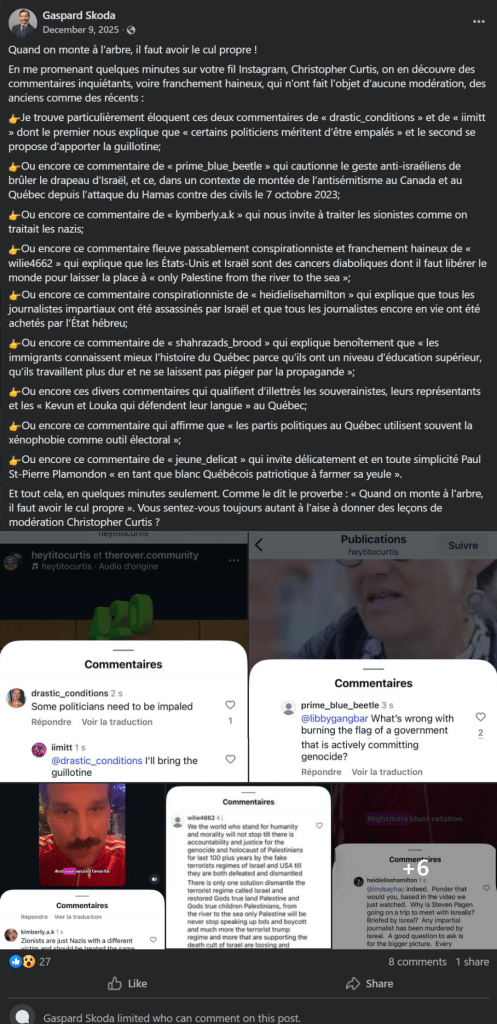
I’ll give him this: some of the comments he highlighted should have at best been addressed with facts, at worst deleted — just like how he deleted most of the problematic comments under his own post after the op-ed was published.
Other comments on our platforms that he singled out seem to me more like assertions he doesn’t agree with, perhaps unfortunate assertions, but being a dick is not necessarily a punishable offence. As an individual who is not elected to office or otherwise representative of the public, he is free to delete any comments on his own page that he doesn’t like. But as a news media with a mandate to serve and inform our communities, I would argue that we don’t have that same freedom, so I think Skoda is comparing apples and oranges in drawing this equivalence between his Facebook account and our Instagram account.
I would also argue that, judging by the frequency with which he posts on Facebook, he seems to have much more time to spend on moderation than we do. And that singling out a few comments over multiple videos doesn’t quite add up to the multiple comments under a single post of his.
But his post showed that there is an expectation that we consistently and rigorously moderate the comments section, and I can’t say I disagree with that expectation.
What’s our responsibility?
So, what is the extent of our responsibility in moderating comments on our Instagram page or other platforms?
In a perfect world, if money were not a concern, I would say that our responsibility would be extensive. We would have a dedicated social media manager overseeing the comment sections across all our platforms, whose job would be to maintain an environment conducive to learning, free discussion, and respectful disagreement. They would respond to mis/disinformation with facts, answer questions, call out attacks and insults and, in the most extreme cases, block and delete trolls or intolerant repeat offenders.
But we don’t have the money for that right now. And it’s not like we have the time for it either.
Because it takes time to sift through it all! We can’t just delete everything we don’t agree with. Free speech is a prerequisite for impactful journalism, and so we must always protect that right for everyone.
Of course, there are limits to that right, namely when one person’s free speech interferes with another’s right to safety. And so when a comment incites violence, it should be deleted. In theory, that’s simple. In practice, it’s not always so easy to situate the line between what is allowed and what is not.
We don’t often delete comments, which, in my view, should be a last resort anyway. We end up keeping a lot of comments that I personally find abhorrent because I can’t say the line was really crossed. Being offensive is not the same thing as interfering with someone’s right to safety.
I also think that deleting comments too freely prevents others from chiming in, allowing the community to police itself in a certain way. I don’t believe that there is truly a free market of ideas, but leaving up dickish comments lets others address just how dickish they are in a much more straightforward way than I ever could as @therover.community.
The bottom line is, I agree that we owe it to our community to maintain a healthy environment in the comments section, but how to do that effectively and consistently is not clear to me with our current resources.
What does our community think about this? What do you expect from us, and how can we fulfill that? I would like to know!
Did you like this column? Share it with a friend!
Author

Comments (2)
Leave a comment
Related Articles
Gaza: A Healthcare System on the Brink of Collapse
Drug shortages, growing famine, and daily deaths.
OPINION: Why is McGill Fighting to be on the Wrong Side of History?
The university insists on silencing its students as they push McGill to take a stand on genocide.
A Road Trip Through Trump’s America
What a week in West Virginia reveals about the direction of the United States.
Clearly The Rover and I have different lines when it comes to what’s incitement to violence and what isn’t. Call me an old prude but “NO JUSTICE NO PEACE” is an unequivoval call to more violence and more war. Seriously, and I mean very seriously, as in I’d love to hear an explanation from one of you guys, seriously how hard is it to write on a sign “YES JUSTICE YES PEACE” instead? Isn’t that a much more hopeful, unifying, and desirable message?
Still no reply from staff…..