
MP Slams ‘Authoritarian’ Decision to Bar Rima Hassan from Canada
The federal government prevented Hassan, a member of the European Parliament, from speaking at two Montreal conferences last month.
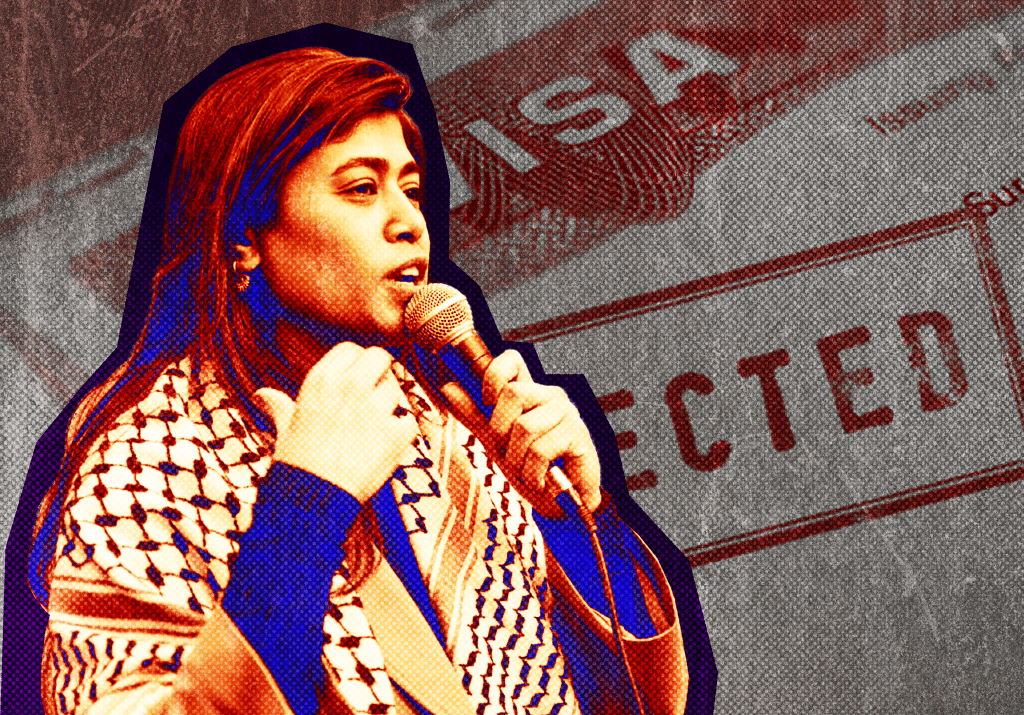
A Montreal Member of Parliament is calling Canada’s decision to bar Rima Hassan from entering the country “a blatant case of political censorship” by the federal government.
Hassan, a French-Palestinian member of the European Parliament, discovered while at the airport for her flight to Canada that her previously approved Electronic Travel Authorization (eTA) had been put under review the night before her departure, preventing her from entering the country.
New Democratic Party MP Alexandre Boulerice was in Winnipeg on Saturday, March 28, when he first heard the news of Hassan’s eTA status and was contacted by her team. He said his immediate reaction was one of astonishment, surprise, disgust, and indignation.
Support your local indie journalists
“This is a blatant case of political censorship,” he said. “Because Ms. Hassan is a thorn in their side, because Ms. Hassan is firm and clear, and also because she’s targeted by certain groups, certain political parties.
“We live in an increasingly worrying world, with a rise in fascism, authoritarianism, and what we call illiberal democracies, like Hungary. This is happening more and more in the United States under Mr. Trump. We mustn’t follow their example and become a similar country where we censor, where we silence dissenting or opposition voices, voices that are disruptive.”
If we believe in human rights, freedom of expression, and democracy, we must be open to dialogue, he said.
“I’m not talking about dialogue with people who advocate hatred or racism or anything like that. There are already laws in Canada for that. But Ms. Hassan is a Member of the European Parliament who does parliamentary work, who is an active participant in French and European public life, and she has never been convicted of anything at all.”
Why was the eTA placed under review?
What was initially believed to be a small hiccup became much more complicated upon learning that a list of documents would have to be provided as part of the review.
According to an X post by Hassan, those documents included:
- All of her bank statements over the last two years;
- Details and supporting documents of her professional activities over the last 10 years;
- Details and justifications of her registered address over the last 10 years;
- Details and supporting documents of the legal proceedings initiated against her;
- A copy of her criminal record;
- A family information form.
“Decisions regarding the granting of travel documents are made independently, on a case-by-case basis, by trained officers,” stated the office of Minister of Immigration, Refugees, and Citizenship, Lena Metlege Diab.
While most visitors coming to Canada by air from visa-exempt countries must have an approved eTA prior to travel, an eTA does not guarantee entry to Canada.
“ETAs can be cancelled for inadmissibility for a number of reasons, including failing to disclose complete and accurate information on an application,” the office added. “Refused eTA applicants can reapply once they have addressed the reasons leading to the refusal of their application.”
While the minister’s office said they cannot comment on individual cases due to privacy laws, an Instagram post by Hassan on March 28, cited the reasons for the review of her authorization as the absence of any mention of a visa or entry refusal in a country, as well as the absence of any mention of an alleged criminal offence, arrest, indictment, or conviction.
In the post, Hassan stated that the first point refers to a denial of entry into Israeli territory in February 2025 for a delegation of European Parliament members as part of an official mission of the European Parliament, previously authorized by the Israeli authorities.
“This ban occurred upon our arrival at Tel Aviv airport without valid justification or prior warning and affected the entire delegation,” Hassan wrote.
“Since when does being prevented from entering Israel prevent someone from entering Canada?” said Boulerice in disbelief.
“I was part of a delegation of Canadian MPs to Israel, and I was turned back at a checkpoint. We were all turned back at a checkpoint by the Israeli army, trying to reach a certain place, Hebron. I’m not going to report it every time I travel abroad.”
Hassan’s post added that the second reason cited pertains to complaints filed against her for “glorification of terrorism,” which have not resulted in any conviction or indictment.
On Thursday, April 3, Hassan was arrested by French police and charged with “apology for terrorism,” due to a post she made on X quoting Kōzō Okamoto, a member of the Japanese Red Army who participated in the 1972 attack at Lod Airport in Israel, in which 26 people were killed. The post has since been deleted. Nevertheless, Hassan is set to stand trial on July 7, 2026.
In the post, Okamoto was quoted as saying, “I dedicated my youth to the Palestinian cause. As long as there is oppression, resistance will not only be a right, but a duty.”
‘It’s a double standard’
In light of her denied entry to Canada, comparisons have been drawn between Hassan’s case and that of IDF soldiers who have spoken at Canadian universities.
“I think that this comparison speaks for itself; it says everything,” affirmed Boulerice. “There is, after all, a case at the International Court of Justice concerning the genocide in Gaza that killed more than 70,000 people, the majority of them women and children.
“(IDF soldiers) can come here and tell all their stories, whereas someone who is a lawyer, Ms. Hassan, is not just a Member of the European Parliament, she is also an international legal expert, and she cannot come and speak, meet with civil society, meet with Amnesty International and Oxfam. It’s a double standard that makes absolutely no sense, and it shows that we have a government that has no backbone when it comes to international law and human rights.”
Boulerice also made reference to statements from pro-Israel lobbies, including the Centre for Israel and Jewish Affairs (CIJA) and B’nai Brith Canada, who he said were “claiming victory for the cancellation of Hassan’s visit.”
“It’s not as if we thought certain groups exerted pressure,” he said. “It’s that the groups themselves publicly said, ‘It was us, and we’re happy.’”
What are the arguments against Hassan entering the country?
B’nai Brith stated in a post on X that “After intelligence provided by B’nai Brith Canada to the CBSA, Rima Hassan was denied entry into Canada.”
In a subsequent video posted online, B’nai Brith’s Director of Research and Advocacy Richard Robertson stated that “When B’nai Brith Canada becomes aware of a threat to Canadian society, we act. This is what we did in the case of Rima Hassan.”
“B’nai Brith Canada was informed that Rima Hassan would be coming to Canada,” he continued. “We investigated and we found out that she was linked to the glorification of terror, the promotion of antisemitism, and the dissemination of other problematic rhetoric.
“To us, it would be unacceptable if someone with Rima Hassan’s track record was able to enter Canada to promote their vitriolic ideology. So, we reached out to the Canadian Border Service Agency (CBSA) to make them aware.”
CIJA also made a post to X stating that “Rima Hassan, who has openly defended Hamas and glorified acts of terrorism, has been denied entry to Canada.”
The Rover reached out to both B’nai Brith Canada and CIJA for comment, but received no reply by publication.
Censorship trickling down at the local level
In response to the claims that Hassan is linked to the glorification of terrorism, violence, and anti-semitism, Boulerice said he has never heard Hassan say anything along those lines.
“Those in France and Europe who think that’s the case should prosecute her, bring her to justice, and currently, she hasn’t been convicted of anything,” he said. “So, if there are people who think that, bring me the evidence, because for me, in all the research I’ve done so far, I’ve never seen or heard anything like that.”
Zev Saltiel, a member of Montreal’s chapter of Independent Jewish Voices (IJV), emphasized his belief that Hassan has the right to react to what she is witnessing happen to her people.
“She’s watching an active genocide, and she is reacting, and that is normal,” he said. “It is normal to respond to the violence that our people are feeling. It’s well known that when our people experience intergenerational trauma, such as Jewish people, like myself, when I see violence like that, I feel it deeply within me and I respond accordingly.”
Saltiel added that Canadians should care about what happened to Hassan because it is representative of censorship trickling down at the local level.
He made reference to the Indigenous student at Royal West Academy in Montreal West, who was suspended for critiquing Israel on her personal social media account.
“She was comparing what is going on by Israel towards Palestinians to the same colonial violence that her family experienced here on Turtle Island,” he said. “The school and the school board’s response was to suspend her — then once the question of this incident went to the ombudsperson, the school and the school board were found to be in the wrong, that silencing this young student’s freedom of speech was, in fact, a violation.
“When we are telling young women that their voices need to be silenced, what are we teaching them? When we are teaching young Indigenous women that their voices are too much, what are we telling them, and what are we contributing to? And that’s what this is.”
‘It’s a clear impediment to freedom of speech’
In B’nai Brith’s video statement, Robertson added that the organization had also written to Concordia University to hold its students accountable.
“Why? Because Concordia University students, the Political Science Student Association at Concordia, were hosting and platforming Hassan,” he said in the video. “Concordia, the time is now for you to hold your students accountable and to do your part in fighting racism, extremism, and radicalization in this country.”
One of the conferences Hassan was set to attend was a panel event organized by Concordia University’s Political Science Student Association (PSSA).
The event had been planned for six months with panellists including journalist and Concordia alum Aaron Maté, Berkeley professor Hatem Bazian, student activist Reem, and MEP Rima Hassan.
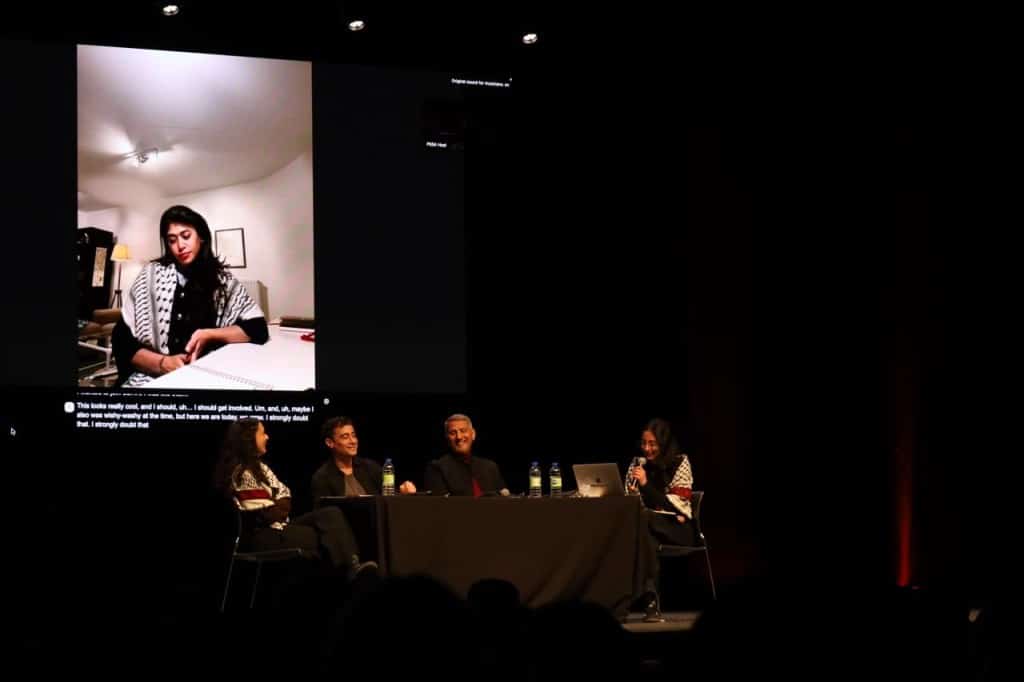
The panel addressed the issue of censorship related to the Palestinian movement.
In response to pressures placed on Concordia to hold the students accountable, PSSA marketing coordinator Anca Bordeianu said, “Maybe they could have a meeting with us to understand what happened. But I don’t see what else they could do to hold us accountable, because what is there to be held accountable for? We did nothing wrong. We just held an event where people discussed censorship around pro-Palestinian voices. No hateful speech happened. No violence was incited whatsoever. So I don’t see what there is to be held accountable for.
“It’s very unfair and ironic at the same time because our event was all about censorship and we wanted to discuss how students, activists get censored by the government, by universities.”
Bordenianu stressed that Hassan’s denied entry “sets a precedent that if you try to speak up against something that the government is doing wrong, you will be silenced or you will be denied access to the country, so it’s a clear impediment to freedom of speech.”
Amid pressure to cancel the event entirely, the panel proceeded as originally planned, with Hassan participating virtually.
“I was really glad that we were able to do it online so that [Hassan] would still be able to speak and still talk about her experience and that the censorship did not work,” said PSSA General Coordinator Lina Elbakaye.
Elbakaye expressed that a crucial takeaway from Hassan’s case is its broader implications for freedom of expression.
“I think [Canadians] should genuinely care about this because this is not about just the Palestinian movement and about the Palestinian message and resistance, but it’s a broader impact about the fact that you cannot talk about your rights,” she said.
“You are being violated, and you’re being sanctioned for simply using your freedom of expression.”
Author

Comments (2)
Leave a comment
Related Articles
‘Everybody Who’s on the Stage Is Part of Your Community’: Ctrl+Alt Festival Returns for a Third Edition
Free festival stacked with queer, local performers to take over the Place du Village July 24-26.
Moving Day: A “Desperate” Struggle for a Growing Number of Montrealers
July 1 is now a race against time for families facing homelessness once their lease expires.
Quebec Workers Experienced a “Counter Revolution” Under Jean Boulet: Experts
The outgoing labour minister leaves behind a legacy of attacking the Constitutional right to strike.
I am from Vancouver,Canada and i strongly condemns the Canadian Gov’t for not letting Rima Hassan into Canada while at the same time allowing Genocidal Israeli Soldiers into Canada ! That is support for Israeli Terror and should be condemned across Canada.Rima Hassan should be allowed into Canada. There is no reason to bar her from Canada !
I also condemns the French Gov’t for charging Rima Hassan with ‘Apology for Terrorism’. That is insulting against Rima Hassan and it is not true. I know Rima Hassan got lots of Support in France and i hope this case is thrown out of Court.
I am from Vancouver,Canada and i strongly condemns the Canadian Gov’t for not letting Rima Hassan into Canada while at the same time allowing Genocidal Israeli Soldiers into Canada. There should be no Israeli Soldiers allowed to enter Canada! Rima Hassan should be allowed into Canada. I also condemns the French Gov’t for charging Rima Hassan with ‘Apology for Terrorism’. That is an Insult against Rima Hassan and it is not true and there is no evidence that Rima Hassan has anything to do with Terrorism.I know Rima Hassan got lots of support in France and i hope this case is thrown out of court.