
A Battle Over Words
Critics of the McGill University encampment protestors point to the language used in pro-Palestinian chants as evidence of antisemitism. The history of the words being challenged indicates it’s not so cut and dry.
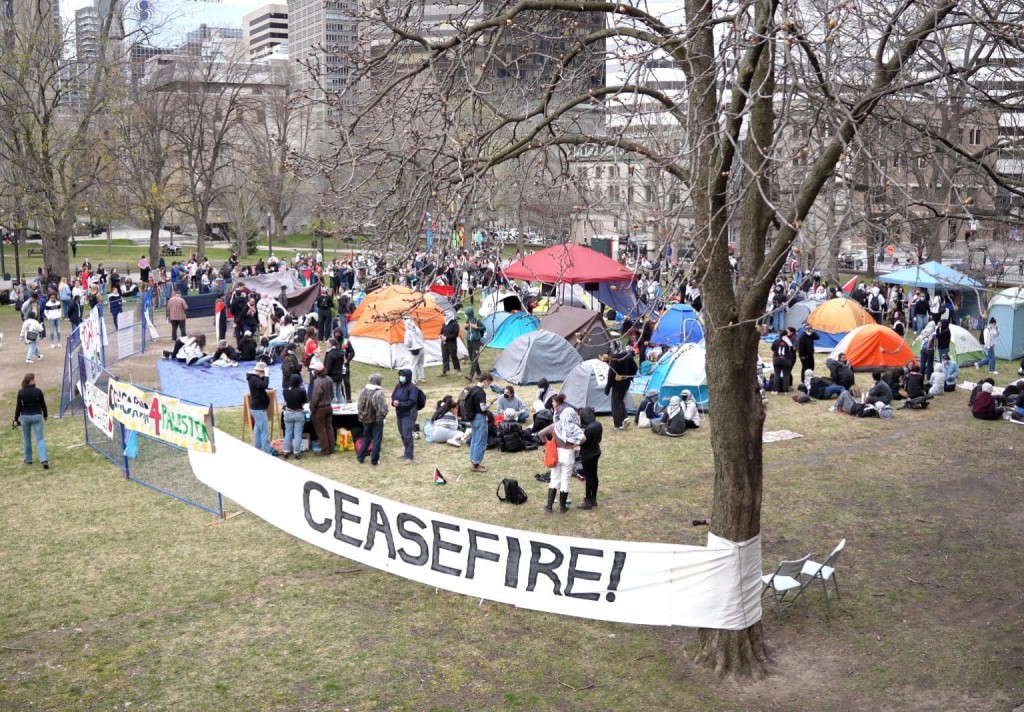
The student camp on the lawn of McGill University. PHOTO: Oona Barrett
It was the kind of rain that made you pray for snow.
An unrelenting downpour battered the encampment and turned the field into a cold, muddy pit. Even our bones felt wet.
And yet, about 100 of them held firm on the McGill University grounds, hunkering down under tarps and in their tents as the storm raged.
Before heading to the encampment Tuesday, I’d seen all manner of criticism levelled at the students. They, I was told, are lazy, naive and entitled. But also conniving, relentlessly hateful and possibly funded by dark money. One Twitter commentator — a prominent local businessman — suggested the Holocaust survivor and financier George Soros was paying protesters to stage a coup on campus.
Judging by the duct tape and twine holding the camp together, I’d say the cheque hasn’t cleared yet.
Support Independent Journalism.
Organizers insist they won’t leave until McGill divests its multimillion-dollar investments in arms manufacturers and other companies that profit from the subjugation of the Palestinian people. On Tuesday — the fourth day since protesters from Concordia University and McGill took over a small patch of land near the Roddick Gates — rumours began circulating that police would storm the encampment by 2 p.m.
McGill did ask for police assistance on Tuesday to shut down the protest, citing “evidence of appalling antisemitic rhetoric.” Meanwhile, Montreal lawyer Neil Oberman filed an injunction on behalf of two McGill students who say they feel threatened by the camp’s presence on campus. Not merely aimed at antiwar protesters, the injunction seeks to ban “any protest or actions related to protesting” within 100 meters of McGill for a period of 10 days.
Among the justifications for requesting a court order is that, while the encampment has remained peaceful, protesters are inciting violence through chants like “The only solution is intifada revolution.” Shunted off to a corner of the university’s front lawn, the tents aren’t obstructing anyone’s ability to move across campus. The main issue appears to be the chants.
Like the Arabic word “jihad,” intifada is the subject of intense debate depending on how it is used. In the explosion of Islamophobia that followed 9/11, jihad became synonymous with holy war and the terrorism of groups like Al-Qaeda. But jihad — which means “to strive” — can be used for something as wholesome as fighting through a difficult pregnancy.
In the case of intifada — which translates to “uprising” in English — protesters at McGill claim it refers to the Palestinian resistance movement of the early 90s.
Back then, protesters in the West Bank fought back against illegal Israeli settlements by organizing strikes, throwing stones and Molotov cocktails at soldiers. Critics of the term say it refers to the second far more violent intifada of the early 2000s, which was marred by suicide bombings that targeted Israeli civilians.
“The term ‘intifada’ is as broad as the term ‘revolution,’” said Willa Holt, the communications coordinator for Independent Jewish Voices (IJV). “The ambiguity is strong enough that to imply that anyone at this nonviolent protest is implying something violent is a bad faith interpretation.”
The Superior Court seems to have agreed with Holt’s assessment. It rejected Oberman’s request on Wednesday morning, claiming the evidence presented didn’t meet the legal threshold to warrant an eviction.
One Jewish student at the encampment Tuesday said “intifada revolution” was a call for all of their allies in Israel, Palestinians and Jews alike, to resist a government that’s committing genocide through direct but nonviolent action. He said that this is usually explained by organizers before they start chanting. But, if you happen to be passing by, you probably won’t hear that crucial piece of context.
Some of the strongest calls for police action — from Liberal MP Anthony Housefather and Hampstead Mayor Jeremy Levi — demanded police preemptively crackdown on dissent at Montreal universities. Before the last tent was pitched on Saturday, Housefather said police needed to get involved to avoid escalations seen on American university campuses. Levi went further, calling on officers to use “any means necessary” against protesters.
The Hampstead mayor has emerged as one of the strongest supporters of Israel’s war on Gaza, publicly supporting Prime Minister Benjamin Netanyahu even as an overwhelming majority of Israelis want him to resign. In fact, Levi publicly urged Oberman to get involved before he filed the ill-fated injunction request on Monday.
And while the politicians frequently demand protesters denounce the excesses seen in the antiwar movement, neither of them has uttered a word of condemnation against the Israeli Defense Force. This despite the IDF killing a Canadian aid worker, thousands of Palestinian children and besieging hospitals throughout Gaza. Housefather is privately critical of Netanyahu but does not dare question the embattled prime minister in public.
Two parents I know well say their kids have heard antisemitic rhetoric while walking by the encampment, making them feel unsafe. They are Jewish and they oppose the war but say the tone and chants coming out of the encampment makes them feel threatened. In one case, it caused a mother whose child was visiting the downtown campus to re-consider whether she’ll send them to McGill.
“There have been people who’ve come by the encampment, random people, who’ve come by and shouted awful things,” said Holt, a McGill graduate. “I saw it myself yesterday. But no one at the camp — that I’ve seen — has said anything remotely antisemitic. To focus on what’s being said and who’s being offended on campus distracts from the actual destruction of Gaza and the role many of our institutions play in that.”
Jewish students and groups like IJV are among the camp’s organizers and the group held a seder dinner to mark the end of Passover just hours after the first tents were erected on Saturday. Jewish professors have also defended the camp. In a letter sent to McGill President Deep Saini, a professor in the department of education wrote that they supported the protest and had only heard of one antisemitic incident.
“The perpetrators were not participants in the encampment and were decried by organizers,” read the letter, which was posted on social media Monday. “To be clear, the community organizing and participating in the encampment care about equality and human rights for all — including Palestinians, Jews and anyone else impacted.”
At the encampment Tuesday, three women in their seventies gathered under one of the tarps, chanting alongside students young enough to be their grandchildren. They’ve been marching almost every weekend since the war began.
“I am an alumni and I don’t think it should be controversial to ask that my university doesn’t invest in arms manufacturers,” one of them said. “I’ve tried to be reasonable, I’ve tried to meet with my member of parliament but he won’t return my calls. We’re out here because we want to see an end to this war and all the killing, not because we hate anyone. Nothing could be further from the truth.”
Towards the end of the afternoon Tuesday, as protesters settled in for a night under the pouring rain, a Concordia student came to drop off supplies for the camp, which now includes students from Université du Québec à Montréal and Université de Montréal.
“I’ve heard those claims too, that this is being funded by ‘outside groups’ whatever that means,” said Izik Hesselink, who works at the Concordia student housing co-op. “In reality, we’re taking funds that would normally be used for an activity night or other student events and diverting them to a cause we believe in. If we can get some warm meals or a generator on site, why not lend a helping hand?
“We’re students resisting a war, it’s not like we invented protesting. It’s a longstanding tradition.”
Author

Related Articles
Editor’s Note: Haters Be Damned, it’s Awards Season at The Rover
With more nominations in our name, Savannah writes about why industry awards matter to an indie outlet like ours.
Gaza: A Healthcare System on the Brink of Collapse
Drug shortages, growing famine, and daily deaths.
OPINION: Why is McGill Fighting to be on the Wrong Side of History?
The university insists on silencing its students as they push McGill to take a stand on genocide.
Comments (0)
There are no comments on this article.