
The Sea in Gaza: Memory, Survival, and the Last Refuge
Has the war changed the meaning of the sea?
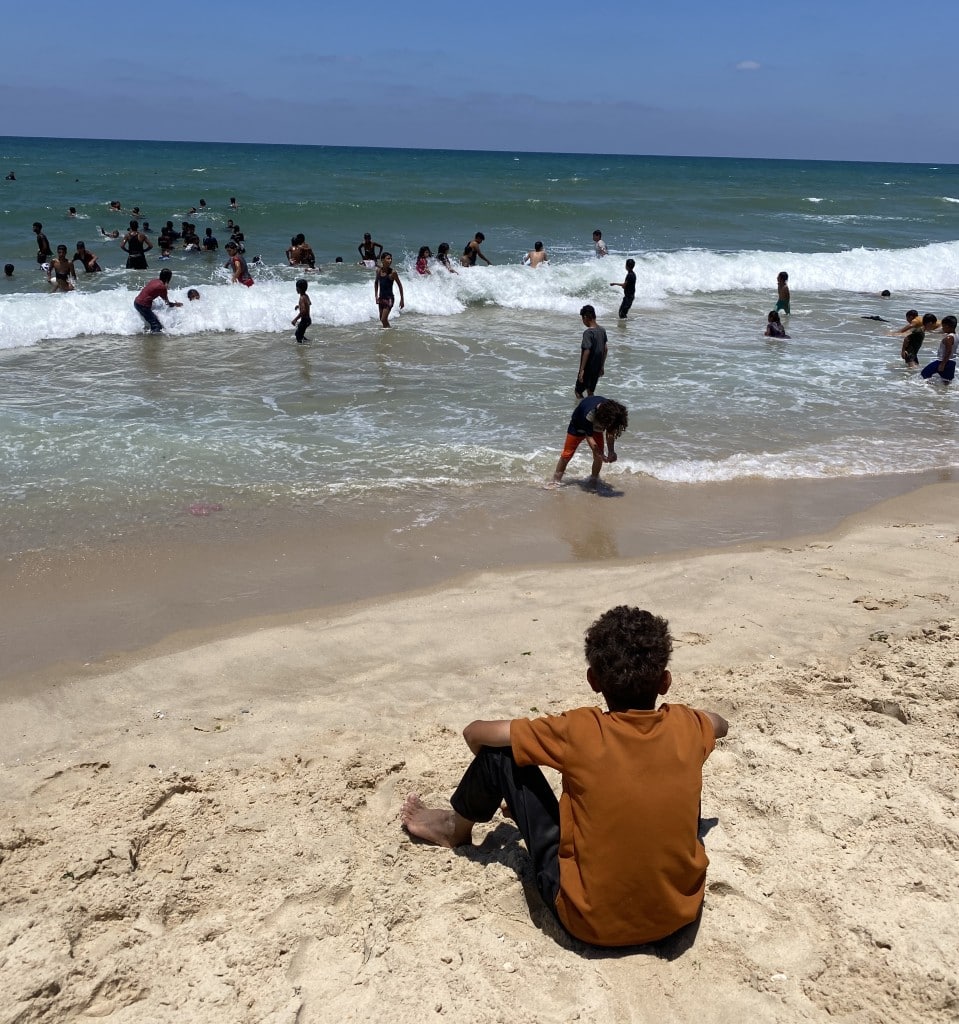
Has the war changed the meaning of the sea?
In Gaza, this is no mere poetic question. It looms large for every resident who still sets foot on the sand.
Before October 7, Gaza’s waterfront was a city within a city. On Thursday evenings — the start of the weekend — Sharia’ Rachid would light up: crowded cafés, tables of young people playing chess, families laughing and making plans for the future, children running along the promenade, and everywhere the smell of roasted corn wafting along the coast. The shore belonged to everyone. For me, the sea had its own rituals. On my days off, whenever I had free time, I’d head toward the harbour to meet my friend Alaa Al-Nimr at a small café overlooking the sea. It was a simple place, but it had a special charm. Fishermen would pass by with their catch, children played on the shore, and we’d talk for hours about life, the future, and my articles. Alaa always encouraged me to write. The sea was a refuge for both of us.
Alaa Al-Nimr was martyred on November 20, 2023.
The sea had sustained Gaza for generations. Today, it is burying it.
Twenty years and eight days ago, Hoda Ghalia’s family was sitting on this very same beach. An ordinary place, an ordinary afternoon. Israeli shells killed her father, her stepmother, and five of her brothers and sisters right before her eyes. The image of that little girl running across the sand screaming “Daddy, Daddy” was seen around the world. Gaza has never forgotten.
Sarah is raising money to fund her education. You can donate here.
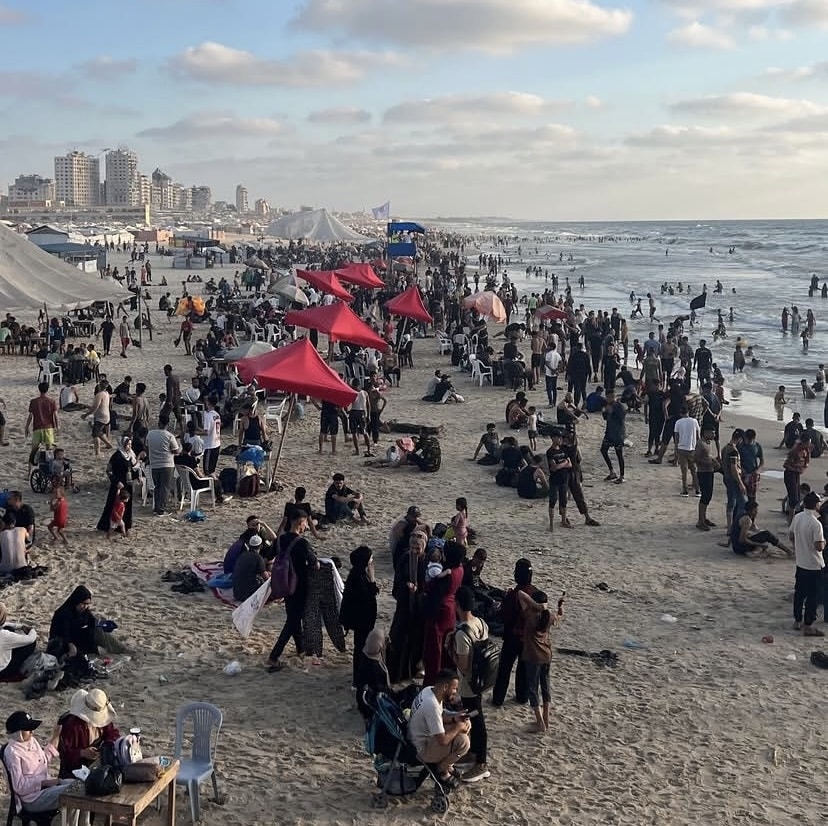
Twenty years later, nothing has changed except the scale of the attacks.
In the early days of the war, the port of Gaza was directly bombed. Dozens of fishing boats were destroyed. Later, Israeli tanks entered the port and deliberately ravaged it, symbolically erasing one of the city’s most cherished landmarks. The path that once led to the shore—once bustling and full of life—is now littered with rubble and tents housing displaced people. Street vendors have vanished. The traces of famine and dire humanitarian conditions are evident in every corner of the area.
On June 30, 2025, an Israeli strike targeted the Al-Buqa’a café on the waterfront. Dozens of people were killed — children, women, students, journalists, and athletes. Their only “crime”: sitting by the sea and being Palestinian.
On June 17, 2026, another strike targeted the beach in Khan Younès. Two martyrs and six wounded.
Umm Mohammad, 47, sometimes returns to sit facing the water. She, who used to come here seeking joy, confides today: “Before, I’d come here and feel joy. Now, when I sit facing the sea, I remember everything I’ve lost. I remember the day we left Gaza, when we walked down this street and the soldiers stopped us at the checkpoint. They took all my gold, all my belongings. They killed my son right before my eyes. I feel a crushing weight that I can’t describe.”
She pauses, looks out at the sea, and adds: “Everything in our lives has become salty because of the war.”
The sea has changed its face. But for some, it remains the only means of survival. This is the case for Gaza’s fishermen.
On the waters off Gaza, every trip out to sea could be the last
“Fishing has its seasons. We have none left.”
Abdel Jarboue, 41, a fisherman from the Shati’ refugee camp and father of five children. His wife was killed as a martyr. He is raising his children alone, and the sea — his sole source of income — has also been taken from him. Before the war, he ran a bustling boat, employed workers, and worked alongside his sons. Today, he fishes alone. “We can barely catch a single fish — not enough to feed a family. And the equipment we used to buy for a few shekels now costs thousands of dollars, if we can even find it.”
The sea has fed Gaza for generations. Today, it is burying it.
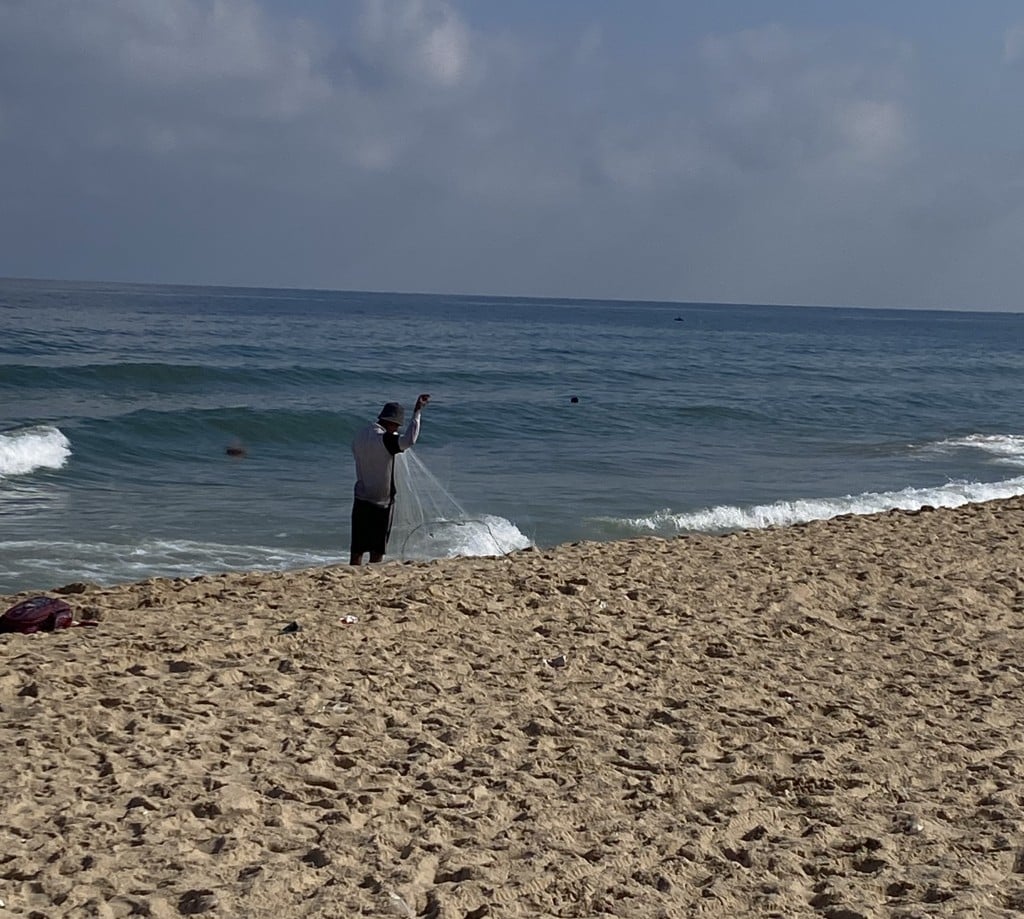
Jarboue is not alone. Adel Abu Riala, 38, originally from Beit Lahiya and now displaced to Al-Mawasi, a father of four, has been fishing for 13 years — a trade he inherited from his father and grandfather. What he catches each day is barely enough to feed his family.
But scarcity is not his only enemy. “Yesterday, they wounded my colleague right in front of me, arrested him, and confiscated his boat. I escaped arrest by a miracle. The occupation has destroyed my four boats and left me with just one, which is broken down, and I can’t find any nails or fiberglass to repair it, because everything is banned from entering.” He no longer has access to a single nautical mile. The sea he has known all his life has become, he says, “a place that reeks of death.”
Occupation forces continue to fire on small boats and beaches, preventing fishermen from going out to sea. Palestinian fishermen now face an impossible choice: stay ashore or risk their lives at sea.
According to data from the fishermen’s union, 170 fishermen have been killed since the start of the war, 40 others wounded, and 30 arrested at sea. Nearly 4,000 fishermen have been affected by these ongoing attacks. The material damage is just as devastating: 100 per cent of boats have been destroyed in northern Gaza, 95 per cent in Gaza City, and 80 per cent in central Gaza, Khan Younis, and Rafah.
Khouloud, 33, now lives in a school converted into a shelter in the Nuseirat camp. She shares this space with dozens of displaced families — no privacy, no running water, no room to breathe. Every day is the same as the one before: the waiting, the noise, the overcrowding.
But what weighs on her most is Omar’s absence. She used to go to the sea with her 13-year-old son. He was blind, but he loved the sound of the waves and the feeling of the sea spray on his face. The sea was his best friend. Omar died as a result of Israeli attacks, due to a lack of medical care.
“The occupation has cut me off from the place where I had formed a deep bond with my son. When I come to the sea, the waves still whisper his voice to me. ”
In Gaza, they say, “If you get lost, follow the sea; it will bring you home.” But today, even if you follow the sea, you will no longer find your home. Landmarks have vanished, neighbourhoods have been wiped out, and where there were once streets and memories, there is now nothing but rubble. The sea is still there. The houses are not.
My imagination, however, has already left Gaza. I see myself breaking free from the siege and discovering the world as it exists elsewhere. I imagine myself skydiving, surfing the waves, attending conferences, signing my first book in front of an audience, and saying aloud what we’ve long been saying — as if I were a character in a novel capable of changing things, even just a little. Sometimes I dream of something simpler: studying physical therapy at a European university on a full scholarship and building a future that seems impossible from inside Gaza.
These thoughts come back to me every time I look at the sea. What scares me most is ending up accepting the life I live today, growing old while watching my dreams fade away, until they’re nothing more than things I once believed in. I’m afraid that one day I’ll look at myself in the mirror and see someone who has given up. But what frightens me even more is losing that sense of freedom and possibility I feel when I gaze at the horizon. What does the sea mean to someone who cannot leave it?
I still think of Alaa. He, too, used to gaze at that horizon. He, too, loved the sea with an endless love. Sometimes I imagine him sitting next to me, gazing at the waves, dreaming with me of our future. He’s no longer here to look at it. So I look for both of us.
I stand here, sometimes an hour before sunset, sometimes alone, sometimes with friends. I gaze at the farthest point on the horizon and reach toward a life I haven’t yet lived, toward experiences I haven’t yet had, toward people I haven’t yet met.
Did you like this column? Share it with a friend!
Author
Comments (1)
Leave a comment
Related Articles
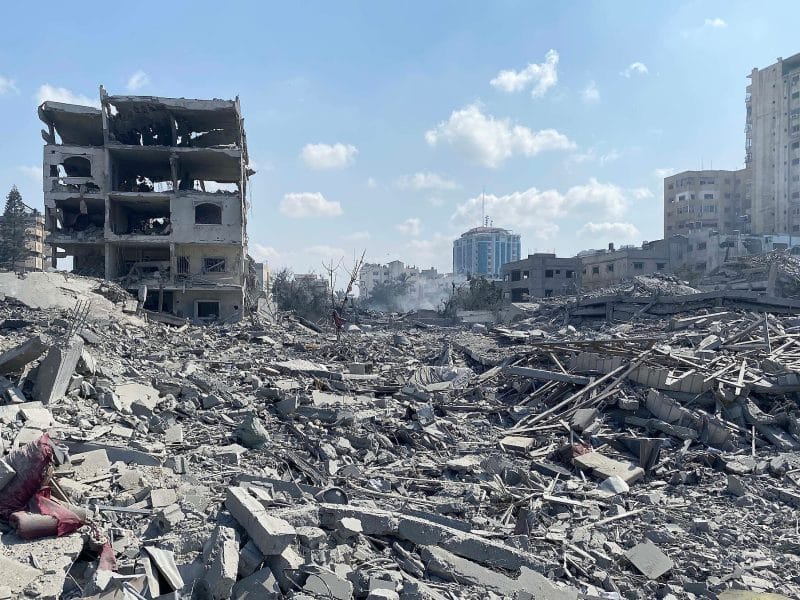
Beneath the Rubble, a Life Erased: the Lost Memories and Dreams of Gaza’s Residents
What remains of a life when everything that proved its existence disappears beneath the ruins?

Fill Out Our Audience Survey!
Help us build The Rover.
Editor’s Note: Here’s What We Made and How We Spent in 2025
Our 2025 Transparency Report shows stable income, a growing audience, and more money going out to more freelancers.
Thank you for sharing your corner of Gaza with us. May Palestine be free soon and may I see you soon at the reading of your 1st book 🕊🤲🤍