
Stripper Strike Provokes Internal Discord, Media Circus — and Worker Mobilization
While the majority of strippers did not strike on May 23, sex workers report feeling motivated to continue the fight for labour rights.
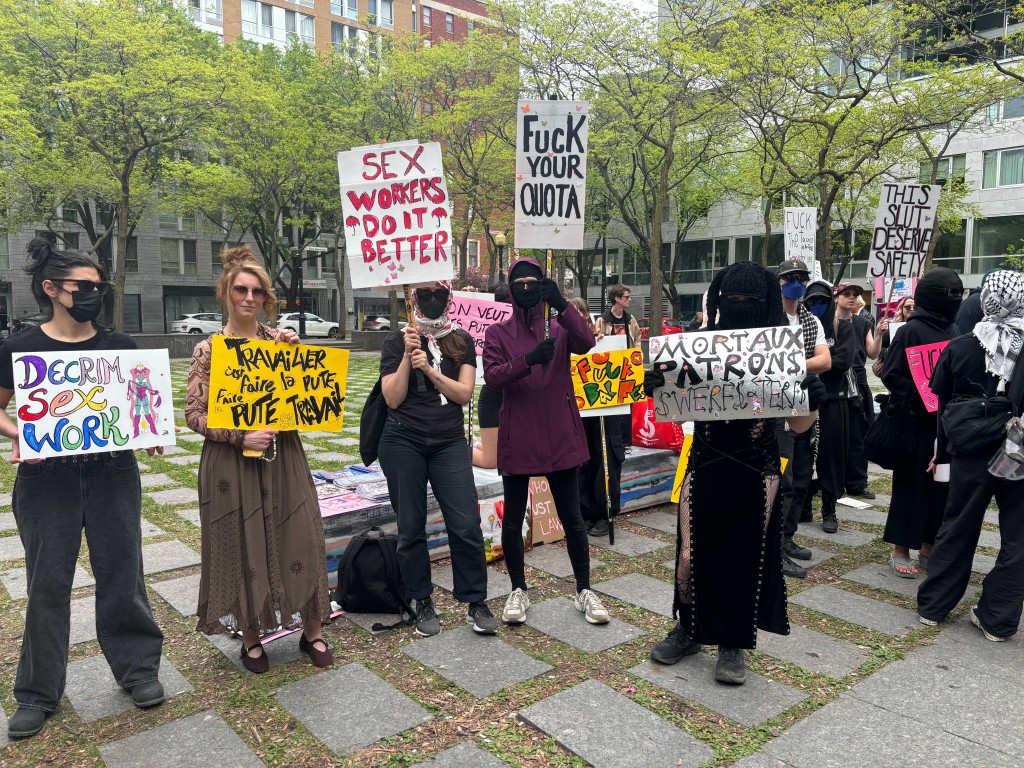
The names of sex workers mentioned have been changed due to the criminalization of sex work.
Around 200 people took to the streets of downtown Montreal for a protest supporting the stripper strike on May 23, the Saturday of the Formula 1 Grand Prix.
But as the sun set that night, strip clubs didn’t seem short on workers.
Clients asked working dancers, “Aren’t you supposed to be on strike?” half in jest. Strippers said it was an “okay” night — a lot of clients, but not a lot of dances or tippers. While there were reportedly slightly fewer strippers working in clubs than previous Grand Prix weekends, whether this was due to strike participation, fear of media presence in clubs, or the simple fact that F1 isn’t as lucrative as it used to be, is difficult to say.
Over at Peace Park, sex workers clad head to toe in baggy clothes with covered faces, some with stripper outfits and masks, along with allies from the Immigrant Workers Centre and SQEES, a Quebec service workers union, gathered ahead of the protest.
The strike was organized by the Sex Work Autonomous Committee (SWAC). They were calling for the decriminalization of sex work, safer working conditions, elimination of the bar fee (where strippers pay the club a fee to work) and official employee status to access worker protections and to unionize. They called on massage parlour workers and strippers to strike that night.
Support your local indie journalists
As media swarmed to cover the strike, with the demand for worker status front and centre, a network of sex workers began to form online, called Pleasers on the Ground (PotG). Representatives from PotG spoke out opposing the demand for employee status, among other concerns.
Addressing the crowd that formed at Peace Park, Adore Goldman, one of the only uncovered faces of SWAC, said:
“Of course, it’s not unanimity that makes this strike successful. The demand for employee status has caused a lot of discussion in the last weeks, but whatever we think, without this demand and without the threat of the strike, we wouldn’t have been talked about nearly as much.”
A stripper at the protest clad in a bunny mask said, “We don’t have the protections of employees, but we don’t have the freedoms of contractors. So I would love for them to pick a lane. Personally, I am down to be a contractor, but I would love to have the freedom to choose how much I charge for a dance, whether or not I take off my underwear onstage, what time I show up and leave.”
One individual shared that they would love to have worker status so that when their progressive disability no longer allows them to strip, they could access long-term disability benefits.
Another stripper said she was enthusiastic about getting worker status to formally unionize.
“Under the current model, employers have no obligation to provide us with a safe working environment, and the safety of workers is most important to me,” she said. “If we became employees, we would have the right to unionize, and we could come up with a collective agreement that includes all of our demands, including autonomy.”
Most strippers did not heed the demand to strike. Some strippers told me that before the strike was announced, they were already planning not to work due to declining profitability.
Christina, a stripper who is a member of PotG, said she overheard her manager say that he would fire people who participated in the strike. When she informed her colleagues so they could make an “informed decision” on whether to participate, people didn’t really seem to care.
“Everyone was just like ‘No, fuck the strike, we’re not doing it’ or just being like ‘Who can afford to strike?'” said Christina.
Based on accounts, it seems like the majority of sex workers are not in favour of employee status. Aside from the SWAC members I spoke to, none of the other sex workers featured in my last article voiced support for employee status (one was ambivalent, one did not answer, and the rest were opposed).
Coco, a Black stripper of the PotG network, says that sex workers requiring formal worker status could lead to the “gentrification’” of sex work. With the current stigma surrounding sex work, Coco says that if it’s on your record that you’re a sex worker, custody battles, interactions with police, and even getting another job could get even more fraught for sex workers of colour in particular. She says it could also shut migrant workers and those with criminal records out of sex work.
“Truly, who would employee status benefit? Would it make the club more homogeneous? Would it only be a certain demographic working (in clubs) because those people can afford to have it on their record that they’re (strip club) employees?” says Coco.
While all sex workers I spoke to are in support of SWAC’s demand for decriminalization of sex work (i.e. removing laws criminalizing the purchase and sale of sexual services from the Criminal Code), Coco says that having formalized worker status, which would involve registering yourself officially as a stripper, massage parlour worker, etc, would have similar effects to legalization, as the government would then be involved in determining who is and isn’t officially a sex worker.
“It would just take one right-wing government to take a look at the laws that are in these municipal codes or whatsoever and make them even more repressive,” said Coco. “People are going to fall through the cracks, and what’s going to happen is that the second market is going to create itself.”
Nina and Alex, along with a chorus of other workers, were concerned that waged, unionized work would take away the autonomy that drew them to the work in the first place.
“I have ADHD, I have pretty bad anxiety, which has been a lot better since becoming a stripper, I think, because I have so much agency. And the fact that I have agency allows me to manage my anxiety better,” said Nina.
Nina and Alex recall being left to their own devices by management as they learned the ropes of stripping from more experienced dancers.
“There’s a lot of room for error when you start out, which is really nice. We are allowed to make mistakes,” said Nina.
They worry that if management starts taking a bigger cut of their tips and dances, they’ll be pressured to up the intensity of their performances — something Alex is not interested in doing.
“My asset is my ass,” she said. “That’s why there’s certain clubs that I don’t want to work at, because I’m not doing three back-to-back songs onstage.”
PotG members said that the wage plus commission model does not seem to be working in Californian clubs, where strippers have been reclassified as employees.
California passed the Assembly Bill 5 Law, or AB law, aimed to reclassify self-employed workers as employees in 2019. While dancers now have a guaranteed minimum wage and got access to unemployment insurance during the pandemic, strip clubs took the opportunity to take larger cuts of private dances.
Many dancers say they are financially worse off. A former stripper who has worked in Montreal and San Francisco said that employee status has “driven down wages significantly.” She says more strippers in California are turning to full-service sex work or second jobs as the effective hourly rate has dropped since they became waged workers. She also noted that in San Francisco, several clubs are owned by the same corporation. This stripper also worked a few shifts at the unionized peep show Lusty Lady, which was operational until 2013. She said that the pay was low, and many workers were supplementing their income there.
An anonymous representative from SWAC said that the pitfalls of California’s legislation can point to what not to do — and that organized workplaces in tandem with waged work can ensure higher wages and better working conditions. They said that they believe that there can be multiple ways to advocate for better working conditions, and worker status is just one of them. They also said that there could be a vision for the future in which both the employee model and the independent contractor model operate simultaneously.
SWAC says that workers had many opportunities to voice their concerns at their meetings ahead of the strike. While SWAC makes its decisions democratically, the committee expects people to come to meetings and does not do peer-to-peer outreach. The majority of sex workers are not SWAC members. So while SWAC’s demands and day of action were years in the making, many sex workers felt blindsided by the wide publicizing of the strike and its demands.
While 58 community and labour organizations signed off on SWAC’s strike, Coco says that many POC and trans sex workers felt unheard.
“I think it’s so dangerous to speak on behalf of people you’ve never opened dialogue with, especially the most vulnerable people in our community,” said Coco. “It’s so easy to say that you are supported by different (non-sex work) orgs, because when you reach out to people and say, ‘Hey, do you support sex workers? If yes, please sign this,’ then of course people are going to sign it. It doesn’t mean you’ve done the actual outreach work with those communities (of sex workers).”
The week before the strike, PotG paid a visit to a trans strip night in the Gay Village. SWAC leadership had never visited the club. Now, a few trans strippers have partnered with the PotG network to make sure their voices are heard.
“Most folks, myself included, were unaware that SWAC was asking for employee status,” said one trans stripper. “Asking to change something within a flawed system and a government that has historically not protected us does not change the system and structure, it opens up a door for new legal ways for the government to exploit us.”
For trans strippers, the anonymity of the job is more than just the stigma surrounding sex work — it can also protect them.
“With the government targeting trans people, (the risk of) crossing the border, the employee status would make trans dancers required to be even more visible and create more danger for us to be targeted,” added the trans dancer.
Nina and Alex of PotG said the strike sparked a lot of anxiety among sex workers.
“Nina: It got so loud in the media, and we were like, we’re feeling misrepresented, and we talked with other people in our clubs and like —
Alex: Some of them feel unsafe.
Nina: Some of them (were) having panic attacks about this.”
Sex workers informed me that one stripper was fired for calling in to work to say she would not be at her shift — not because she was striking, but because the tension and possible media presence of the strike made her hesitant to show up for work.
The Rover contacted four strip clubs across the city, including one that allegedly fired a worker. Managers did not respond to this request for comment by deadline.
Goldman did not say whether she was still able to work as a stripper in Montreal, but said that at least one person has lost her job in a strip club and another lost their “civilian” job for participating in the strike. SWAC has also established a fund for those who have lost their jobs in the strike.
In an email, Goldman said that SWAC has been fighting for decriminalization for seven years in the form of demonstrations.
“Despite our efforts, we weren’t able to get attention from the federal government,” said Goldman. “We think that organizing as workers in our workplaces is the most effective strategy to push for decriminalization, as it will create contradictions in the criminal and immigration law that the government will have to address.”
Alice is a sex worker who has been involved with Industrial Workers of the World (IWW), an anarcho-syndicalist union, since 2018. They highlighted that decriminalization, along with employee status, are legislative issues, whereas the bevy of SWAC’s workers demands were a workplace issue. Striking for both at the same time without broad consensus didn’t make strategic sense to Alice.
“I personally feel like (SWAC’s) heart was in the right place,” said Alice. “I think for the most part they wanted good things, they just went about it in a way that’s messy and disorganized, and it probably feels bad on their end to have the community have animosity towards you when you were trying to help people.”
They said that SWAC’s lack of one-on-one outreach with fellow workers set up their strike to “fail.”
“A lot of people don’t have time to go to meetings,” they said. “A lot of people don’t want to share how they feel in a really public forum. You have to approach them like a person, and you have to approach people in a way that makes them feel like they can trust and confide in you. And you have to listen more than you talk at them.”
Alice says they’re interested in “militant unionism” — from working in kitchens to strip clubs, they’ve rallied workers to take direct action in their workplaces to make change. As they explain in their article for IWW, Alice once refused to dance on the pole until security made a client stop filming workers.
“I’ve seen journalists talk, they’re praising the stripper strike, but they’re not actually listening to us,” said Alice. “I feel like these conversations need to be happening in our own community and not having a spectacle. I feel like (journalists) miss the point too, it’s a spectacle for them because sex sells. But what I really want them to be talking about is organizing the working class and labour and how we can build worker power in our communities.”
SWAC has been encouraging sex workers to form autonomous unions at their workplace to improve their working conditions. Many strippers and sex workers outside of SWAC say that they have already started engaging in direct action work.
Alex says that they know of a case where strippers used the bar fee as a point of leverage. A group of strippers successfully negotiated a month of no bar fee in exchange for cleaning the club. Christina recalls when she and her fellow massage parlour workers banded together to successfully demand higher pay per massage. Ahead of the F1, PotG distributed harm reduction kits, including cup covers and naloxone, provided by AIDS Community Care Montreal and Stella. Beyond the work that SWAC does already, outside of official committees, strippers and sex workers all told me that they look out for each other.
Despite the current tensions and discord, sex workers, regardless of their affiliation, reported feeling galvanized to continue to fight for better working conditions, decriminalization, and to connect with each other. And while PotG formed out of opposition to some of SWAC’s demands, they do not see themselves as a competing advocacy group, but a sex worker network open to all. SWAC is reportedly reviewing their outreach and messaging for future advocacy.
“There are so many (SWAC members) that are fucking great,” said Alex. “Even if we don’t agree on everything, we can definitely chat about it. Our opinions and our points were heard by a lot of (SWAC) members, but there’s been a disconnect from some others.”
Alice, who is not affiliated with PotG, said that they were happy to see the strike provoke discussion in their community.
“I’ve gotten to talk to my co-workers about organizing theory, and I’ve proposed the idea that we do organizer training to learn these techniques and strategies we could use in our workplace to be even more effective,” said Alice. “(There are) people I’ve never talked to at work, but I’ve always seen around who I never thought I’d be talking to about this stuff.”
Christina said that her newfound involvement in PotG has made her feel fulfilled at her job for the first time in a while. Coco says she’s excited to educate and mobilize her fellow workers in the fight for decriminalization.
“Coco: I feel like we’re all feeling pretty optimistic about the future, just as long as people stop trying to like…
Christina: Make a stunt out of it.”
Comments (2)
Leave a comment
Related Articles

Quebec Workers Experienced a “Counter Revolution” Under Jean Boulet: Experts
The outgoing labour minister leaves behind a legacy of attacking the Constitutional right to strike.
« Combien de mères avez-vous fait pleurer? »
À Montréal-Nord, la communauté se soulève contre la brutalité policière et le profilage racial.
“How Many Mothers Have You Made Cry?”
In Montréal-Nord, a community rises up against police brutality and racial profiling.
I’m thankful your reporting is giving us a window into the difficulties of sex worker organizing. In the end, the debate over independent contract work and employed work is an internal division the sex worker community will have to work out on its own. But one thing we can all agree on, both inside and outside the industry: decriminalization must come first.
Another b.s story these are not strippers , just a bunch of radical leftist activists kefyeh wearing loosers…. spoke to the manager of paree strip club during F1 and he said that strike rumor was absolute b.s and all the girls at his club made F.U money during that week…..