
How Gazans Are Watching the World Cup
Amid power outages, fear of bombings, and the loss of the places where they once watched the games, soccer remains a rare moment of respite in a life upended by war.
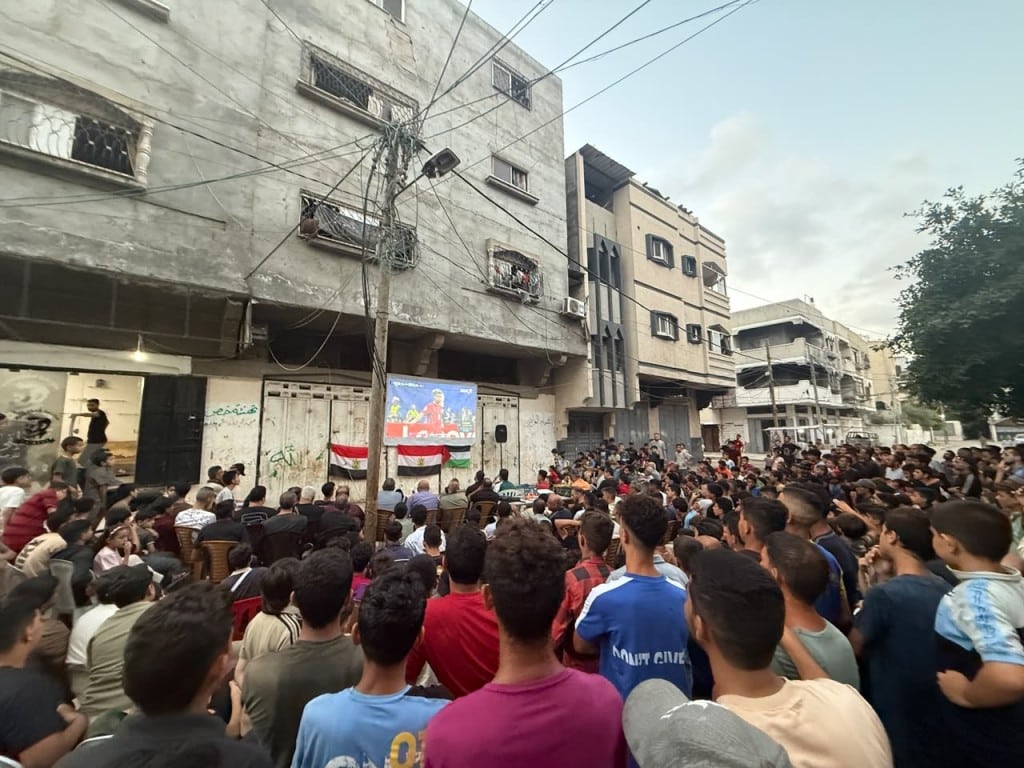
In the refugee camps, Palestinians gather around screens powered by makeshift generators to follow the world’s biggest soccer tournament. Amid power outages, fear of bombings, and the loss of the places where they used to watch matches, soccer remains a rare moment of respite in a life upended by war.
Abdel Rahman al-Sheikh Khalil is 30 years old. Trained as an accountant, he used to handle numbers before the war; today, he runs a café set up in a tent west of Gaza City. During the 2022 World Cup, he watched the matches with friends at one of the cafés along Gaza’s waterfront. Now he watches the 2026 World Cup from his own makeshift café. “We don’t have that joy anymore,” he says. “It’s not just soccer that’s changed. It’s our perspective on everything.”
Sarah is raising money to fund her education. You can donate here.
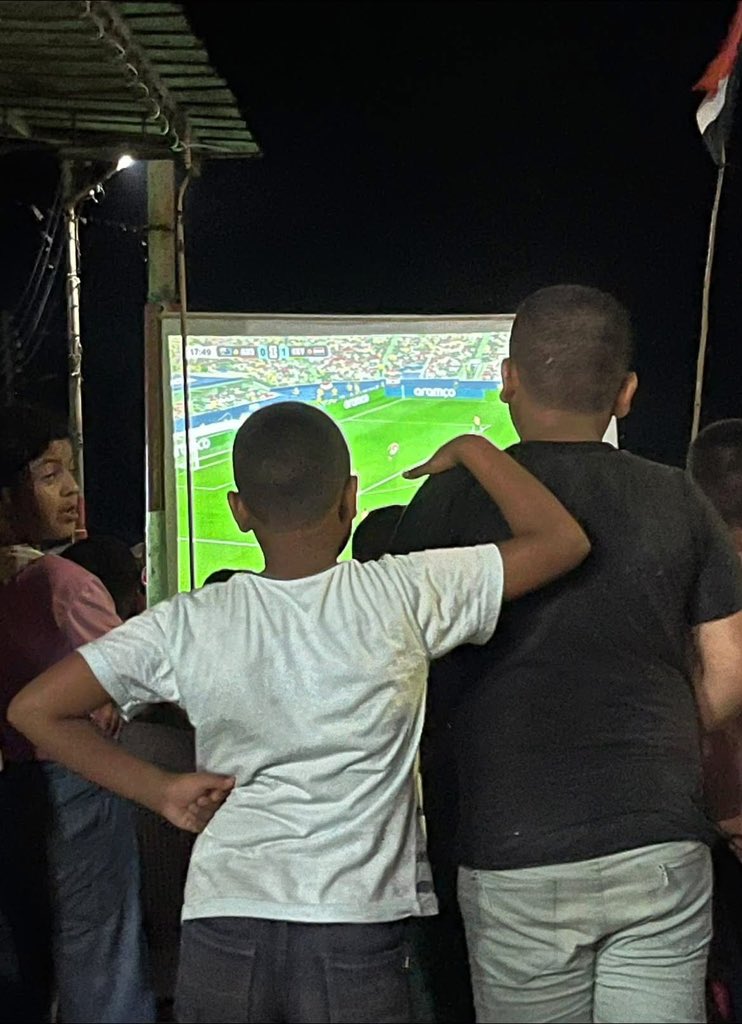
The place is a café in name only — a name Abdel Rahman gave it himself. A tarp stretched between two wooden poles, a few mismatched plastic chairs scavenged here and there, a single screen perched on a crate. Electricity comes from a small generator he bought with his last savings, which he rations out match by match so it doesn’t run out of fuel before the end. When that happens anyway, he stops serving to go restart it, while customers wait impatiently, their eyes glued to the frozen screen. Exposed electrical wires run from the neighbouring tent — worn and patched up more than once. Abdel Rahman doesn’t charge for the matches themselves, only for the tea and coffee he still manages to prepare, as best he can, on a gas stove. “I don’t do this to make a living,” he says. “People here are exhausted by everything the war has put them through. They need a place to have a little fun, to forget — even if just for two hours. That’s what I’m trying to offer them.”
Elsewhere in Gaza, other tent cafés are driven by the same desire. In Zawayda, in the centre of the Gaza Strip, 17-year-old Khaled al-Aloul says he’s trying to recapture a bit of the atmosphere that “young and old” alike love here. A die-hard fan of Cristiano Ronaldo, he has never attended a World Cup match in a stadium; the blockade, the occupation, and the war have always prevented him from doing so. Coach Mohammed Salama sums up the contrast differently: the whole world is watching the tournament, while in Gaza people are deprived of everything, even the simple act of watching a match on television. The stadiums and sports facilities themselves have been destroyed by the war.
In Gaza, even joy doesn’t last long. On the evening of July 7, as the Egypt-Argentina match kicked off, an Israeli drone strike killed Mohammed Fawaz al-Wahidi, director of public relations for the Egyptian Committee for the Reconstruction of Gaza, while he was organizing public screenings of the match in displacement camps. Here, death never takes a break.
Between past and present: Yarmouk Stadium
In 2022, thousands of fans crowded into Yarmouk Stadium in Gaza City to watch the matches on a giant screen, the stands packed, car horns blaring in the surrounding streets with every goal, the atmosphere spilling over late into the night. It was the main stadium in the Gaza Strip, where local clubs played in front of thousands of spectators.
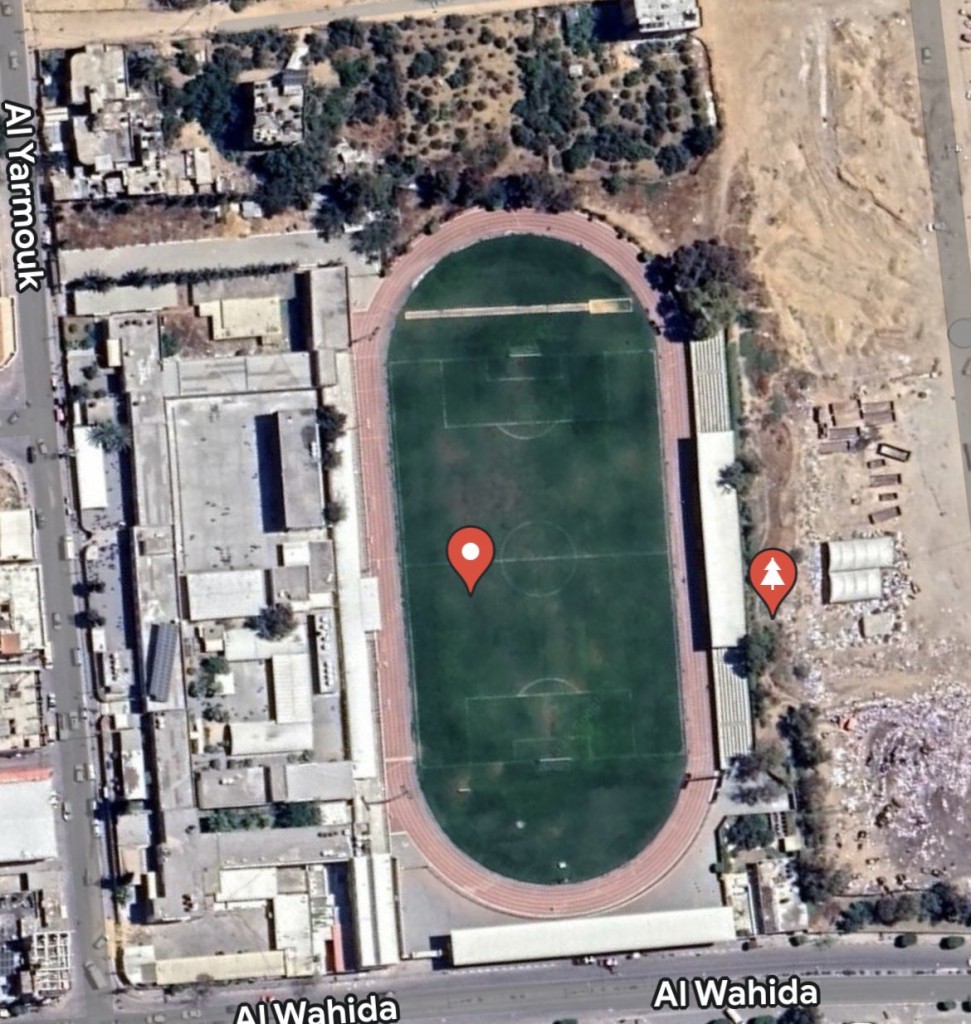
It was here, in fact, that Mohammed Salama — the coach we met earlier — spent a good part of his career. “You could feel that the stadium was alive,” he says. Today, the field has disappeared beneath the tents. The Israeli army bombed the stadium, then temporarily turned it into a detention and interrogation site for Gaza residents, before it in turn became a camp for displaced families, who now sleep where the bleachers once held the crowds. “When I walk by, I don’t recognize anything anymore,” says Salama. “There are tents where our training field used to be. It hurts me to see it like this — it’s no longer a stadium; it’s just a place where people are surviving.”
All that remains of the pre-war Yarmouk Stadium is its name.
Soccer: A Loss in Its Own Right
Behind these scenes of daily resilience, the human toll on Palestinian sports remains immense. According to the Palestinian Football Association and the Palestinian Olympic Committee, more than 1,000 members of Gaza’s sports community have been killed since October 2023 — about 560 in soccer alone, including players, coaches, and administrators. Nearly 265 sports facilities have been damaged or destroyed in the Gaza Strip — about 90 per cent of the territory’s total sports infrastructure — including Yarmouk Stadium itself and about ten fields funded by FIFA.
Behind the numbers are names that Mohammed Salama’s generation knew by heart. Mohammed Barakat, nicknamed “the Lion” — the first player from Gaza to score more than 100 goals for a single club — was killed at age 39 in an Israeli strike in Khan Younis in 2024. His brother Yousef, 45, says that soccer was Mohammed’s whole life, and that every major tournament today rekindles the family’s grief: when they see the players take the field, they imagine Mohammed among them, and the pride of watching the national team play is always mixed with sadness. “His spot on the field will always remain empty, just like the void he left in our lives,” he says.
Hani al-Masdar, coach of the Olympic team, was killed in January of that same year, just days before his players were set to compete in the Asian Cup in Doha. Suleiman al-Obeid, 41, nicknamed “the Palestinian Pelé,” was killed in August 2025 while waiting in line for humanitarian aid, leaving behind five children. More recently, goalkeeper Saleem al-Ashqar, 32, who had been married for five months and was about to become a father, was shot and killed by the Israeli army while returning home in late June 2026. Shadi Abu al-Araj, goalkeeper for the national beach soccer team, and Mohammad Khalifa, a promising international player, are among the other casualties.
Mohammed Salama sums up what these names mean to him.
“Every time I watch a major tournament, I ask myself: How many players around the world are preparing for their next match while our players in Gaza have been killed in the war? ”
For many of them, the dream of staying on the field came to an abrupt end. “Their spot on the field will always remain empty,” he says, “just like the one they left behind at home.”
The ceasefire signed in October 2025 put an end to the massive bombardments. It did not end the war. In addition to the “yellow line” demarcating the areas under Israeli control established during the ceasefire, a second line — the “orange line” — was created and continues to advance, month after month: Israel held approximately 53 per cent of Gaza’s territory at the time of the agreement, compared to nearly 64 per cent today. More than 1,000 Palestinians have been killed since then, despite the truce. Nearly two million people remain displaced, most of them crammed into a narrow coastal strip where electricity, water, and fuel are in short supply almost everywhere.
In his tent-café in Gaza City, Abdel Rahman continues to ration fuel for his generator, game after game. He doesn’t know how many more evenings he’ll be able to keep it going. But as long as the screen lights up, he says, people will come to sit down, and for 90 minutes, they’ll forget the war and their suffering; they’ll let themselves be carried away by the sheer joy of the game. They’ll celebrate their favourite team’s victory, mourn its elimination, and continue, as always, to hope for a better life.
Saleh Massoud, a 22-year-old medical student, comes to watch the games with his friends. He admits that fear never completely goes away, even in these moments of joy: the café could be targeted, as could the walk home once night falls. “But despite everything we’re going through, we carry on,” he says. “We’ll watch the games, no matter what happens.”
Author
Related Articles
The Sea in Gaza: Memory, Survival, and the Last Refuge
Has the war changed the meaning of the sea?
Editor’s Note: The Rover Does TV News, Our Way
The Week Is Rover will bring our independent journalism to YouTube, where we’ll fight the information wars on a new front.
The Bombings Continue… Life at a Standstill in Gaza
“Calling this a ceasefire is a joke.”
Comments (0)
There are no comments on this article.