
When Letter Carriers Break Down
With another strike looming, Canada Post workers are struggling to make ends meet.
Sophie has picked up a second job as a waitress because she can’t make ends meet with her wages as a postal worker.
“I’m working one day a week at a restaurant because I can’t afford to live”, said Sophie, a Montreal letter carrier who did not want her real name published for fear of reprisals.
She had picked up the gig during the strike at the end of last year and now fears her future may not be at Canada Post.
“I’ve started applying for other jobs,” she says. “If we go on strike again in May, that’s it.”
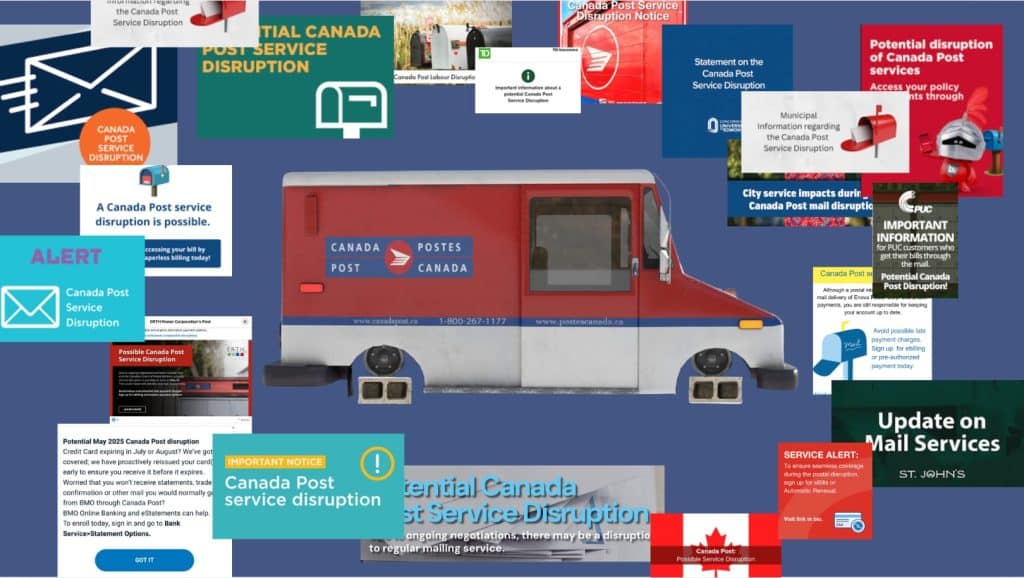
Canada Post letter carriers are facing growing uncertainty, as talk of a potential work stoppage spreads and major institutions like banks warn customers to prepare for service disruptions. Postal workers say they’re unsure they can afford another strike after having been out of work for 32 days last year.
A former professional athlete, Sophie lost all work opportunities during the pandemic. She pivoted to Canada Post because she wanted to stay active. Initially, she loved the job. “It’s being organized, being active and being outside. It’s amazing,” she recalls.
But after going on strike last fall, being forced back onto the job, and with the possibility of another labour dispute around the corner, things have taken a toll.
“I’m usually a pretty even(-tempered) person at work, and I have lost my temper. I’ve started crying. … Everyone’s high stress. It’s not great.”
The situation is worsening at Sophie’s office. She realized just how widespread her concerns were during a meeting at her depot last month.
“We were asked how many people are ready to go on burnout, and I’d say like 80 per cent of us raised our hands,” Sophie said. It’s a sentiment shared across Canada. “I’m on a letter carrier Facebook group, and it’s happening all over Canada. It’s not just my particular office, we’re all noticing it.
“We haven’t heard anything about a work stoppage. So we’re also kind of all worried that we’re about to lose our jobs,” says Sophie.
Canada Post’s contract with its 50,000 employees expired on November 15, 2024, sparking a national strike.
Support Independent Journalism.
“It’s April 21, we’re hearing (from banks) that there might be a work stoppage on May 22. We’ve heard nothing from the company,” Sophie says.
At the request of Labour Minister Steven MacKinnon, the Canada Industrial Relations Board (CIRB) intervened, demanding the worker’s return to work, which the CIRB ruled in favour of. As part of the CIRB’s ruling, the employer’s contracts with its 55,000 employees were extended until May 2025.
Sophie has some questions for the union, which she feels has been out of reach.
“What’s happening? What are you going to do? Are you going to get us a contract? Because none of us can afford to go on strike again”, she says. The Canadian Union of Postal Workers (CUPW), refused to comment on this story.
Canada Post responded, saying they are continuing negotiations with the CUPW to reach a new agreement. A mediator is involved, and no further comments were made at the time.
Sophie remains critical of the union, which she feels has “failed us completely.”
MacKinnon also ordered an Industrial Inquiry Commission (IIC), underway since the beginning of the year. The commissioner, William Kaplan, will present his report of recommendations to the Minister of Labour by May 15, which includes recommendations about the labour dispute.
The following information can be found on the Canada Post website:
“At the end of 2024, the national strike was paused for the IIC work to take place. At that time, the existing collective agreements between Canada Post and CUPW were reinstated and remain in effect until at least May 22, 2025. This means a labour disruption could happen as early as May 22, but not before. We will keep customers informed about any important next steps in the process.”
The Toll of Changes
Recent changes have made the job more challenging. “A few years ago, they started doing this restructuring based more on how other parcel companies work,” Sophie says.
One change, “separate sort from delivery” (SSD), has been especially difficult.
“When I started, I used to sort my own mail in the morning, pack it up how I wanted it, and then take it out and deliver it,” Sophie says. Now, dedicated staff handles sorting. This means being in the elements eight hours a day, when they used to have 2 hours indoors to take breaks: “It just made our days a lot harder physically.”
As a result, letter carriers are on the road for longer. Sophie feels the toll.
“We spend eight hours outside walking around all day, whereas we used to have two hours inside where you had a bathroom, you could talk to people, you could avoid the elements,” said Sophie “It just made our days a lot harder physically”.
Also, with the SSD system, she spends a lot of time during her day reorganizing the mail that she delivers in a manner that is adjusted to the reality of the route, accounting for traffic, the size of the blocks, etc. It also causes delays for loading trucks in the morning, as many letter carriers have to do it simultaneously, and there’s only so much space to do so.
“Everything we do as a letter carrier has a time value… the corporation has fixated on the time that it’s taking us to do things,” said Lindsay, a letter carrier in Montreal. Lindsay added this obsession with “dead time” is being used to justify longer routes. “The corporation is saying that it’s an effort to cut down on dead time… Now it’s not accounting for the time that it would take you to do it healthily and safely.”
Another source of stress: after the strike, Sophie noticed the volume of work increasing. “We would just have mail piling up that we just weren’t able to take out. Everyone was overwhelmed. Everyone was working overtime. We couldn’t get everything out.”
Part of the problem, Sophie says, is that Canada Post seems to no longer use “on-call” workers when carriers have to miss a day of work, or when the mail volume requires it. This means the mail goes undelivered and piles onto whatever new mail they receive when carriers get back to work. It also means on-call workers have seen their income drop and has introduced an element of uncertainty as to their future employment at the post office.
Sophie agrees that some changes are necessary but thinks they should be done more thoughtfully and with fair compensation. Canada Post admits to earlier staffing issues in Montreal and claims the situation has improved through recruitment and planning, though challenges persist.
“Working with our human resources teams, we actively recruited and trained new personnel,” said Canada Post spokesperson Phil Legault. “Our operations teams in greater Montréal understand the importance of the service we provide and go to great lengths to work on contingency plans when unexpected absences happen.”
The added work and stress affect customer service, which matters to Sophie.
“We’re public servants, we’re a Crown Corporation. We’re supposed to represent the government on some level,” she says. But the pressure makes it harder to deliver the quality of service expected.
“I’m just talking about my opinion, it feels from the inside like Canada Post is trying to destroy itself, they’re forcing work stoppages,” Sophie says. “When people say I’m thinking of applying, I just say don’t, do something else, it’s not worth it. A year and a half ago, I was like, this is the best job I’ve had.
New Year, New Route
Lindsay, 32, has also noticed changes. Initially, she loved the job, her eyes sparkling when she talked about it – now, she’s on stress leave.
“I really liked the idea of being part of a union, but also of being a member of the community that I’m serving,” she says.
After the strike, routes at Lindsay’s depot were redrawn.
“Canada Post restructures routes on a regular basis… due to a number of factors, including growth and densification of neighbourhoods, changing mail and parcel volumes, and the needs of customers,” the company said in a statement to The Rover.
On top of this, Lindsay’s parcel volume surged.
“Before Amazon closed, I might have had 40 parcels a day. And, now it’s typically at least 70 or 80, sometimes over 100,”
This increase wasn’t factored into the new routes.
Like Sophie, Lindsay is concerned about the future.
“(Canada Post) is trying to restructure to be a lot more like a for-profit delivery company. Even with having a collective agreement …many changes have been really detrimental,” she said. “They’re trying not to pay pensions anymore… They’re basically creating a working environment that is impossible to do if you’re older,” says Lindsay. “I think they’re forcing a lot of older people into early retirement.”
The CUPW mentions that Canada Post wants all workers who are not in the Pension Plan currently to work 2,000 hours as a regular employee before being eligible for the group benefits and pension plans, and current temporary hours would not apply toward the 2000 hours. Also, new pension plan members would be based on a defined contribution with no defined benefit from the employer. Canada Post also wants to cut the amount of their contribution for new members in half.
On the day she broke down and went on leave, Lindsay was told by a union representative that she was the fourth one to do so that day. It was still early morning then.
The Hours
Jordan, a 30-year-old letter carrier, is also feeling the effects of the changes.
“The first year is pretty difficult. You’re on call and you’re a probationary employee, you have to get 480 hours logged before you become permanent,” he explains. Now, the job is difficult all around, he says, describing a similar situation as Sophie and Lindsay. “A lot of people are leaving. A lot of new employees simply can’t handle it.”
He’s been thinking about leaving as well. But he still has hope.
“I don’t know… Maybe I’ll get a better route in the future and more vacation time. But another part of me is like, maybe I should get out now before it’s too late and I’m really stuck in this thing, so I’m waiting until after the negotiations finish to make a decision.”
Canada Post recently introduced a new responsibility for letter carriers: delivering Raddar, a thick flyer, every week. “I have to deliver about 400 of those a day. The weight really adds up,” Jordan explains. The flyers also take up a lot of space, requiring Brandon to split his route into portions to carry them.
Jordan thinks that the public doesn’t know how Canada Post is funded.
“I wish people knew that even though it’s a Crown corporation owned by the government, it’s run privately for-profit, so there’s zero tax dollars that go into running the company. Our wages are not paid by tax dollars,” he explains.
That model was instilled in the 80s during Brian Mulroney’s tenure as Prime Minister of Canada, when several Crown corporations were privatized, including Air Canada and Petro-Canada. Except now, letter mail is not profitable anymore.
“But if I’m spending 90% of my day delivering envelopes, it doesn’t matter if I deliver one of five envelopes to each door, it’s gonna take me the same amount of time. If 30 years ago, every house received five envelopes a day, that was a lot of money for the company. But if every house now is getting one envelope every other day, it’s a huge drop, but it doesn’t take me any less time to do the job”.
Jordan believes that Canada Post should be publicly funded like other essential services.
“It’s an essential service. We still need it,” he says.
Who Makes the Money?
Jordan cites another myth, mentioned by executives, that employees get seven weeks of vacation.”To have seven weeks [of vacation], you have to have been working for 28 years, which is maybe, like a fraction of a percent of the workforce.”
Starting letter carriers have three weeks of vacation, and an additional week is added after the seven-year mark. From then on, employees get a bonus week of vacation every seven years.
Jordan also disputes the claim that letter carriers earn $75,000 per year. None of the letter carriers we spoke to earns over 27$ per hour.
“I can’t even buy groceries right now,” Jordan says. He also points out that Doug Ettinger, Canada Post’s CEO, sits on the Purolator board and earns around $500,000 a year. Puraltor is owned by Canada Post but operates as a purely private parcel delivery company. While the crown corporation has posted deficits every year since 2018, Puralotor is profitable.
The letter carrier noticed a recent shift in parcel pickup.
“What was interesting was that, leading up to the strike, a lot of the people suddenly didn’t have these pickups anymore. (The clients) would say, Oh, we switched to Purolator. And this would be early November, right before the strike”, says Jordan. “And so Canada Post is getting further and further and further into the red, and Purolator is making more and more money. My suspicion is that they’re basically trying to pivot all of Canada Post’s business into the Purolator model and just make it fully private.”
For Eric, who has been with Canada Post for two years, the changes are not cost-saving.
“It’s more taxing on the members, they’re having to take time off, to go on injury leave, and that all costs money. But to them, they think, well, that extra hour they’re going to be out on the road is going to save us.”
In 2022, the postal sector had the highest disabling injury frequency rate (DIFR) in the federal sector, with 18.6 injuries per million hours worked, reflecting the elevated risks that concern workers like Eric.
Blair, now a permanent employee after two years at Canada Post, recalls how, in the weeks before the strike last November, management repeatedly warned of a “safety blitz” — threatening immediate 24-hour suspensions for any infractions, with the supposed one-week campaign stretching on indefinitely.
Blair says the union took notice and responded forcefully. At a meeting, they instructed carriers to document unsafe conditions and hold supervisors accountable: “They were like, ‘If you see anything unsafe on a route, take a picture of it, write it up, and don’t deliver there. Make your supervisor go and take care of the problem, because the supervisors try to get us to take care of the problem. But technically, it’s their job.’”
Blair recounts an injury they sustained while delivering mail in cold, icy conditions. Following protocol, Blair called a supervisor, who came over to assess and document the situation. “And then, she was like, can you keep working?” they said. “Part of the reason why I went to work when I was injured is because I knew that my route wouldn’t get (delivered while I was gone), and that it would be so much more work.”
Warned by coworkers to report injuries and avoid accommodation, Blair filed a report after the fall, despite pressure from management to stay quiet.
“The doctor said, ‘You don’t tell your boss anything. You send them this paper…they’re trying to sabotage you.’”
What followed was a difficult process marked by missing paperwork, medical delays, and alleged attempts to undermine their claim until union intervention forced compliance. “They escalated, and got the vice-president of the Montreal chapter to call them and be like, stop. A law is a law. You’re breaking the law right now.”
Now back at work, Blair urges others to document everything. “It feels like you’re really punished for having a very normal injury,” they say. Canada Post insists safety is a top priority, citing a 51 per cent drop in injuries since 2018 — but for many workers, the gap between policy and practice remains.
The next two weeks will be decisive for the letter carriers and their union. Sophie expresses concerns about a strike, which remain unanswered.
“We keep asking, do we get to re-vote if we go on strike?” Sophie said. “Apparently not, because it’s the same strike that was paused, not ended. Which we’re also so confused about because maybe we have changed our minds.”
Did you like this column? Share it with a friend!
Author

Related Articles

‘Everybody Who’s on the Stage Is Part of Your Community’: Ctrl+Alt Festival Returns for a Third Edition
Free festival stacked with queer, local performers to take over the Place du Village July 24-26.

Moving Day: A “Desperate” Struggle for a Growing Number of Montrealers
July 1 is now a race against time for families facing homelessness once their lease expires.

Quebec Workers Experienced a “Counter Revolution” Under Jean Boulet: Experts
The outgoing labour minister leaves behind a legacy of attacking the Constitutional right to strike.
Comments (0)
There are no comments on this article.