
Occupation and Defiance in Trump’s America
Three months out from the reduction of ICE agents in the Twin Cities, Minnesota, residents remain on alert.
“We have gotten in a lot of trouble with our parents for the things we’ve been doing,” Alexis* said with a sly smirk on her face.
“We would find the location that ICE were in, and we would just go.”
To her right, her best friend, Natalie*, nodded.
When Natalie was seven years old, she drew a picture at school. It was November 2016. Donald Trump had just been elected president.
The drawing depicted her undocumented mother being deported and whisked away on an airplane. She and her father were crying, watching the plane take off from the ground.
Trump was re-elected in 2024. One year later, ICE terror gripped Minnesota.
“It’s very personal for me,” Natalie recalled.
Now 17, she committed herself to opposing ICE operations, following agents around the Twin Cities as a legal observer and defending her neighbours. We agreed not to use Alexis’ and Natalie’s real names because of safety concerns, as legal observers report ICE targeting and following them.
The activity has proven extremely dangerous, one that has cost the lives of both Renée Good and Alex Pretti.
Support your local indie journalists
A Winter Offensive
ICE is losing the fight against the people of Minnesota.
Immigration and Customs Enforcement’s (ICE) descent on the Twin Cities (Minneapolis and Saint Paul) in December 2025 and subsequent terror campaign against its residents generated fierce civil resistance against federal agents. The shooting deaths of Good and Pretti, the judicial cover-up of their killings, and the federal government’s disparaging of the victims as “domestic terrorists” sparked levels of organized rage in Minnesota not seen since the murder of George Floyd launched a wave of Black Lives Matter protests across the country in 2020.
At least 3,000 federal agents travelled to Minnesota as part of what the federal government called Operation Metro Surge. Within days, the routines of daily life in Minneapolis became defined by abductions, murder, and violent behaviour by ICE agents.
Constitutional boundaries seemed to whither away in December and into January. Lawless quotidian terror defined these months, with countless residents sheltering in place, afraid to leave their houses for fear of being racially profiled and abducted by ICE.
Outrageous and conspicuous violence was not just rampant, it became the norm in daily ICE operations in the Twin Cities.
Everyone was impacted by the occupation. Abandoned cars were left strewn in the middle of downtown streets with doors left ajar, their windows shattered, their drivers dragged from their vehicles by masked agents. Parents picking their kids up from school were targets for abduction. Toddlers were used as bait by agents to lure residents sheltering in place out of their homes and into ICE detention. Tear gas seeped into kindergarten and elementary school classrooms. Children became accustomed to the sting of chemical weapons in their neighbourhoods.
Economic activity in the Twin Cities was devastated by ICE’s occupation. Over $100 million was reportedly lost in wages. Revenue collapsed for small businesses. Food insecurity was widespread. An already existing housing crisis deepened as tenants struggled to pay rent due to vanishing wages. Evictions rose nearly 60 per cent in March.
The spectacle of brutality felt deliberate, with border patrol commander Greg Bovino’s theatrical presentation wearing a special operations kit, a dark SS-like trenchcoat and boisterous jarhead macho, designed to project a military image to the most extreme elements of the MAGA movement. The message was clear: Republicans were finally bringing order, by use of punitive force, back to Democratic-run cities “overrun” by non-white immigration. The pageantry of villainy was embraced. And though the massive, highly visible raids have subsided, ICE remains present in Minnesota, instead carrying out more covert operations.
The aesthetics of a lack of formal uniforms, skull iconography, military-style tactical gear, the anonymity of masks, and the violent behaviour of federal forces, most of whom were from outside Minnesota, conveyed a contempt for the public at large. Agents themselves described their deployment in language synonymous with the 2003 US invasion of Iraq, where prolonged occupation spurred an intense domestic insurgency.
Propelled by a Republican electorate which held MASS DEPORTATIONS NOW banners during the 2024 Republican National Convention, President Donald Trump did not attempt to hide his intentions to unleash racial terror across the United States if elected. But the ensuing ferocity and sheer lawlessness of immigration operations surprised even the most vulnerable in Minneapolis.
“We didn’t think that it was going to be as bad as it is right now,” said Dahir Munye, the president of the Somali Student Union at the University of Minnesota (MNU). “When ICE happened and all the attacks on the Somali community here in Minnesota, it was like, we’re really being attacked right now. Some of us aren’t going to make it through these four years.”
The Department of Homeland Security claims that at least 4,000 abductions and detentions occurred from December to early February. Although there seems to be a lack of clarity in the true figure, as the federal government has not released a complete list. Court testimony provided under oath by ICE agents in a subsequent lawsuit has since revealed that a hard quota of 3,000 arrests per day set by the administration’s immigration frontman, Stephen Miller, drove the agency to keep the quantity of operations as high as possible, no matter the costs.
Miller was reported by senior DHS sources to have ordered federal agents to escalate hostilities with anti-ICE demonstrators in Minneapolis and “force confrontations” that would project strength in the “PR battle.” He postulated to subordinates that demonstrators “need to be vanquished by any force necessary,” and to be seen doing so to deter dissent. These official directives all but guaranteed scenes that would lead to agents killing Americans.
The shape of resistance
Within days of Operation Metro Surge commencing, Minnesotans organized to oppose ICE operations across the Twin Cities and its suburbs.
The goal was to disrupt the activities of ICE and make life as miserable as possible for its agents within the bounds of the law. Information acquisition and dissemination were at the core of their efforts.
Rapid response activists followed agents wherever they went, blowing whistles, honking car horns and yelling to warn anyone nearby that ICE was in their neighbourhood. Observers would post their location to websites that mapped and tracked crowdsourced ICE activity. Rapid response would use Signal, an encrypted messaging app, to stay in constant communication with dispatchers tracking ICE’s movements from home.
For racialized Minnesotans, information regarding the precise movements of ICE in their neighbourhoods was vital to avoiding potential detention or abduction.
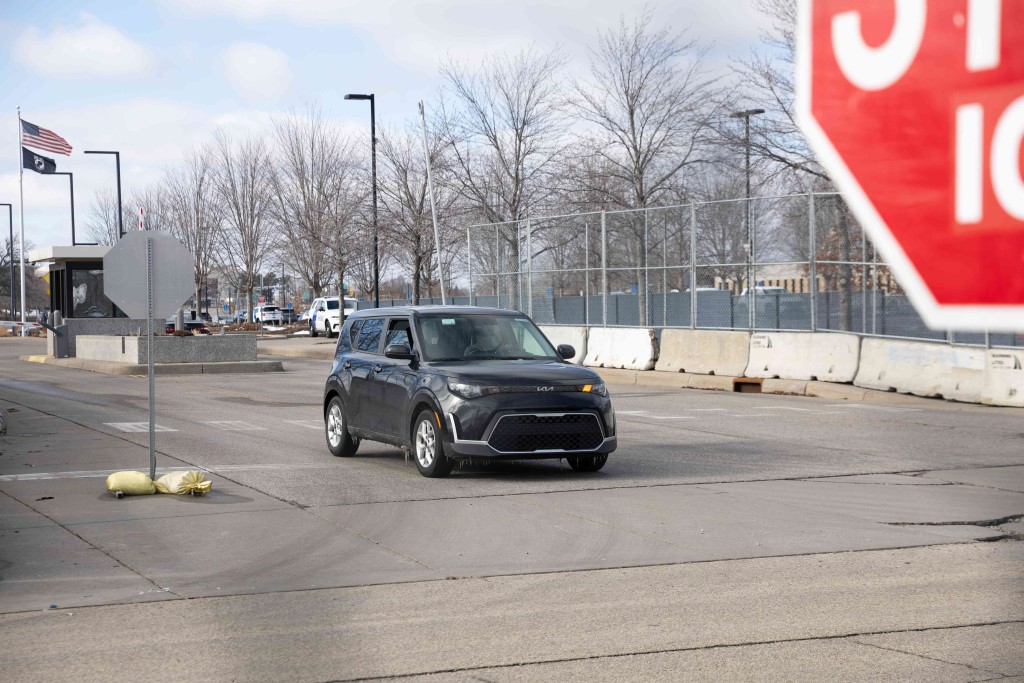
When a convoy of ICE agents left the Federal Whipple Building, the de facto headquarters of ICE in Minnesota, observers would tip off dispatchers, providing the license plate numbers of agents’ vehicles.
“If a big chunk of them left at the same time, we would obtain their plates and send those out to the rapid response networks. They would have those plates immediately, and we tried to do our best in seeing which direction they go,” said Marie Samuels*, a dispatcher. “Drivers would just immediately go follow them, but that’s extremely dangerous.”
We agreed not to use Samuels’ real name for safety concerns.
Workshops and teach-ins informing people of their legal rights and how to safely observe ICE raids took place across the Twin Cities. Immigrant Defence Network claims to have trained at least 30,000 Minnesotans in “constitutional observing” since December 2025.
Conducting legal observation of ICE was and remains a high-risk activity. Both Good and Pretti were doing so when they were shot and killed by federal agents. ICE agents have been documented systematically following legal observers home in an effort to intimidate them. They have routinely drawn guns at legal observers in their vicinity to these same ends.
J*, a legal observer, told me he was cornered and threatened by agents who pulled long guns at him after they’d had enough of his presence around their operations. “I had been following them a little too closely … they all trained their guns on me.”
J’s name has been altered for safety concerns.
Samuels also heard first-hand accounts of ICE agents following observers home. She said that officers would “keep going back” to the addresses of observers, “and just keep stalking them.”
Beyond surveilling and tracking agent activity, the resistance also encompassed logistics and support tasks, like “delivering food to people who are taking shelter in place and cannot leave their houses for the fear of ICE.” That’s according to Sima Shakhsari, an associate professor at MNU. They added: “Mutual aid efforts, such as raising funds for people to pay rent, or pay for their cost of living while they can’t go to work and legal support for people who need it.”
Shakhsari began holding classes online as the threat of ICE increased and has vowed to keep doing so “for as long as people feel unsafe and for as long as ICE is still detaining people and attacking people.”
The threat to students on MNU’s campus was heightened by the constant presence of ICE agents on its property. MNU had leased one of its buildings to the hotel chain Hilton, which operates The Graduate, where ICE agents were known to be staying. The building became a site of constant noise-making demonstrations to prevent agents from sleeping. Activists brought drums, trombones, whistles, airhorns, pots and a range of sonic implements to immiserate federal agents within. Several larger demonstrations occurred at the site, leading to waves of violence from ICE and local police.
Some municipal politicians also attempted to have the liquor license of The Graduate’s hotel bar revoked on the grounds of safety. The attempt failed (5-8) in the Minneapolis City Council.
Whipple
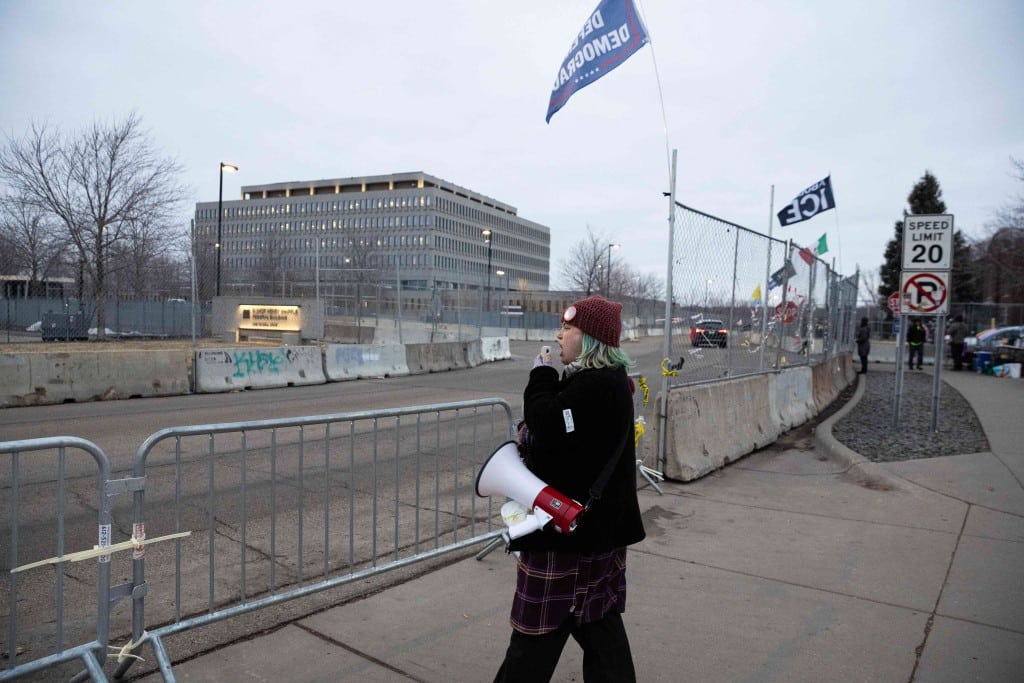
The Bishop Henry Whipple Federal Building has emerged as the site of persistent demonstrations since Operation Metro Surge began.
Activists maintain a 24-hour presence at the outskirts of the building. A smattering of volunteers wearing reflective vests, known as Haven Watch, observe the comings and goings of federal agents and detainees at the facility. Their main task is to support those being released from detention and provide them with any resources they might require, such as housing, transportation, communication or legal aid.
Provisions of all kinds are maintained in bins and a portable table. Extra socks, gloves, heating pads and clothing. Food, water, energy drinks and instant coffee. A whiteboard fastened to a chain-linked fence indicates any shortages of goods. People stop by throughout the day to drop off donations.
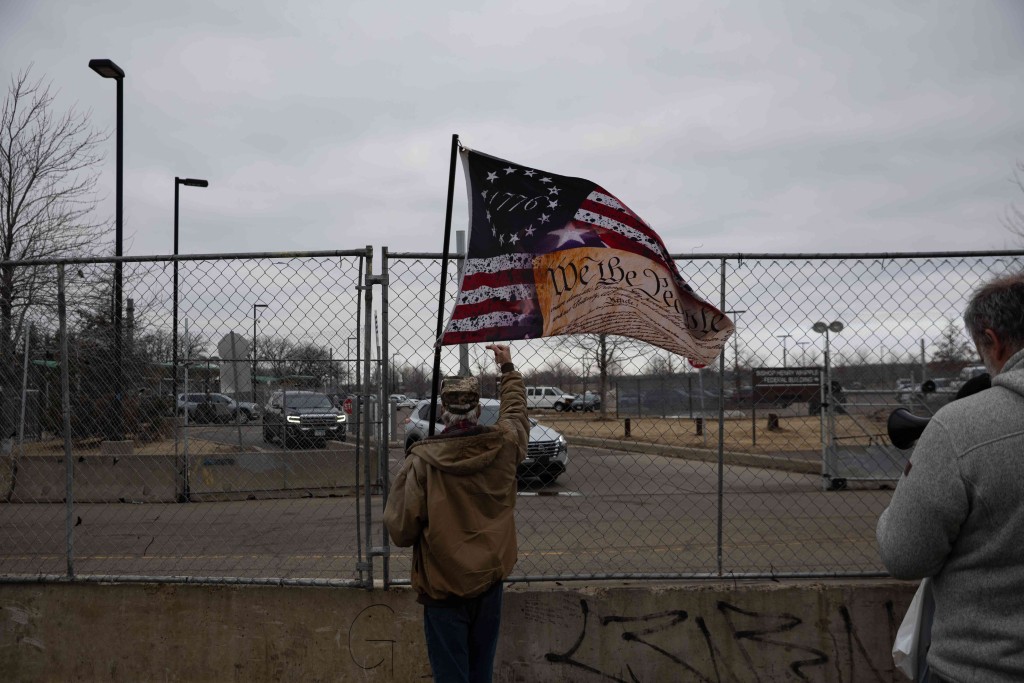
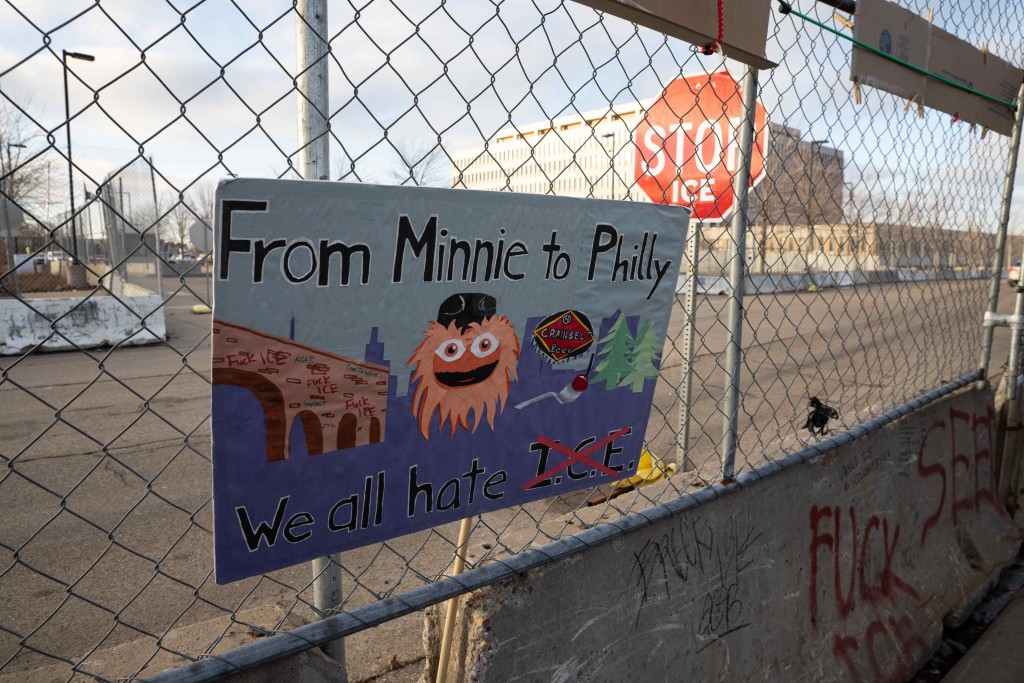
A more informal, autonomous group of activists visits the building throughout the week to berate ICE agents as they go to and from the facility. The agents are easily identifiable by the full-faced masks and heavily tinted windows of their vehicles. These activists insult ICE agents through booming loudspeakers and blow whistles in their direction from behind extensive temporary fencing, lined with flags.
“You fucking piece of shit,” the “anti-fascist clown” in face paint screamed through a loudspeaker at a masked ICE agent driving out of the facility.
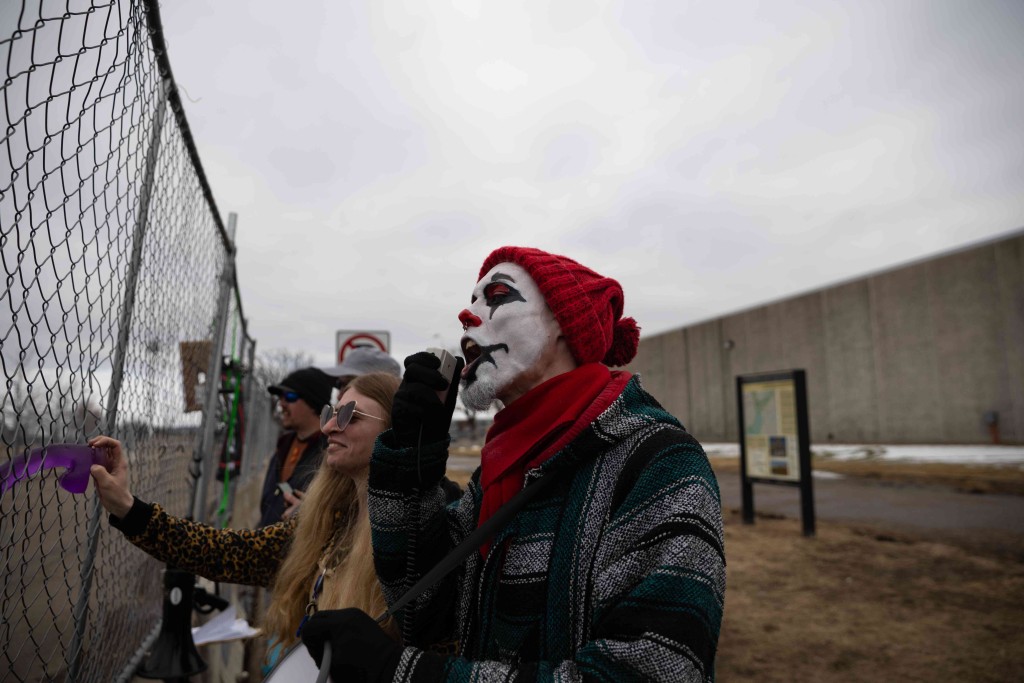
“Nazis, fascists, pedophile protectors!” another bellowed.
Temporary fencing, erected in January by the federal government to prevent activists from impeding ICE vehicles, added another border to the grey dystopic scene.
Some activists pop over after work for two hours to let their thoughts about ICE in their state be known to the agents themselves as they leave Whipple. Others come after a day in class, spending two or so hours voicing themselves before heading home for dinner. Personalities range from leftists with coloured hair, queer folks, a 60-year-old US Army veteran, gun-rights libertarian types and run-of-the-mill liberals. The threat of ICE has forged unlikely alliances.
Many of the drivers, some heading to the tennis facility nearby, gave a sustained middle finger towards the Whipple Building as they drove past it. Others honked and smiled in support of the demonstrators.
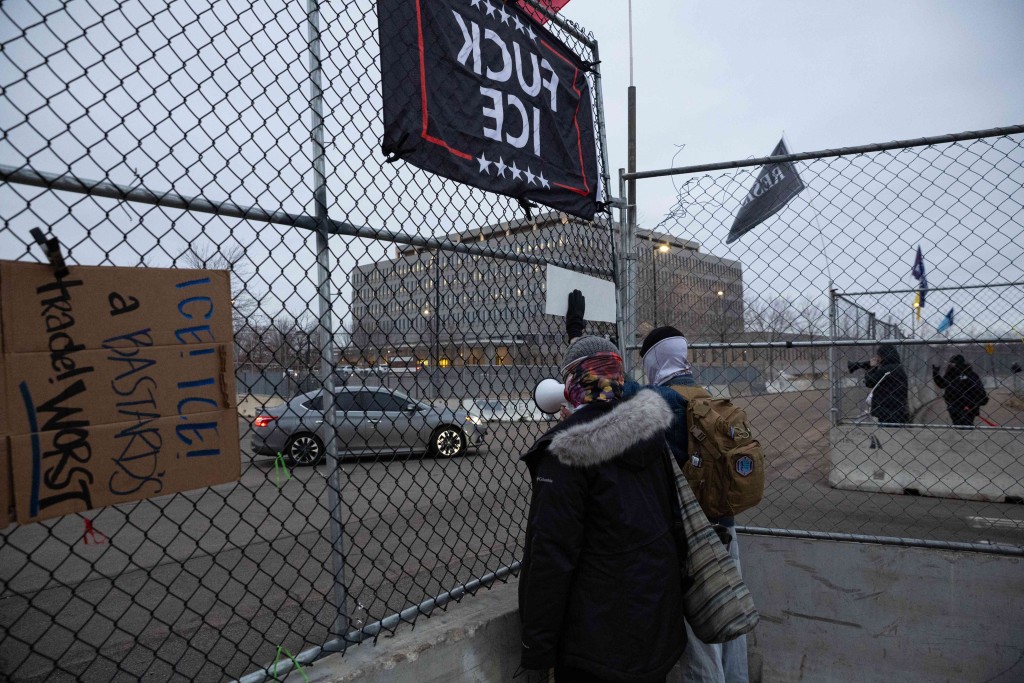
At Whipple, J told me he doesn’t identify as an activist, but feels as though his frequent involvement in anti-ICE resistance is a duty. He couldn’t live with himself if he didn’t do anything. As a local boxing coach, he said the radicalizing moment for him was when one of the kids he mentors was assaulted outside his high school by ICE agents. “That’s when the gloves came off for me,” he said, the rage rising in his tone. “It became obvious that they were just racially profiling people.”
Members of his family were also targeted by the indiscriminate raids: “They started picking up Native Americans. Like, my sister-in-law, an Ojibwe woman.”
A blue woollen scarf was tied around his lower face, concealing his lower face. He took it off. “I don’t even know why I’m trying to hide my face anymore,” he said, exasperated. “These dudes have scanned my face like three times.” ICE has boasted about creating databases of “domestic terrorists” to track legal observers and protesters alike.
The Whipple Building is located on the grounds of Fort Snelling, a centuries-old US Army installation. The fort became an infamous location in the US-Dakota War in the county’s genocidal campaign of territorial expansion when the US Army forced more than 1,600 Dakota women, children, and elders into an internment camp at the fort during the harsh winter of 1862–1863.
Most prisoners were killed by disease, hunger and exposure. The remaining survivors were expelled by the Army and forcibly resettled in reserves west of Minnesota. Thirty-eight Dakota men detained in Fort Snelling were found guilty in a military tribunal and executed.
The event was the single largest mass execution on American soil.
The site’s historical significance was not lost on the activists there.
“This was a concentration camp,” Said J. “The layers of irony there… It’s just too fucking much.”
Small yellow, red, black, and white ribbons flew gently in the late winter winds, tied to the temporary fencing erected around the perimeter of the Whipple Building. They had been placed by people of the Dakota tribe, who, on February 7, 2026, held a ceremony to commemorate the losses of their ancestors in the Dakota War.
“It’s just repeating history. The government stealing families, stealing kids,” a member of the Dakota tribe, Brian LaBatte, told the Minnesota Reformer. “I mean, they’ve done it to us already.”
Politicization of the youth
Anti-ICE mobilized countless new forces to take to the streets and organize. Many of whom had never engaged politically in their lives.
“We have gotten in a lot of trouble with our parents for the things we’ve been doing,” Alexis, a high school senior, told me with a smirk, describing her and Natalie’s efforts to track and follow ICE operations throughout their neighbourhood. “We would find the location that ICE were in, and we would just go.”
Their efforts to observe ICE as a duty to their families and their immigrant neighbours. “It’s very personal for me,” said Natalie.
Recalling Trump’s first election in 2016, when she was a kid, Natalie said, “When Trump first got elected, I remember in my art class, my mom’s Costa Rican, and I mean, I was young. I didn’t understand what was happening. I remember drawing a picture of her getting on a plane and me and my dad watching and we’re all crying because I was so scared of her getting deported.”
They detailed how day-to-day life changed after the beginning of Operation Metro Surge: “It was a very collective anxiety.” Natalie recalled, “Whenever we left our house, whether we were going to the store, or school, or anywhere, you would notice, like half the cars on the road were these giant blacked-out Suburbans.”
ICE maintained a presence around elementary schools and high schools in the Twin Cities, “Especially our school, because we have a really high percentage of immigrants. ICE would be tracking us, they would be following us from school to wherever.”
On one occasion, while observing ICE, Natalie and Alexis witnessed a standoff. “There was one night that we saw on Signal that there was an emergency. It was at a Taco Bell in Minneapolis. ICE had been circling the parking lot for hours, waiting for people to come out.”
The situation escalated: “One agent was driving and another was at the back of the car holding out pepper spray and shielding his face from behind, prepared to spray.”
“A group of people gathered there with whistles, just kind of hounding them off so the people that were working could leave, like, safely.”
Ultimately, ICE backed off.
Apart from the more dangerous activities of observing ICE, the pair have also helped their community in the more mundane tasks of life, upended by ICE’s occupation. “I would offer rides and stuff for their parents or them. It brought people together in the sense that I wouldn’t talk to these people in a million years regularly, but now we have a joint, collective idea that we both agree on.”
These ordeals have utterly upended their adolescence. “It was so hard to want to go to school because the second I’m out of school, I’m at the Whipple building, I’m at a protest, I’m passing out flyers. That was my whole life,” said Natalie.
Alexis butted in: “I would say we don’t have much of a social life outside of that, necessarily. It was very, very kind of one brain, one mind, one thought. I think kind of the collective thought was like, ‘How can we focus on school when this is happening after school or in school?’”
“It is so hard to sit there in school and focus when we have no hope for the future.”
Political futures
Collective efforts to oppose ICE operations have produced new coalitions across a disparate range of politics and identities.
The diversity of solidarity around this one major issue has provided a window into potential political futures for the state. Existing organizations such as the Democratic Socialists of America (DSA), which have been involved in mobilizing against ICE, have sought to channel that momentum into a broader agenda to improve the lives of everyday people. Through on-the-ground community engagement and the long game of organizing, the DSA is working towards sustaining surging working-class energy into positive political change.
Aminah Sheikh, a member at large of the Twin Cities DSA, posited that recognizing the broader context of the ongoing crises of capitalism is important to understanding this moment. With a history in union organizing and labour agitation, Sheikh saw the sharp rise in ICE activity as an offensive by the capital class. “It’s not just an attack on immigrants; it’s an attack on the working class, the working poor and the unhoused.”
Operation Metro Surge, in her view, was designed “to create chaos, to create division and to terrorize people.”
The most effective defence is organizing sustained networks that can oppose threats to the working class from workplaces to the seats of elected office.
In this task, the Democratic leadership has failed to meet the moment, argued Craig Wymore, membership coordinator and member of the Twin Cities DSA steering committee.
“(They have) fought back on effective strategies against ICE every single time,” argued Wymore, noting that the Democratic Party-backed Minneapolis Mayor Jacob Frey vetoed an eviction moratorium introduced by DSA-aligned municipal councillors to soften the burden of the eviction crisis caused by ICE. “The Democratic Party is running so frequently at the behest of whoever pays them the most money, so it’s very difficult for DSA and those with people-oriented politics to take foot. It is hard to fight $4 million of PAC money coming to Mayor Frey’s office in the most recent election.”
The Democratic Party establishment-aligned candidates relied on large donors from real estate, building developers and PACs (political action committees) with a sizable party staffing network, while the DSA Twin Cities has relied on small individual donors and a grassroots volunteer base.
Despite gaping funding disadvantages relative to the Democratic Party’s sizable donor list, the DSA has mobilized its membership to organize door-knocking campaigns, lobby for political change, and endorse candidates who espouse its values.
“We’ve been pushing hard to get more and more people involved in the political process.”
“We want victory for the working class,” added Sheikh.
Shifting strategies
The firing of Bovino in early February, DHS’s Kristi Noem in March and the drawdown of ICE agents in the Twin Cities provided brief victories for Twin City residents. The reduction in the overall number of raids was a defeat against ICE, but not a total victory. Minnesotans remain highly vigilant of future federal incursions and the ongoing nature of ICE’s activities in their state.
Anxiety, suspicion and the lingering trauma of ICE’s occupation still permeate the community.
Dr. Shakhsari argues ICE altered its strategies to be more effective in its immigration raids. Rather than executing performative raids that attract the attention of activists and media, they’re shifting to more undercover, clandestine operations.
“They cover up their license plates, or they put fake license plates (and go) in plainclothes. They try to appear like they’re not ICE agents, and they try to avoid crowds as much as they can.”
“They’re just changing their image and representation so that they’re not traceable by the activists. And there are still arrests happening, less so maybe in the Twin Cities proper, but more so in the suburbs and other parts of Minnesota.”
For the large Somali community residing in Minnesota, the fear of their own federal government hasn’t yet subsided. President Trump’s fixation on those of Somali origin in racist tirades has had pernicious impacts on their livelihoods. “There’s something in the back of our minds that’s saying this isn’t over yet,” said Munye of the Somali Student Union at MNU.
“I know friends who don’t even go to work anymore. If they can work online, they’ll work online. I also know people that have either taken leave from their jobs or just quit their job saying, like, ‘Hey, I can’t come in.’”
Despite the reduction in the number of abductions in February, said Munye, “There are still a lot of people that are still scared.”
ICE’s cenotaph
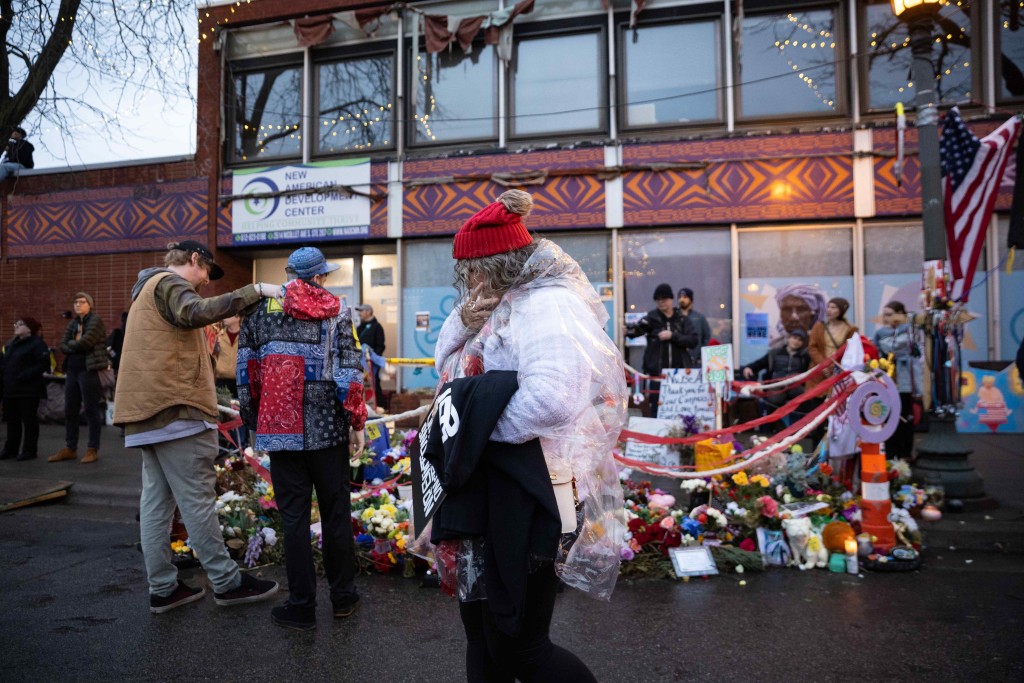
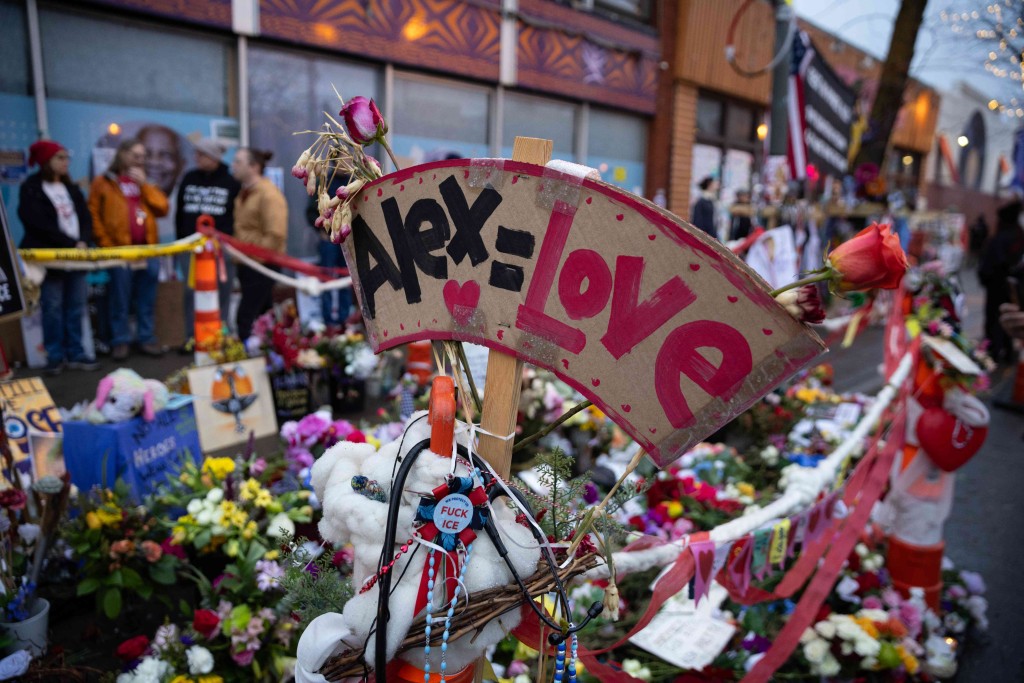
The scent of fresh-cut flowers in the wet spring air greeted visitors to the memorial of Alex Pretti. The weight of the historical moment and the significance of Pretti’s sacrifice to defend his neighbours didn’t seem lost on those who had come to pay their respects.
Just over a month later, in the place of his killing, a sense of quiet, contemplative gravity mixed with a heavy charge of moral outrage. The emotional impact of the site still summoned tears and comforting embraces amid a light rain misting the many objects of remembrance. The quiet anger of collective trauma met with the gratitude of martyrdom.
The memorial, a symbol of a vision for a world not yet realized.
Author

Related Articles

La « mort sociale » des femmes musulmanes au Québec
Confrontées à des pertes d’emploi et à des atteintes à leurs droits garantis par la Charte, des musulmanes s’interrogent sur leur avenir dans une province où elles se sentent isolées et en danger.
The “Social Death” of Muslim Women in Quebec
Beset by job losses and attacks on their Charter rights, Muslims ponder their future in a province that’s left them feeling isolated and afraid.

Live from the Fall Classic: Game 7 with The Rover
Cheering for Canada’s Team in the World Series was a balm for my soul. But no matter what, my heart will always belong to the Expos.
Comments (0)
There are no comments on this article.