
“How Many Mothers Have You Made Cry?”
In Montréal-Nord, a community rises up against police brutality and racial profiling.
Lisez cet article en français.
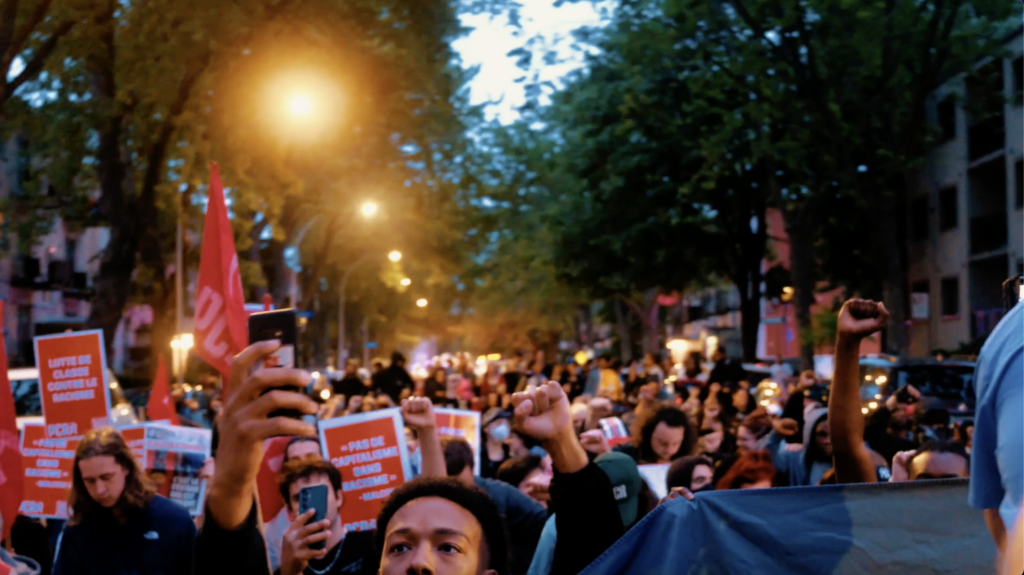
The officers smashed their shields and batons in unison, sending a chill through the crowd.
If the rattle of weapons was meant to back them off, it had the opposite effect. Dozens more protesters pushed towards the column of riot police, determined to march on.
They had gathered outside Station 39 in Montréal-Nord on Monday, just days after the borough’s entire night patrol was sidelined over allegations of racist violence. Chief among those claims was that officers were ripping locs from Black men’s scalps and collecting them as trophies.
Support your local indie journalists
Of the 16 cops taken off the front lines, two are facing possible criminal charges from Quebec’s crown prosecutor. They had faced complaints from citizens, but it was the testimony of their fellow officers that ultimately tipped the scales. Mayor Soraya Martinez Ferrada has called for an independent investigation into the allegations. She’s also promised to fast-track the outfitting of body cameras on Montreal’s roughly 4,500 police officers.
But at the corner of Pascal St. and Langelier Blvd. — as police stood face to face with a community on the edge — the mayor’s words rang hollow. A young man in locs and a tracksuit grabbed a bullhorn and turned to the crowd.
“We’re going to pass by them calmly, no ruckus, I don’t want to see any construction signs turned over,” said Samuel Bunche, a professional kickboxer who grew up in Montréal-Nord. “We’re going to pass through, but we’re going to do it the right way. Even though we’re going through a lot right now, we’re going to show them.”
If any of these protesters had a reason to be angry, it was Bunche. In the spring of 2020, Laval police beat and humiliated him in front of his family. After Bunche repeatedly asked why an officer wanted him to step out of the car, he was pulled out by his hair, kneed in the stomach and punched in the back of his head while he lay face down on the sidewalk.
“It was denigrating, dehumanizing, it’s like you have no dignity at all,” Bunche told me, before the standoff. “It’s something I live with every day of my life.”
On the night Montréal-Nord marched against the police, Bunche was a leading voice for calm. So was former Montréal-Nord mayoral candidate Anastasia Marcelin, who stood down police and negotiated with them as the protesters grew restless.
Marcelin grabbed the megaphone.
By now, the crowd numbered in the hundreds; a social worker who’s been beaten by the cops for “refusing to comply,” a nurses’ aide who remembers being handcuffed to a city bus over a case of mistaken identity, and an elderly man who says he gets pulled over dozens of times a year for being Black while driving a fancy car.
None among them had seen a shred of justice for the humiliating ritual of police repression. They had been told, time and time again, to be patient, to trust the process, to give the police yet another chance to reform their behaviour.
There was little appetite for the feigned surprise of politicians and the promise of another internal investigation, another community outreach program and another smiling police chief.
“We want their fucking names,” someone yelled. “Give us the officers’ names.”
As Marcelin paced between the cops and the crowd, she would implore her neighbours to give patience one more try.
“Nothing has happened so far, we have secured the police, we have avoided a ruckus because they take us for savage beasts,” said Marcelin, a mother and community organizer. “But we are human beings.”
The crowd erupted.
They had marched from the police station along Henri Bourrassa Blvd., chanting for justice as they passed car dealerships, garages and low-rise apartments with Haitian flags hanging from balconies. At least 100 police officers flanked the crowd on bicycles and in patrol cars, but aside from a few young men yelling, the crowd mostly ignored the cops.
When they tried to turn down Pascal St. at dusk, the police made their presence known.
This was more than a mere disagreement over the protest route. Marcelin and the organizers wanted to make their way to the park where police gunned down Fredy Villanueva 18 summers ago.
Villanueva was a teenager when they shot him to death. He wasn’t armed or participating in any crimes. He was playing a dice game with his older brother and some friends outside the local skating rink. That’s when the police moved in to question the group, causing Villanueva’s older brother to walk away.
In the ensuing struggle to subdue the brother, Const. Jean-Loup Lapointe shot Fredy to death. A coroner’s inquest ultimately found that Villanueva hadn’t even touched the officer or his partner. He was just trying to diffuse the situation.
Neither Lapointe nor his partner was punished for the killing of an unarmed teenager.
In fact, the investigation into Villanueva’s death was so badly botched that it led to the creation of the Bureau des enquêts indépendantes (BEI), which provides civilian oversight when the police investigate themselves for violence. But if the BEI was meant to inspire confidence in the judicial system, it has fallen short. Of the 56 fatal police shootings investigated by the BEI since it was launched in 2016, not one has resulted in disciplinary sanctions.
Dardia G. Joseph works at a legal clinic in neighbouring St-Michel, where the borough’s Black residents experience racial profiling on a daily basis. Police in Montreal are four times more likely to stop Black men than whites, according to the department’s own statistics. A 2024 Superior Court ruling found Montreal police engage in “systemic” racial profiling. But of the nearly 500 racial profiling complaints made against the police force each year, less than 2 per cent result in a sanction, according to the St-Michel Legal Clinic.
Just last year, a 30-year-old Latino man was slowly choked to death in front of his family.
The man, Abisay Cruz, was unarmed and going through a mental health crisis when police subdued him and put their knees on his back. Despite repeatedly telling them he couldn’t breathe, the cops never moved. Cruz died calling out for his mother. Not one of the officers who killed him faced so much as a paid suspension.
So when Police Chief Fady Dagher told reporters last Friday that he was surprised at the latest allegations, Joseph says it’s not a particularly compelling argument.
“The question of ignorance, from our public officials, is it even true?” Joseph said. “And if he didn’t know, if he was really surprised by the allegations, should he have known? I think we need to take a serious and critical look at the police chief’s apparent ignorance of this problem. Because it’s definitely not news to the members of our community.”
Perhaps more galling than Dagher’s ignorance is the reaction from the highest echelons of Quebec politics. When Christine Fréchette was asked by Radio-Canada about the allegations of racism facing 16 officers, the Premier continued to deny the existence of systemic racism inside Quebec’s public institutions.
At the front of the police column Monday, Marcelin convinced the cops to turn around and let the 500 or so protesters walk on. The standoff lasted just a few minutes but there were so many ways it could have erupted as night fell over the borough.
After they shot Villanueva in 2008, mourners outside a vigil for Fredy clashed with police, torching cars and setting bonfires on the streets of Montréal-Nord. The riot squad also tear-gassed protesters last year during a march for Cruz. There have been countless instances of collective punishment against the community in retaliation for a rock thrown or a window smashed.
“The police never miss a chance to show you they have a monopoly on violence,” said Rayan, an Arab youth from the borough. “They get transferred to a new station for killing someone. We get lit up by tear gas and rubber bullets for breaking glass.”
On at least two occasions, Marcelin shouted down teenagers who tried to antagonize the cops, going so far as to grab them by the arm and look into their eyes. It worked every time. But Marcelin let the officers have it as well.
“You fucked up our kids, you made them aggressive,” she yelled through a black megaphone. “They have mothers, they have fathers, they have families. Police, when you hurt them, you’re destroying entire generations. Why? Because the boys whose heads you’re fucking up, they fall into banditry. You start early, you start harassing them from the age of 12, you ruin them.
“Station 39 fucked up one of my brothers. How many mothers have you made cry? How many families?”
When they arrived at the site of Villanueva’s killing, Stephanie Germain stood on a park bench and grabbed the megaphone. First she wanted them to observe a minute of silence for all the people of colour who’d been killed by cops across Quebec.
There was, of course, Villanueva and Cruz, but also Nooran Rezayi — a 15-year-old shot dead for reaching into his backpack on a sidewalk in Longueuil last year.
Ronny Kay was killed by Montreal police in 2022 while holding what appeared to be a gun. He was unarmed. So was Joshua Papigatuk, who was shot to death next to his twin brother Garnet during an intervention by the Nunavik regional police in 2024. Alain Maglore, Quilem Registre, Bony Jean-Pierre and a list of names that goes all the way back to Anthony Griffin, who was shot while running away from a Montreal police officer in 1987.
The minute passed, and Germain got on the microphone.
“Montreal-Nord raised me, and when I walk through these streets I remember all the good and bad memories,” she said. “Unfortunately, the police were part of many of those bad memories.
“We’ve always thought the system doesn’t work. But it turns out that it depends on who is speaking up. What did we learn from this? We learned that it was the police who denounced their colleagues. And then what happened? Suddenly the system worked.
“When the victims speak out, when the victims denounce, who listens to them?”
“No one!” the crowd roared back.
“Exactly. Let’s remember that. Let’s remember that we have a two-tiered justice system, one where the victims (of police violence) don’t have a voice, but the police always do. That is what I’ve been thinking about lately. That’s what I’m struggling with.”
Check out the June 21 episode of The Week Is Rover, where we’ll delve into the allegations coming out of Station 39 in Montréal-Nord, the community’s response, and the political fallout. Subscribe to our YouTube channel to make sure you don’t miss it.
Author
Related Articles
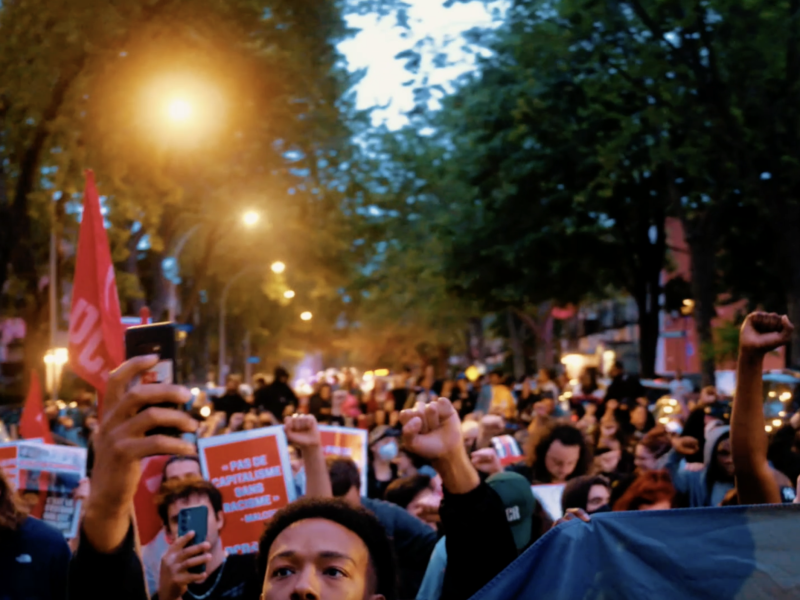
« Combien de mères avez-vous fait pleurer? »
À Montréal-Nord, la communauté se soulève contre la brutalité policière et le profilage racial.
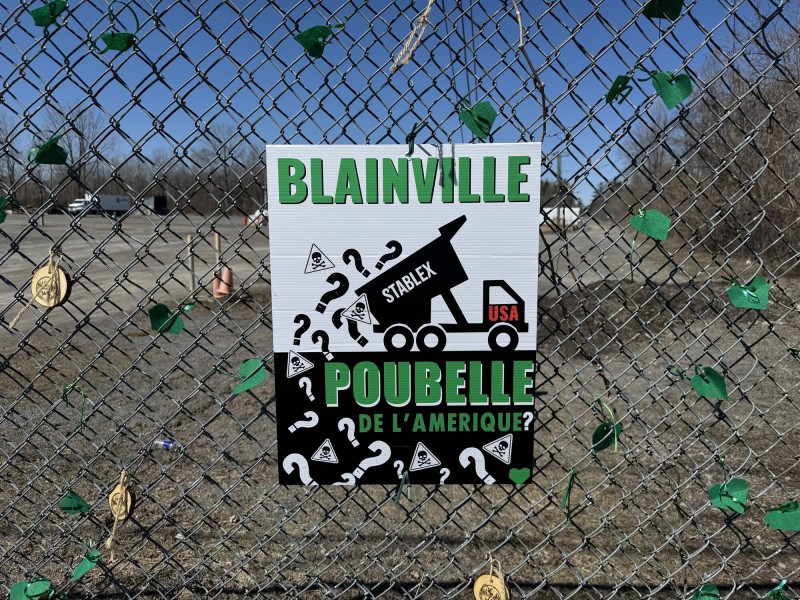
Blainville Teenager Takes Stablex Fight International
After concluding that local avenues had been exhausted, a 14-year-old Blainville resident has brought the fight over the Stablex hazardous waste expansion before the CEC, an international environmental body established by Canada, the United States, and Mexico.
Stripper Strike Provokes Internal Discord, Media Circus — and Worker Mobilization
While the majority of strippers did not strike on May 23, sex workers report feeling motivated to continue the fight for labour rights.
Comments (0)
There are no comments on this article.