
“How Come I Didn’t Die?”
After 25 years of pro wrestling, “Sexxxy” Eddy Dorowzowski talks about suffering for his art and finding himself in the squared circle.
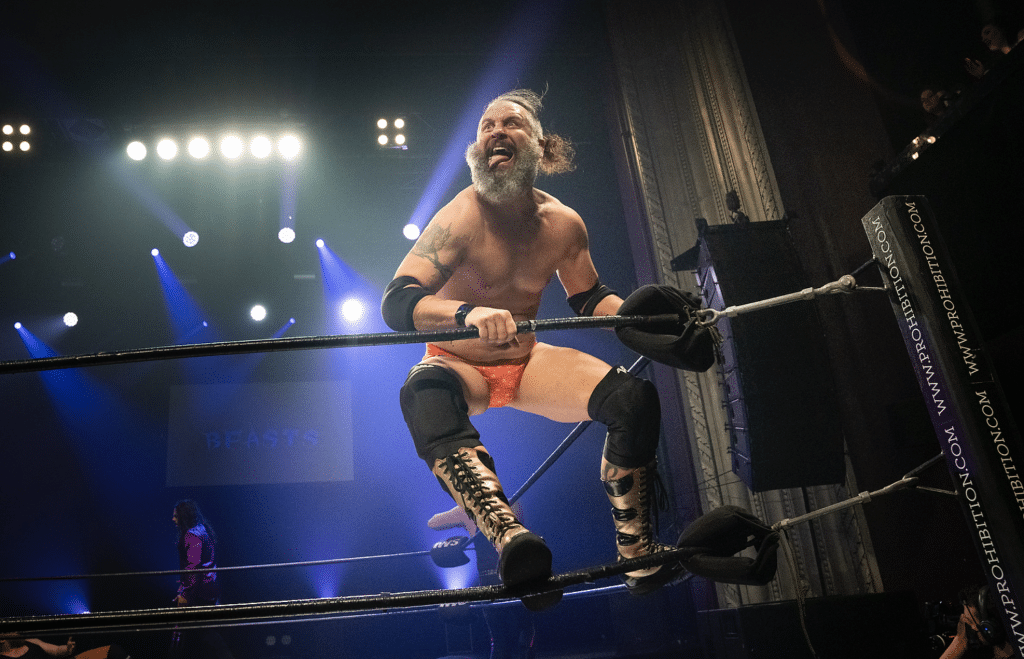
Sexxxy Eddy plays for the crowd at Olympia Theatre. PHOTO: Vincenzo D’Alto
When I was 17, I took a girl to see professional wrestling.
She went to a private Catholic school in the city, the kind with iron gates out front and a rugby “pitch” where the football field should be. And though she lived among us townies, I cannot begin to describe the culture shock this poor girl was subjected to at Tournament of the Icons. That night, my date watched half naked men stand in the arena and cut each other open broken glass.
We didn’t end up dating much longer.
That was the first time I saw an International Wrestling Syndicate show. Back then, the IWS put on matches in basement pubs and high school gyms but once a year they took a big swing.
For their yearly Tournament of the Icons, the syndicate enlisted a couple of aging superstars to draw in those of us who used to rent early Wrestlemanias on VHS. Once we were in the arena to see old Jake “the Snake” Roberts or old Brutus “the Barber” Beefcake or old Jim “the Anvil” Neidhart, they had us right where they wanted us.
Because while you sat and waited to see Beefcake relive his glory days, you got to see the best wrestling Quebec had to offer.
The IWS celebrated 25 years in the business last Saturday at Olympia Theatre downtown, making it one of the longest-running promotions in North America. Over that span, the Montreal-based IWS went from putting on shows in parking lots to launching the careers of two World Wrestling Entertainment champions. There have been IWS wrestlers headline shows in Japan, Mexico, England and across the United States.
One of its most travelled veterans, the 45-year-old Eddy Dorowzowski, sat down with The Rover before Saturday’s big show to talk about two decades of life and near death experiences in the ring.
By day, Dorowzowski works as a mover at Concordia University. On weekends, he becomes “Sexxxy Eddy”, an oiled up brawler known who can play his over the top sexuality for laughs while putting himself through hell to give the crowd an entertaining match.
The Rover: There’s this story about how the IWS started to break through to audiences in the United States because of you nearly bleeding to death at a show in the states.
Sexxxy Eddy: It was at a deathmatch at Combat Zone Wrestling in Delaware. Just like regular pro wrestling, the outcome of a death match is predetermined but a lot of the violence is real. There’s gonna be thumbtacks, there’s gonna be barbed wire and glass tubes, there might be fire. There will be blood, though, that is a guarantee. It was, in my case, this tiny shard of glass that pierced an artery in my arm.
Accidents happen, we know that, but this was pretty gruesome. The blood was squirting out of my arm like a fountain and, when I made a fist, the blood would go higher. So I controlled it and aimed it at my mouth and so the cameraman got a great angle and he started to squeal. You can actually hear it on the video. It went viral just as things started going viral on the internet. I didn’t know what that meant, “to go viral.” It was in Smyrna, Delaware. Certain states have certain laws about what weapons you can use. But some states, like Delaware, they don’t give a fuck. They let you do what you want.
TR: What are the weapons you can’t use?
SE: In Philadelphia, I think it’s glass that’s banned. Or is barbed wire? In New York, they check your pulse and blood pressure before you can compete.
TR: In Delaware you can just roll off a barstool and bust each other up with glass tubes?
SE: It was really secretive. Almost like Fight Club. People bought tickets but they didn’t announce the location until a few days before the fight. Like, we knew what state it would be in but that was it. Because, sometimes, rival federations would catch wind and call the cops to have the event shut down.
It would be in a field, a random warehouse, somewhere off the beaten path. You know how they used to have these secret illegal raves? Well it’s like that but with people beating the shit out of each other.
Here in Montreal we always had these 18 and over shows because there’s blood in the main event. Down there, there’s kids in the crowd, I remember a dad telling his 8-year-old, “Look, I got blood on my shirt! I’m gonna get this autographed.” It’s not called tournament of life, it’s Tournament of Death.
These were entire events based around death matches. At IWS we would have just one and it was always the last fight of the night. Even if we’d get a big star from the WWE, he’s not headlining because if there’s a death match before he goes on, there’s gonna be broken glass everywhere and he’ll get all cut up. Bad for business.
But now, we’re on Triller TV, Netflix is gonna be at the show Saturday to do a documentary series on indie wrestling. It’s still crazy to see something that started on gym mats and at barbecues, continue to grow 25 years later.
TR: When you were coming up, didn’t you guys make VHS tapes of yourselves and send them around to promoters in the mail?
SE: You have to travel to get anywhere in the wrestling business and you need a tape to get on the road. So you’d put together a tape of your best matches, bring it to the post office, weigh it, put stamps on it and hope the promoter opens the package. Now that it’s so much easier to shoot and send video, it gets lost in the shuffle because thousands of people are doing it.
TR: But back in the day it was a physical network of people sending and receiving VHS tapes?
SE: Back then, the people sending tapes were deadly serious about becoming wrestlers. Back then, if you wanted to see the best wrestling in Japan, you couldn’t just go online and stream it. You had to order the tapes and that’s usually how you met the tape traders. So they’d send you the stuff they had and you’d send them your tape and that would open new doors to you. It was like a secret society. And when you’re a part of it and you know your tapes have been to Japan, that’s a real honour.
TR: Do you have any idea where the tapes are today?
SE: If they haven’t been destroyed, I’m assuming they’re mostly in boxes in people’s basements up and down (the Eastern Seaboard). Maybe a few in Japan. Today, I’ll hear ‘Oh I saw your blood thing on the internet.” But at the beginning, you sent it out not knowing if it would even be opened. I kind of miss that.
TR: Where did Sexxxy Eddy come from?
SE: I just wanted to get girls. I thought, “Well if I put Sexxxy in my name and act like the wrestlers I admire, the ones that have all the girls swooning, I got this!” I was an impressionable kid, I thought maybe if I had that personna and did a little striptease, I’d get all the girls.
TR: Did you?
SE: No, I didn’t. At least not for a while.
TR: So maybe the ‘Sexxxy’ part of Sexxxy Eddy wasn’t really you at first?
SE: It wasn’t me. I thought you slap a name on yourself and you become the character. But you have to learn your craft, learn how to work the crowd, work the camera, all these little things that — when you put them together — it’s your character. It took me a while to develop this authentic charisma, to really start to win over the crowd with my presence and not just the spectacularly bloody fights.
It took years for the character to become second nature, for me to start getting the reaction I wanted when it began. Look, we started this thing thinking we’d be doing a few shows. So in every match, I wanted to do every single wrestling move I knew. I didn’t know about pacing myself, about leaving them wanting more. We had no idea what we were doing but we kept doing it.
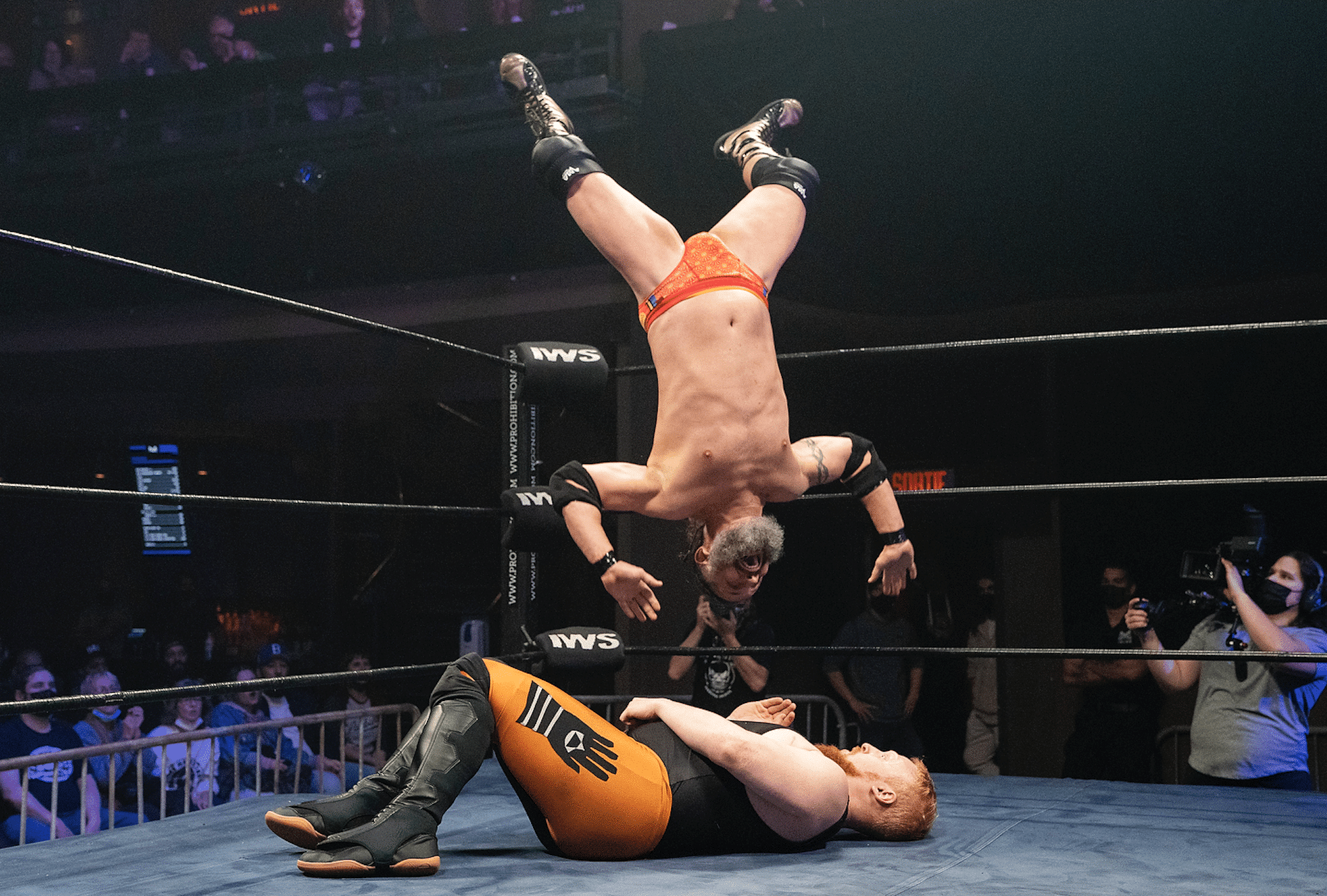
PHOTO: Vincenzo D’Alto
TR: You weren’t involved in the promotional side as much as (IWS owner) Manny Eleftheriou?
SE: No, I really wanted to be a wrestler. I didn’t want to have to chase after sponsors and book venues. And I didn’t want that conflict of interest either, being an owner and a wrestler. And even the years where I’d only do two shows for the IWS, it was still my home. It’s still the organization I’d represent if I was in Philly or New Jersey or outside a bar in Delaware.
TR: You almost become like a sales rep for IWS in the United States?
SE: Yeah, people would see what we could do — all the violence but also good, technical wrestling — and they’d say, “Hey we wanna see more of you guys.” Where can they see more? The IWS. So they’d call us again. If we shit the bed, that would have been it for us. You don’t get called back. But we bled for them.
TR: Was it just deathmatch stuff or did they actually want you to wrestle?
SE: After the blood fountain incident, they called us back down there and I brought two other IWS wrestlers. Both of them ended up in the WWE.
TR: How long after the blood fountain incident was this?
SE: I had to take a few months off because they gave me 21 stitches, they had to cauterize the artery in my arm, close the wound and stitch it on top. I thought that was it for me. I couldn’t afford to do all that training, drive eight hours, get the shit beaten out of me for almost no money.
But they called me back to do a show in the ECW Arena (in Philadelphia) and — to an indie wrestler — that place is like Mecca. The place is packed and I’d seen tapes of my absolute favourite wrestlers performing there — Rob Van Damme, Sabu, the Sandman — and now I’m a part of it. So they play one note of my entrance music and the crowd goes insane. Because they’ve all seen the blood fountain video. That’s one of my top three moments ever.
I wrestled El Generico and Kevin Steen, who both went on to become superstars in the WWE. We knew we had a good match worked out, we did things that still you can’t reproduce; the moments, the crowd, the timing of it all. We went all out, we had an absolute barnburner of a match and it still gets talked about in independent wrestling. That was the test for IWS, “They can do the blood stuff but can they wrestle? Can they entertain a Philly crowd?” Because those are some tough fans, they’ve seen everything and they will boo you if they don’t like what you’re doing. But by the end of the match they were chanting “IWS! IWS!” So much so that the promoter had to get on the mic and quiet them down. That opened the floodgates for us. From that point forward, we’d be going down for shows almost every month.
TR: How much wrestling were you doing at your peak?
SE: I think the most I did was 60 or 70 matches in a year. I don’t wrestle nearly as much as the guys on TV but the indie matches are a different kind of hard. On the big circuit, they’re wrestling the same guys all the time — which means they can develop a bit of a routine — and they’re wrestling in good, comfy rings.
In the indies, the rings are hard, the ropes are tight and you have to trust someone you’ve never worked with to keep you safe during the match. You always think, in the back of your mind, “This could be my last match because I’m putting my safety in the hands of someone who may accidentally hurt me really bad.” And because you want to leave a good impression, you take risks.
Sometimes I look back and think, “How come I didn’t die?” I’ve gotten my fair share of concussions. Way too many. Mostly undiagnosed. The stuff that we know now we didn’t know back then. We’d hit our head real bad and wrestle the next day. That’s just how it was.
TR: So you’d be travelling up and down the seaboard, wrestling every weekend?
SE: Sometimes it was three matches in a weekend. I’ve got a good catalogue of my career, the wins and losses, who I’ve wrestled and where.
TR: Do you know offhand how many matches you have?
SE: I just passed 1,000, which is pretty cool. You have to consider how many matches I missed out because of injuries and COVID-19.
TR: With the amount of travel and injuries you’re putting your body through, doing something so dangerous and exhilarating, is there a risk of getting caught up in that party lifestyle?
SE: I’ve yo-yo’d a lot.
To have a crowd of thousands booing you or cheering you on, it’s such a rush, it’s such a drug. There’s not much that compares to it. I had moments in my career where I was more my character than myself. I could just sleep with whoever I wanted to and party all night but you still have a job to go back to on Monday.
It’s like Clark Kent and Superman. You can’t always be Superman and wrestling doesn’t last forever. Especially the way we do it. There’s no margin for error. You never know if the next match will be the one that kills or maims you. That’s something you don’t want to think about.
TR: Maybe you don’t think about it but I’m sure you feel it.
SE: Every morning when I wake up. I get a lot of massage therapy and physio. They’ll say, “Hey, how did you injure THAT part of your back?” And I’ll go, “Oh that’s from when I got thrown off a balcony through some tables.”
TR: Was there ever a time where you drank too much or did too many drugs to deal with that pain? All of the flips and broken glass, when you live dangerously like that do you also party dangerously?
SE: You go through these extreme emotions. If I was born five or ten years earlier, I might have been a big star but I don’t think my star would have shone for very long. I’ve had my moments of partying hard where people in my life were telling me to calm down. Of course, that seemed to make me want to go even harder.
The older I get, the newer guys I try to keep up with but I’m 45. It takes me two days to recover from a hangover. Those guys are up all night and in the gym at 7 a.m. I’m still a kid in my brain, I still feel like a really silly person. But my body is a lot older and I’m finally starting to listen to it.
TR: I’ve seen you “electrocute” wrestlers with your crotch and do a naked backflip where you’re covering your genitals with both hands. But beneath that humour, you’re clearly someone who has put years of work on developing the technique and stamina it takes to be a good wrestler. How do you balance the humour with the technique?
SE: It’s like having different cards up your sleeve. Even if you’re the best pure wrestler, some crowds won’t respond to that. You have to be versatile. If you have a bit of comedy you can work with. If you have some stunts, some over-the-top slapstick stuff, you need to use what you can to get the crowd involved.
Now some wrestling purists will say, ‘No, this is blasphemy.’ But honestly, it’s wrestling, it’s supposed to be a bit silly. I mean, if you throw someone into some ropes, do you really think they just come bouncing back to you like they can’t help themselves? If you look at wrestling and say “You’re allowed to do this absurd thing but not that absurd thing” then I say fuck that. This is our art, it’s whatever the crowd lets you get away with it. And if no one likes it, change your brush, change your style.
TR: What are some of the things you can’t do now, at 45, versus when you were younger?
SE: I’ve had to be more selective about the kinds of big moves I do. When you’re young, you try to do every single flip you know in the same match. You’re so desperate to get noticed. But then there’s nothing left to surprise the audience with the next time.
When I went to Japan, I didn’t show my full hand of cards. I left some of the bigger spots out of my repertoire because you want to build a relationship with the audience. That happens over time. If you give them everything up front, they’ll just go get the next flavour of the week when they’re done with you.
Now, at 45, I’ll do less but when I do something it means more. Keeping up the pace is hard at my age. But the acting, the being in character and working the crowd, that is exhausting too.
TR: Is it hard to think about life after wrestling?
SE: I like my time at home on the couch with my wife and our two dogs. It takes a lot out of you to be on the road so often, to have all this wear on your body. It’ll probably be a good thing but like I said, there’s nothing in the world that compares to the feeling you get from making a crowd pop. I don’t know that anyone ever gets over losing that.
***
Author

Related Articles
‘Everybody Who’s on the Stage Is Part of Your Community’: Ctrl+Alt Festival Returns for a Third Edition
Free festival stacked with queer, local performers to take over the Place du Village July 24-26.
Des travailleur·euses du sexe de Montréal feront la grève pendant le week-end de la F1
Cette dernière initiative de « whoreganization » s’inscrit dans le cadre de la lutte des travailleur·euses du sexe pour leurs droits du travail et la décriminalisation.
‘Society Is Built to Keep Us in the Gutter’: Sex Workers in Montreal to Strike During F1 Weekend
This latest “whoreganization” effort is part of sex workers’ fight for labour rights and decriminalization.
Comments (0)
There are no comments on this article.