
Editor’s Note: Our Role in a Sputtering Media Landscape
Local journalism has evaporated and legacy media reinforces the status quo. We’re carving out our place in the vacuum.
ILLUSTRATION: Evan Goulet @evan.goulet
Rising inequality and instability: like it or not, the success of Pierre Poilievre and Donald Trump boils down to their ability to seize on people’s fears around these issues.
Because those fears are far from unfounded — half of Canadians are living paycheque to paycheque while the country’s billionaires grew their wealth by over 50 per cent since the start of the pandemic.
Poilievre and Trump have tapped into these insecurities, and the Democrats and (until recently) the Liberals were getting destroyed in the polls because they couldn’t bring themselves to acknowledge that things are not ok. Whether they are willing and able to actually meet the moment is a whole other thing, but they did put their finger on the sore spot and it’s gotten them this far.
Those fears shone through in the responses we’ve received in our reader survey.
Support Independent Journalism.
In my last column, I started going over those responses about the kind of content you want to see more of. I talked about the challenges I’ve faced reporting on housing, which took the cake for being the most in-demand subject.
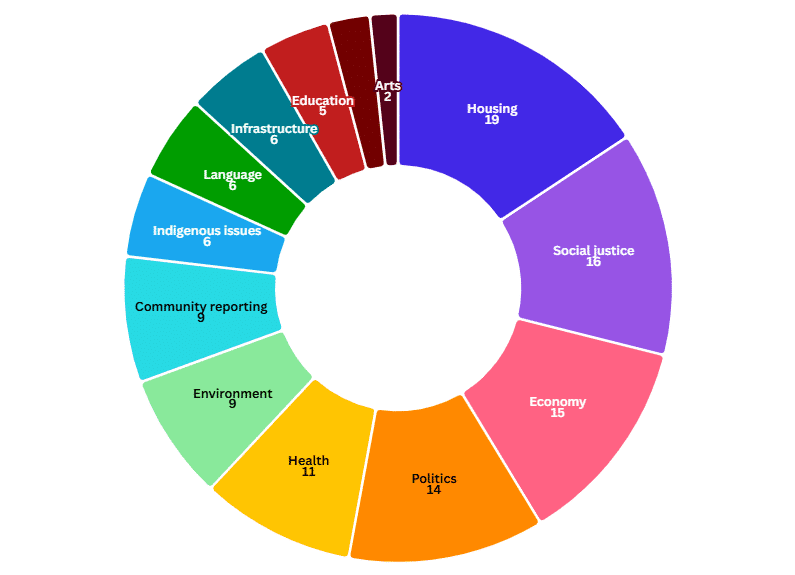
The number of responses referring to issues from each category. Responses could be counted as referring to more than one category of issues. (See methodology below). INFOGRAPHIC: Savannah Stewart
The next three categories that saw the most responses are, admittedly, sort of vague catch-all categories, that included many different issues: Social Justice, Economy, and Politics. They are also inevitably intertwined, revealing the symptoms of a much larger issue, so I’ll discuss all three together now.
Social Justice, Economy & Politics
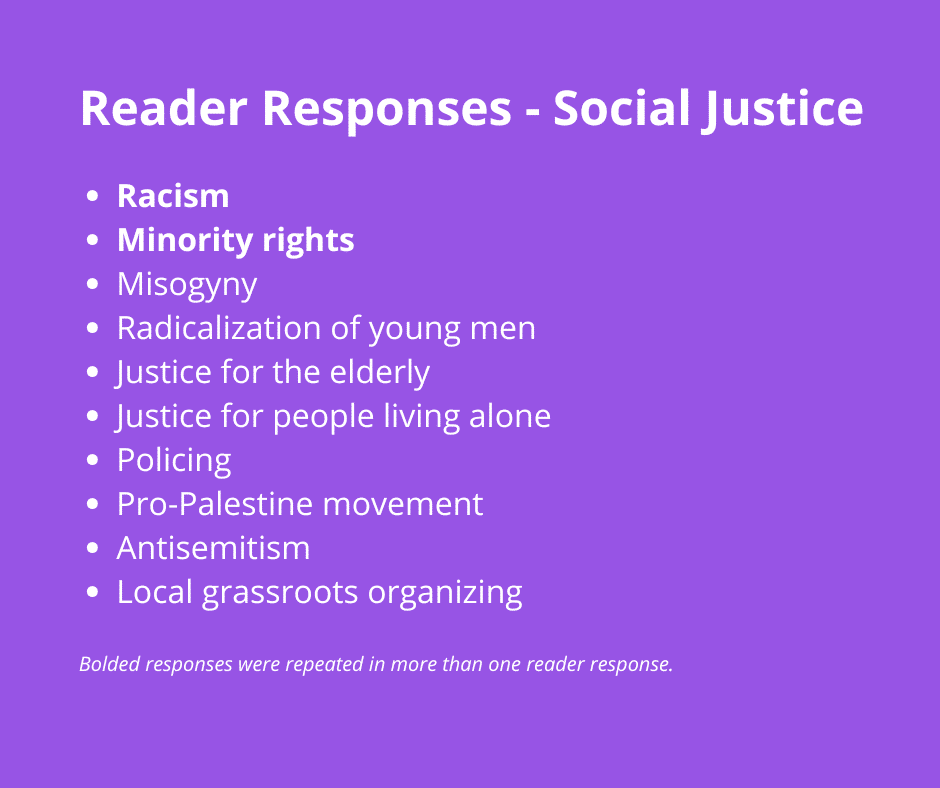
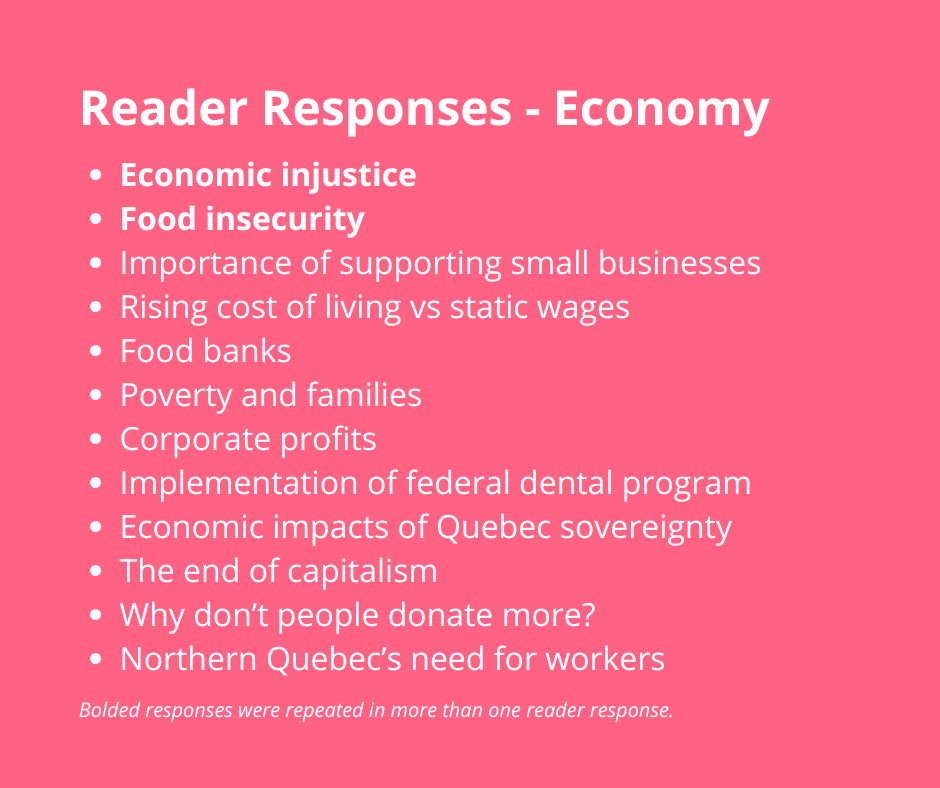
Taken altogether, these responses demonstrate to me our collective grappling with inequality and instability, here and abroad. Issues like the rise of authoritarianism and food insecurity, which I don’t remember seeing in these reader survey responses just one year ago, were each mentioned several times.
I’m reading into these responses that you also want reporting that provides a glimpse of what the world could look like if we set down a different path than the status quo. That’s the role of alternative media like ours, one that was explicitly founded to escape the effects of corporate ownership in journalism.
Pierre Poilievre is trying his hardest to make you believe that Justin Trudeau and the Liberals (and now, Mark Carney, too) are responsible for basically all the issues raised in these responses. But if the housing crisis is Trudeau’s fault, how do you explain that countries across the Western world are facing the same challenges, regardless of political leaning? The same goes for inflation, economic injustice, and the erosion of democracy.
It seems obvious to me that what we’re seeing is the natural progression of the neoliberal politics of the 1980s and onwards. The systematic dismantling of the social safety net, the deregulation of markets, and the insistence on privatizing all aspects of human activity, including access to basic rights like housing and medical care, have ushered in rampant disparity and growing polarization among the majority. At the same time, the elite minority continues to profit off the chaos that ensues.
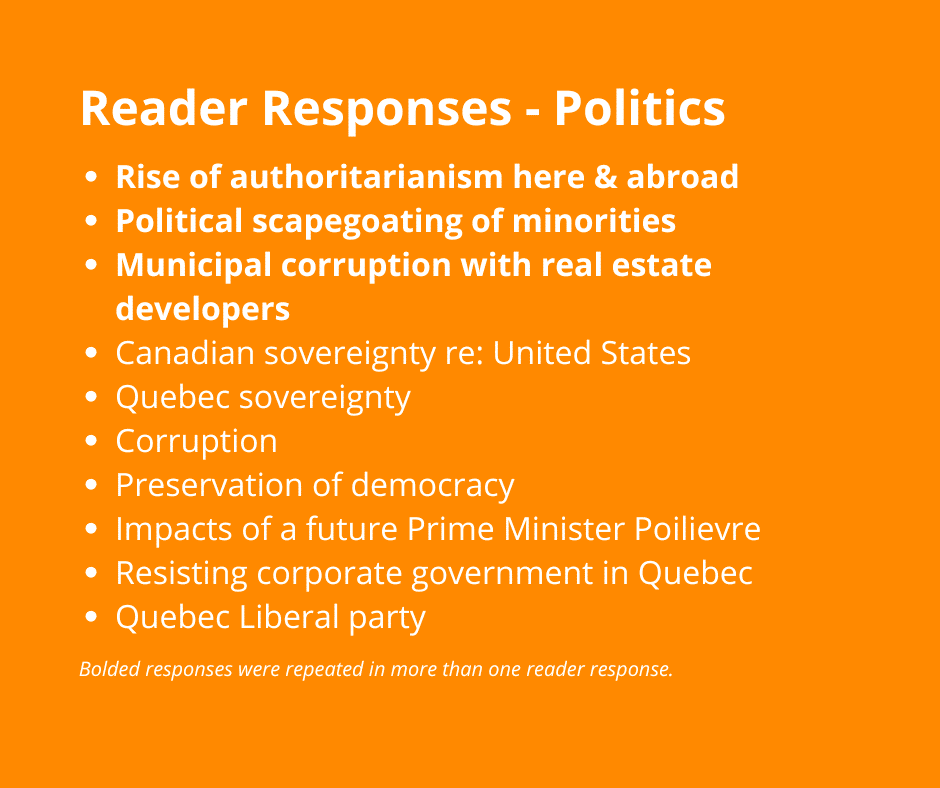
Essentially, I see the issues raised as the symptoms of a system working exactly the way it is intended.
Journalism and Neoliberalism — and Where The Rover Fits Into the Picture
Neoliberalism is like the federal government doing a land acknowledgment while arguing, in court, that it’s not Ottawa’s responsibility to provide First Nations with clean drinking water. It’s the Quebec government’s proclivity to underfund social services so that it can make the case for privatization. It’s the co-opting of social movements for capitalist gain and the prioritizing of shareholders and the bottom line over anything else, including human dignity.
Traditional journalism has done its part to help along the deployment of neoliberalism, both in government policy and in hearts and minds. It’s done so in 10,000 different ways — in the choice of stories, or how stories are framed, in favouring a corporate ownership structure, in packaging news into an “infotainmant” format, etc. Every time a news outlet makes a decision on what to cover not based on public interest but based on ratings, that’s neoliberalism in action. And that kind of thing happens a lot.
Like fish in water, we’re encouraged to ignore the fact that we eat, sleep, breathe, live and die in neoliberalism.
Traditional journalism has also done a great job of presenting neoliberal ideas — which are inherently politically charged — as void of any politics, as “just the way things are.” Neoliberalism, then, becomes a fact of life, not an ideology made real through political and economic decisions with far-reaching implications in the social sphere. Just think of all the news articles we get whenever the Port of Montreal workers are back on strike that spend more time on the economic impact of the strike than on the poor working conditions that caused it. Under neoliberalism, labour rights are minimized, and profits are maximized.
Because the workers always lose out: in Canada, “For every $100 of wealth created in the last 10 years, $34 has gone to the richest 1 per cent and only $5 to the bottom 50 per cent,” according to the Oxfam Canada report that found that the country’s billionaires grew their wealth by half, further deepening wealth inequality.
Looking at the reader survey responses with my Rover editor hat on, my main takeaway is that there’s a need for reporting that shows the links between all these challenges we’re facing — to make explicit the structures creating them that are so naturalized as to seem the only option. There’s a need for reporting that shows that’s not the case.
We’ve reported on a lot of these issues raised, though I’ll be the first to say that we can always do more. The hard part is peeling back the curtain and laying bare the mechanisms that have shaped our world in this way — showing that economic injustice and the rise of authoritarianism and the cost of housing and the radicalization of young men are all interrelated issues. But we’re the best positioned to do so: we’re independent, which makes it a lot easier to question the status quo than it is for the hardworking journalists at The Montreal Gazette or CTV.
Perhaps the reader responses are also an example of what journalistic organizations have been saying the last couple of years: audiences aren’t so much looking for reporting as they are looking for analysis, the kind of thing that is very hard to do with a daily production cycle. Again, that’s where a project like ours can come in and offer a more in-depth alternative.
The next two categories deserve to be mentioned because they came up fairly often: Health and Environment. I don’t have much to say about these except that they continue to show the need for solutions reporting and for more in-depth analysis.
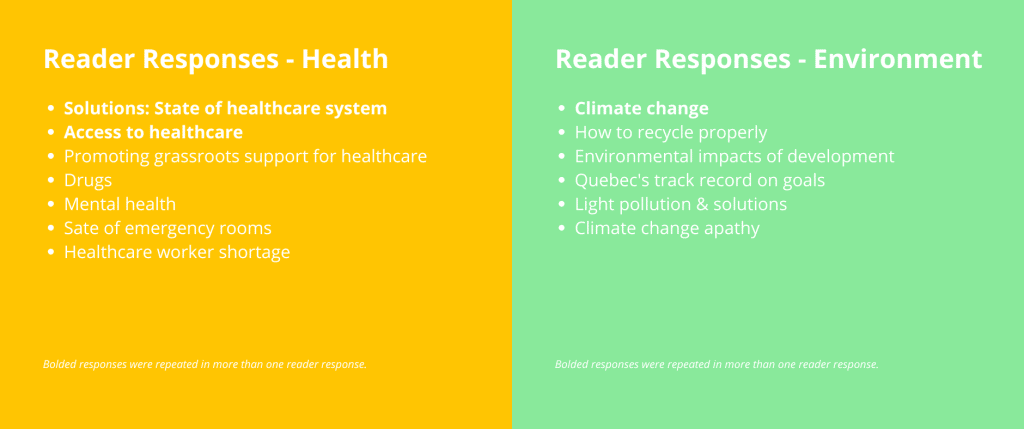
The average Rover reader is painfully aware that there’s a climate crisis and that our healthcare system is in shambles. The next step is understanding the root causes and mobilizing for change, and the message is clear that we can and should be envisioning our work as assisting with that.
A Need for Community Reporting
One of the things that struck me was that community reporting was in pretty hight demand, and hyper-local content. It’s indicative of how bad things got for local journalism in the past 20 years — I did not do a systematic review of this claim, but I’m willing to bet that since 2000, a local paper or two shut down in all the municipalities listed.
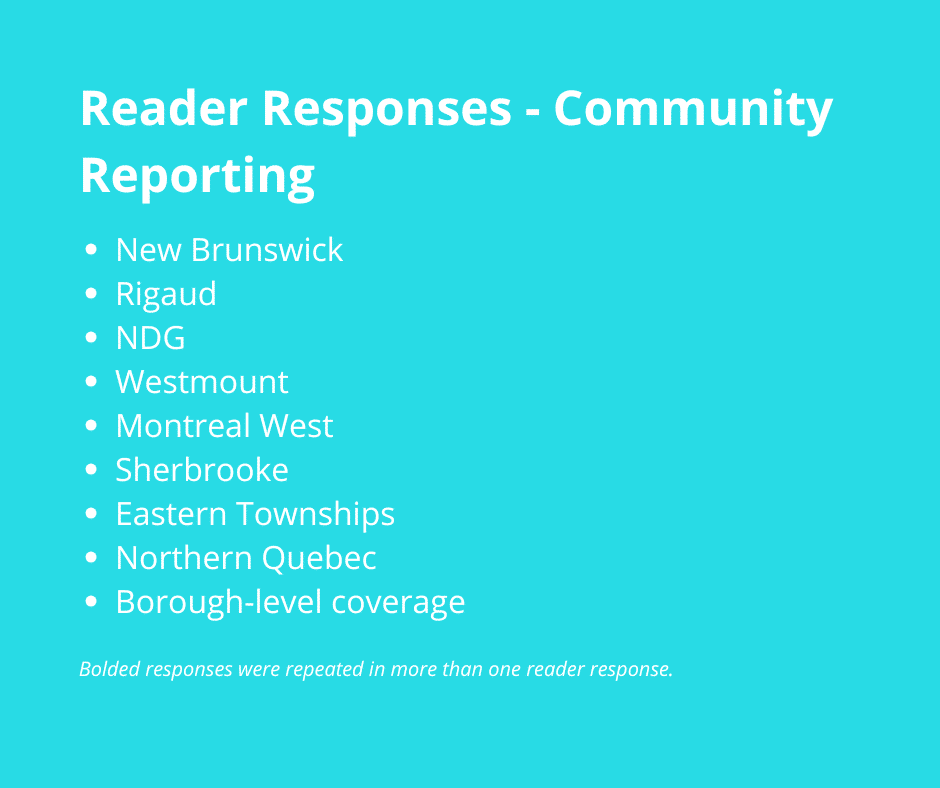
I can say right off the bat that unfortunately, we won’t be able to start covering New Brunswick, Rigaud, Sherbrooke, the Eastern Townships and Northern Quebec in any systematic way — although, a good scoop can indeed get us packing up Chris’ station wagon and heading over, so do reach out if you have one. But I want to take a moment to empathize with the readers who made those requests, because the death of local news has been one of the more devastating of the journalism crises that plague our profession in the 21st century (and yet another symptom of neoliberalism).
There’s no shortage of national and international coverage these days, but finding trustworthy sources of information about your neighbourhood, or your town if it’s not one of the big population centres, is getting harder and harder — yet it’s that local content that relates the most to your everyday life.
Community Facebook groups were a way that people unconsciously sought to counter the closure of local newspapers and get access to hyperlocal information, especially during the pandemic. But with Meta’s censorship of Canadian journalism on those platforms, Facebook and Instagram are not friendly to the facts — and pretty soon they’ll be doing away with fact-checkers, stating that they were “too biased.” So really, no satisfactory alternative has popped up to help people get access to trustworthy information about what’s going on in their communities.
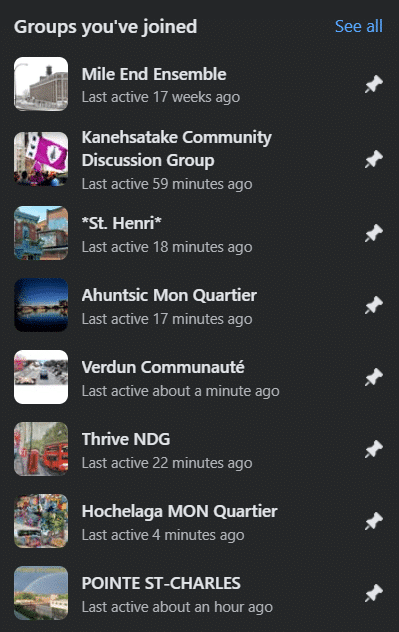
Some of the community Facebook groups I’m a part of to try to stay up-to-date on borough-level news. SCREENSHOT: Facebook
In a perfect world, I’d love to set up a network of reporters to attend the council meetings of Montreal’s boroughs and report back the interesting bits (not in the form of 3,000-word articles as we’re known to do, just bulletpoint-format of what people living in each respective borough should know about what their representatives are working on). But of course, most people, even reporters, don’t nerd out about council meetings the way I do, and we couldn’t afford to do it if it didn’t rely on volunteer work.
So we’ll have to find smaller ways to respond to the real need for community, local and hyper-local reporting, that would fit within the budget. Another challenge to add to the list — luckily, at The Rover, we’re always up for a challenge.
But others have had the same idea as me and are putting it in practice with the Documenters Project. It’s still in the early stages, but it looks promising, and I’m eager to see where it goes.
Did you like this column? Share it with a friend!
METHODOLOGY
I selected the 50 most recent reader responses that answered questions 2 and 3 (What issues need more attention in our community? What questions do you have about our community?) with ideas/requests for the issues they want to see more coverage on. The responses were read and then coded, with a code attributed to each issue raised within the response. A response could have multiple codes, or just one.
Then, I sorted the codes into categories, which were sorted by the number of times the responses referred to issues within that category – see the pie chart for the results.
One response could refer to two different issues within a category and therefore count twice towards the same category. Example: A response that referred to both homelessness and the housing crisis counted as two seperate responses referring to the category of Housing.
Author

Related Articles
Gaza in Ruins: Shattered Roads, Overrun Camps, and a Meaningless Ceasefire
More than 900 Palestinians have been killed since the October 2025 ceasefire.

Les centres jeunesse sont des prisons pour enfants
Alors que Québec promet (encore) de mieux encadrer les fouilles à nu en centre jeunesse, notre chroniqueuse pose une question fondamentale : pourquoi acceptons-nous encore l’enfermement d’enfants?

Weddings Return to Gaza After Years of War and Tragedy
In the past, weddings in Gaza were synonymous with celebration. But today, the weddings we once dreamed of exist only in our imagination.
Comments (0)
There are no comments on this article.