
Guns, Cash and Cannabis a Deadly Mix on Mohawk Territory
Pot shops, casinos and alleged gun-runners are wearing out their welcome in Kanesatake after another fatal shooting rocks the territory.
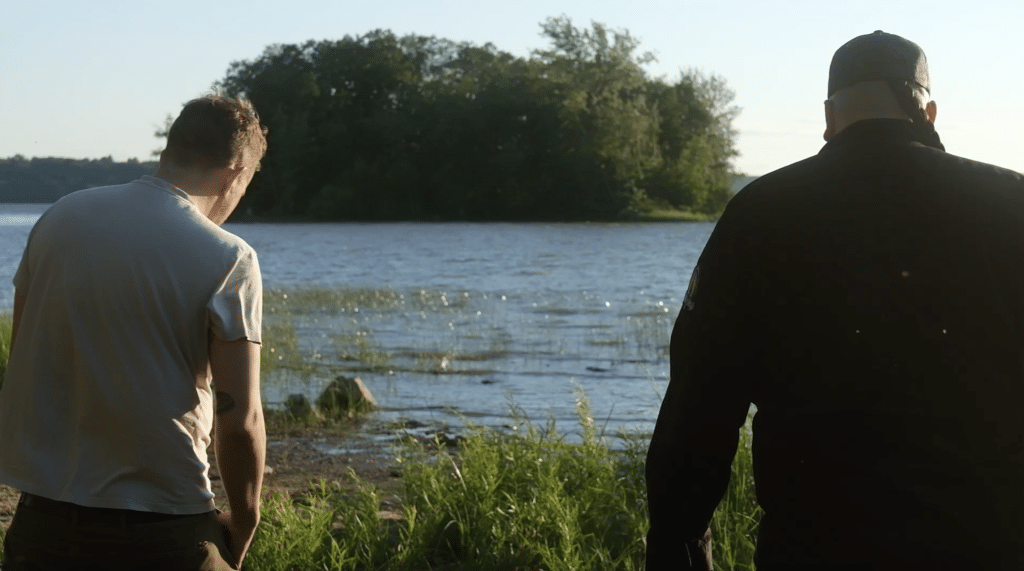
Christopher Curtis, journalist with The Rover, and Kane Montour, head of Kanesatake’s Perimeter Security (KPS), walk along the banks of the Ottawa River. PHOTO: Justin Khan.
On the night he turned 24, there was a warm meal, a birthday cake and a loving family waiting for Ronnie Dariel Beltre Gonzalez at his home in Valleyfield.
It had been a brutal year for the young man. Gonzalez served time at Montreal’s Bordeaux prison that winter for threatening to harm his girlfriend. When he was in lockup, Gonzalez’s parents say he was housed with some of the prison’s hardest men.
“He had been jumped by gangsters, men with knives,” said Marilin Gonzalez, Gonzalez’s mother. “That was unimaginable to us. Before going to prison, he was not involved in that world at all. And from what I understand, the attack was a case of mistaken identity. Still, it was horrifying.”
“Ronnie didn’t have a difficult adolescence, he was in the cadets until he was 18,” said his dad, François St-Pierre. “Ronnie didn’t go out, didn’t get in trouble, didn’t really go to the city unless it was with us. Mostly, he just liked to play basketball and XBOX.
“He had messed up, for sure. He had threatened his girlfriend and that’s unacceptable. But he wasn’t a monster. He was getting his life back on track. He was in night school so he could catch up on some classes and enrol in the military.”
May 28, the night of his birthday, was supposed to be the beginning of something new for Gonzalez and his family. But he didn’t come home that night.
“I called him, messaged him on Instagram, called his friends, called his best friend but he didn’t answer,” said Marilin. “I spent all night calling his phone. He never answered.”
The 24-year-old had spent the week with a childhood friend, who later told his parents that they parted ways when Gonzalez took a ride with some friends from Montreal. That was the last time he saw Gonzalez.

By Saturday May 30, two investigators from the Sûreté du Québec came knocking at Marilin’s door. Their son, they were told, sustained a fatal gunshot wound to the temple. They had found his body in a concrete pit on the Kanesatake Mohawk territory the previous day.
“We didn’t know of any kind of connection he had to (Kanesatake),” his father said. “Our only theory is that he met someone in prison. He had used a cellphone in jail, the ones that the gangsters rent out to other inmates. Maybe he owed someone a debt? Maybe he was coerced into doing something to repay that debt.
“It’s a question we’ve asked ourselves 500 times. It’s a question we may never find that answer to.”
Support your local indie journalists
***
The man who killed Gonzalez on May 29 may have used a pistol bought from a gun-runner in Kanesatake.
That’s according to police evidence that suggests Gonzalez was murdered by a young man working security at a cannabis shack on the territory.
The youth allegedly told friends he was carrying a .40 calibre handgun on the day of the killing. Meanwhile, photos of the purported murder weapon — a nickel-plated Smith & Wesson — began circulating on the social media app Snapchat shortly after the killing.
He allegedly bought his weapon off a Kanesatake man who has since been arrested on gun charges, according to court records.
Sources close to the investigation say the pistol, which is illegal in Canada, was most likely bought through a straw purchase in the United States and smuggled into Quebec by way of the Akwesasne Mohawk territory.
“They usually find a buyer with a clean record who needs fast cash,” said one source with direct knowledge of the gun-trafficking racket. “Often it’s people who need money for drugs. They’re desperate people because you’re asking them to buy a gun that might one day be used in a crime.”
Akwesasne sits on both sides of the U.S.-Canada border and is used, by organized crime, as a pipeline for getting firearms, drugs and people into the country.
A handgun like the one allegedly used in the May 29 murder retails for around $500 in the States but sells for up to $3,500 once it’s been smuggled into Canada.
Gonzalez’s body was found in a hole on the old Sulpician school property near Route 344. Known as “The Brothers” to locals, all that’s left of the Catholic school is a concrete tunnel that runs under the building’s foundation. A hole in the foundation, one barely wide enough for an adult to squeeze into, drops about 12 feet into the tunnel.
Even before Gonzalez died there, it was a spooky place. It belonged to the religious order that stole Kanesatake’s land and abused its children. Today it is a pile of rubble slowly being swallowed by weeds and grass. It’s where kids on the rez go to get up to mischief. Police sources say the body was found by a teenager who came to the old school to smoke a joint.
Within minutes, Kanesatake Perimetre Security was on site to check for signs of life and call the police. It was clear right away the victim was dead, according to police sources. Detectives found two cellphones, a cigarette lighter and a can of Budweiser next to Gonzalez’s body.
Just three days later, Bryin Canadian Whitebean was arrested and charged with first-degree murder. Eighteen-year-old Whitebean is believed to have been working security at a cannabis dispensary along Route 344.
Police sources say there appears to have been a botched robbery at the dispensary around 7 p.m. on May 29. They say Whitebean later told friends it was Gonzalez who tried robbing the dispensary at gunpoint but fled when he encountered armed resistance.
Investigators say that, less than an hour later, Gonzalez was shot at close range, in a wooded area that overlooks the Lake of Two Mountains. The veracity of this testimony has not been challenged in court, and Whitebean has pleaded not guilty to the charge of first-degree murder.
“To me, (Whitebean) sounded like a kid who was in way over his head,” said a source close to the investigation. “He was a kid running around with men who carry guns and aren’t afraid to use them.”
Neither Whitebean’s family nor his lawyer, Zakary Lefebvre, are commenting on the case. If convicted, he could serve a 25-year prison sentence.
This is the second fatal shooting linked to Kanesatake’s lucrative cannabis trade and the fourth shooting on the territory since November. Five years ago, during a July 1 party, Montreal gang leader Arsène Mompoint was murdered outside the Green Room dispensary.
In the Mohawk settlement of just 2,000 people, families say they feel like their home has been taken over by criminals. Some have started floating the idea of blockading all roads into the territory, cutting off the cannabis industry from its customers.
“People are pissed off and motivated, all they need is leadership,” said one local man, who says he sometimes carries a shotgun in his truck for protection. “I’m telling you, if this doesn’t calm down, people are going to take justice into their own hands. And no one’s going to like that.”
***
The execution-style killing has sparked a crackdown on suspected gun traffickers on Mohawk territory.
About three weeks after Gonzalez’s murder, the SQ’s anti-gun task force seized 13 weapons, extended ammunition clips, a bulletproof vest, cocaine, amphetamines and $20,000 in cash during a series of raids spanning Mascouche, Kanesatake and Oka.
One of the three people arrested that day, Christopher “Buffy” Geoffrion, was living in the house of a dispensary owner who narrowly escaped an attempt on his life last November. Geoffrion himself was one of three people gunned down in a gang-related shooting at a Deux Montagnes pool hall last fall.
Council Chief Brant Etienne says he believes the gun-running and gang violence on the territory are largely the result of greed in Kanesatake’s unregulated cannabis trade.
“This is just the natural progression from organized crime to oligarchy,” said Etienne. “The wealthy are coming onto our territory and arming goons to protect themselves. People are getting hurt and killed in the process.”
While the smaller cannabis shops on the territory are family-run businesses that earn a middle-class living selling weed, some of the megastores are being funded by the Hells Angels and other criminal investors. That’s according to multiple police sources, sources on council and sources inside the unregulated cannabis trade.
One local says the fact that Kanesatake has no local police department and is only patrolled by an SQ detachment in neighbouring Oka creates the perception that the territory is lawless.
“People actually think there are no laws here,” said Kane Montour, the head of Kanesatake’s Perimeter Security (KPS). “Like, they believe that if you commit a crime here, you’re somehow outside of Quebec’s legal jurisdiction. So they see that as a free pass to behave like criminals. But this is not a lawless place. The Criminal Code applies here too.”
Montour’s team have helped reduce response times from the police, fire department and paramedics. They’ve also played a role in keeping the peace when dispensaries host events that draw thousands of partygoers into Kanesatake.
“This is a small community, it’s supposed to be a quiet place for our families and our youth,” said Natalie Gelinas, a member of the team and Kanesatake’s former band manager. “These parties bring in so many people, just invading our space, doing whatever they want, acting like this is a no-man’s-land.
“But we’re seeing the dispensaries start to work with us more and more because people here are fed up. They want their lives back.”
***
KPS, a 15-person team of local men and women, make up the closest thing Kanesatake has to a local police department.
The team has played a crucial role in de-escalating conflicts between cannabis store owners and locals. But they are unarmed, and most of their funding could expire as of next month, according to Montour.
“These people, in this community, they’re our neighbours, our friends, our relatives,” Montour said. “They trust us, they give us good information, they help us de-escalate conflicts. But there’s only so much you can do without a local police presence. I’m not going to ask my team to take on men with guns. I’m just not going to put them in that kind of danger.
“But we gather information, we listen to people on the ground, and sometimes we pass along that information to the police and we get results. People are much more willing to trust us because we’ve earned that trust.”
Dispensaries like The Green Room, High Times and Triple 7 double as bars and casinos that draw organized crime onto the territory. The Mompoint hit, in the summer of 2021, was carried out by professionals in broad daylight at a crowded event.
The gunman knew exactly where Mompoint would be, walked up to the gang leader, fired off three slugs and escaped in a stolen car, all in less than 30 seconds. The getaway driver passed through a dirt road only used by locals before leaving the car in a cornfield and torching it.
No arrests were made in the killing, which sources say may be related to a debt someone owed Mompoint but refused to pay. That criminals chose The Green Room — which sits a short walk from an elementary school and daycare — to assassinate one of the city’s most notorious gang leaders spread panic throughout the community.
But far from slowing the cannabis and casino trade, dozens more stores have opened in the past five years. In fact, some store owners — like Robert Gabriel — are being sued by the provincial government for destroying fish habitats in the Lake of Two Mountains to expand their waterfront parking lots.
Further compounding things, former employees of those dispensaries say there are hundreds of thousands in loose cash and narcotics lying around on any given day, making security a top priority. But Etienne says some of these security guards are little more than “armed goons” acting as their own parallel legal system in Kanesatake.
Multiple sources on the territory compared the guards to mercenaries, setting up checkpoints to stop cars and shutting down roads without the permission of Council.
“For the first time in my life, I’m considering leaving this place and never looking back,” said one local store owner, who defended Kanesatake against the Canadian military during the 1990 Oka Crisis. “What little land we have left is being destroyed by these casinos and their customers. This is not what we fought for in ‘90.”
Doorbell security footage obtained by The Rover shows shotgun-wielding guards wandering onto people’s backyards at night and looking into their windows.
Some of these weapons appear to be hunting rifles, which are legal, but one piece of footage shows a man walking through someone’s yard with a handgun strapped to his waist.
“People are afraid, and they’re fed up,” said Etienne. “Some of these security guards are licensed professionals, but there’s a lot of people brought in from our sister communities who have a bad reputation. Some of them are just straight up criminals.”
Some of the dispensaries hire young men to set rival stores ablaze using gas canisters and Molotov Cocktails. Sources in the industry say there have been roughly 30 arsons in the past two years, with some businesses — like the Sweet Grass Lodge — being burnt to the ground.
Last Fall, Montour happened upon an arson attempt while driving back from a hunting trip. Security footage of the incident shows a van pull up to a dispensary at dawn before a man steps out of the vehicle with a five-gallon gas canister and lights it on fire.
Minutes later, Montour sprints towards the flaming canister, grabs it and carries it away from the shop. He then put out the blaze with a fire extinguisher. Montour suffered burns on his forearm and hand that morning.
“Someone is eventually going to get killed in one of these fires,” Montour said. “Sometimes it’s a rivalry between store owners, sometimes it’s an argument over money or just a disgruntled former business partner trying to put them out of business.
“There’s a lot of scores being settled this way, it’s extremely dangerous.”
Earlier this summer, witnesses told The Rover about a brazen daylight attack against a dispensary called Le S’pot on Route 344. They said two hooded men came running out of a black car and tossed a pair of Molotov Cocktails at the store. Le S’pot’s security guard then emerged from the burning building with a shotgun and fired it at the men as they drove away.
This hadn’t been reported to the police.
But police were called to Le S’pot on July 28 after one of the shop’s security guards was gunned down in a drive-by shooting at 1 a.m. The victim, a non-Mohawk called Steven Audet, got into his car and drove to a nearby dispensary where staff applied pressure to his wound until an ambulance arrived.
Audet survived the attack, and police arrested Jérôme Bouchard, another non-Mohawk, the following morning. Bouchard has been charged with discharging a firearm with the intent to injure, mutilate or disfigure a person.
With the majority of KPS’ funding set to expire next month, Kanesatake’s band council chiefs met with Quebec vice-premier Ian Lafrenière on Monday to discuss public security.
“No comment,” Etienne said, regarding the substance of the meeting.
Last month, Quebec’s Interior Security Ministry announced it would be working with Ottawa on a $2 million project to fight organized crime on Indigenous territories in the province.
In a statement sent to The Rover, a spokesperson for the ministry wrote that up to eight officers from Indigenous police forces, including one in Akwesasne, will be assigned to an SQ task force. But since Kanesatake doesn’t have a local police force, they won’t see any of the money.
“These teams will specialize in the traffic of firearms, drugs and money laundering,” the statement reads.
“The perimeter security team does good work, but we’re not a permanent solution,” Montour said. “We can’t keep doing this with funding that expires every few months. We’re up against people that even the cops are afraid of.”
***
What confounds St-Pierre and Marilin is this: Gonzalez was a home body.
He so rarely left the house that he didn’t even have his own driver’s license. So if he ended up an hour’s drive from Valleyfield to Mohawk territory, it’s because someone brought him there.
“Who was he with? Who were these Montreal friends? Why did those people have to kill him?” St-Pierre said. “We’ve tried asking the police but they’re not talking to us. So we’re just stuck asking ourselves the same questions again and again.”
Police sources initially said they believed Gonzalez may have been hired by one of the dispensary owners to set fire to a rival business. His parents say nothing in his demeanour or activity in the weeks leading up to his death would have led them to believe Gonzalez was running around with gangsters.
“To hear him described as a criminal in the newspapers, it’s like he’s been killed twice: his physical death and his social death,” Marilin said. “Ronnie was born in the Dominican Republic, where I’m from. We moved here when he was 8 years old so that he and his siblings could have a chance at a better life. I never ever thought it would end like this.
“If it is true, if he did try to rob that place, then why did they have to kill him? I can almost understand if they beat him up so bad he’d be in the hospital. But no one deserves to die for that.”
In the two months since her son died, Marilin says she’s been struggling.
“I’m in therapy, his siblings are horribly depressed and Ronnie’s dad is fighting to keep the family together,” Marilin said.
For St-Pierre, the memory of what prison did to his son memory still haunts him. Gonzalez had breached his probation conditions and the police were on their way to pick him up.
“The first time he went inside, he put on a hard front, he tried to play it tough,” St-Pierre said. “But when they came to get him that last time, he was terrified, it was like he was a child again. He wasn’t meant for that world. Everybody who knew him loved him. He was a good kid.”
Author

Related Articles

‘Everybody Who’s on the Stage Is Part of Your Community’: Ctrl+Alt Festival Returns for a Third Edition
Free festival stacked with queer, local performers to take over the Place du Village July 24-26.

Moving Day: A “Desperate” Struggle for a Growing Number of Montrealers
July 1 is now a race against time for families facing homelessness once their lease expires.

Quebec Workers Experienced a “Counter Revolution” Under Jean Boulet: Experts
The outgoing labour minister leaves behind a legacy of attacking the Constitutional right to strike.
Comments (0)
There are no comments on this article.