
Illegal Dumping Poses “Grave Threat” to Wildlife in Kanesatake
Quebec’s crown prosecutor is seeking an emergency court order to stop dumping on Mohawk territory.
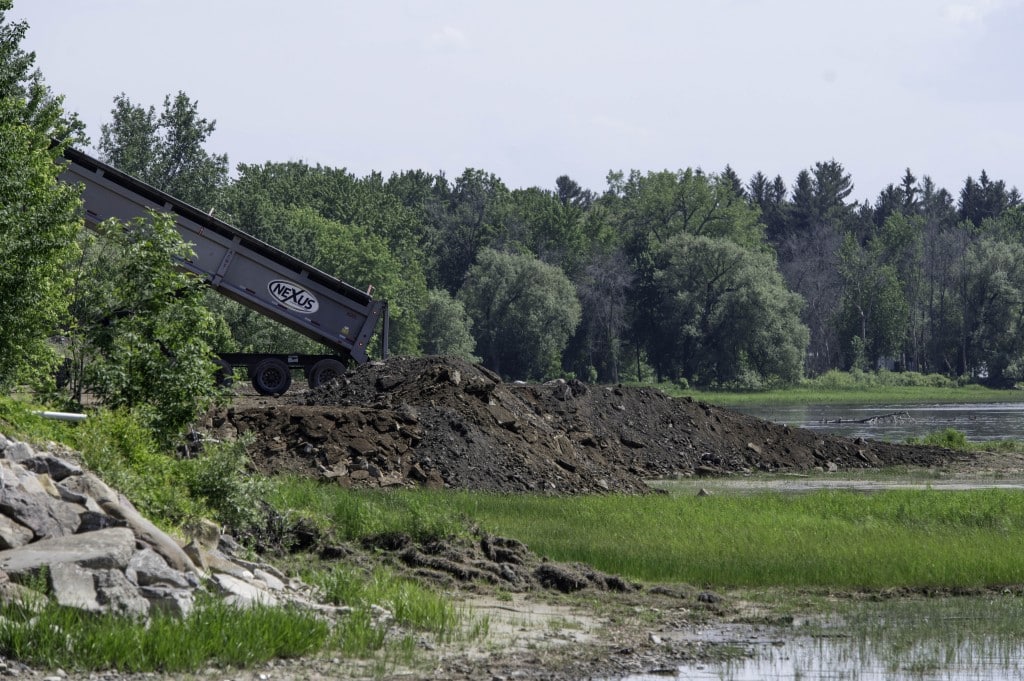
An illegal dumping scheme that went unchecked for years now poses a “grave threat” to marine life in and around the Kanesatake Mohawk territory.
That’s what Crown prosecutors argued in court Wednesday as they seek an emergency injunction against 19 people and companies suspected of participating in the scheme. The Crown wants an immediate stop to construction work on 17 sites that overlook the Lake of Two Mountains, claiming the threat to wildlife warrants immediate action.
In sworn statements presented to the Quebec Superior Court last Friday, conservation officers and biologists said they found hydrocarbons and heavy metals the lots. Some of the contaminants were dumped directly into fish habitats.
A handful of Mohawk landowners told investigators they received countless shipments of soil to build waterfront property. They worked alongside Excavation Denis Dagenais and Les Entreprises Translogik, two small excavation companies that did work in the territory. Translogik representative Jean-François Henley told conservation officers he oversaw more than 1,000 truckloads of soil being dumped along the shore.
Sources close to the investigation say the scheme benefited a small number of Mohawks and mostly involved non-Indigenous players from the construction industry. The Mohawks received hundreds of dollars per load of contaminated soil they accepted while the truckers saved a fortune on disposal fees.
The sources added that it’s unlikely the elderly defendants are intimately involved in the scheme. But since the lots — tiny tracts of land passed down through Mohawk families — are in their name, they could face serious consequences for the dumping. Far from hardened criminals, some of the defendants showed up to at the St-Jérôme courthouse Wednesday using a cain or being helped to their feet by a relative.
About half the defendants were absent because of medical appointments, a family emergency and a few had not have received their summons. The closest thing anyone had to an attorney was a paralegal counsellor who reviewed their case with an attorney the previous night.
“Some of (the defendants) are elderly with health problems, they’re on a fixed income and they can’t afford an attorney,” said Sonya Gagnier, a counsellor with Services Parajudiciaires Autochotone Québec. “Some only just found out they had to appear in court, this is a complicated case and they need to be adequately represented.”
Though she is not an attorney, Gagnier argued effectively Tuesday, contending that — by the Quebec Crown’s own admission — police have known about the dumping for about a year and failed to act on it. If the injunction could wait 10 months, why the sudden sense of urgency?
Defendant Joshua Smith-Gabriel told the court that finding legal representation will be difficult given the complex the nature of the case and the sheer number of conflicts of interest at play. The Mohawk Council of Kanesatake is a plaintiff in the injunction request and Smith-Gabriel says he’s struggling to find a law firm that hasn’t worked for the band council.
“We’re looking at over 1,000 pages of (discovery),” Smith-Gabriel said during Wednesday’s hearing. “That’s going to take experts, it’s going to take time. We can’t get this together in two weeks, we need a six-month delay. … Also, we’ve spoken to lawyers all the way in Vancouver who have a conflict of interest. Council has done business with a lot of these firms over the years.”
Judge Robert Castiglio said the court will not rule on the injunction Wednesday and gave the defendants two choices: either they opt for a brief delay to find legal representation or they can get a longer break if they commit to stopping all work on their land until the court rules on the injunction.
“We have elders building their homes, people building businesses, stopping work isn’t ideal for them,” Smith-Gabriel said.
The defendants chose the first option, meaning dumping and excavation work on the shoreline will continue for at least a few more weeks. Judge Castiglio said he needed to strike a balance between the urgency of the ongoing pollution in Mohawk territory and the challenges defendants face finding legal representation.
The judge gave them two weeks to find a lawyer before the next hearing for the injunction. The suspects face fines of up to $1 million each and up to $6 million for companies that took part in the dumping.
Under Quebec law, soil removed from a construction site must be tested and shipped to a provincially-sanctioned rehabilitation or dump site. There are no such sites in Kanesatake.
And yet, The Rover previously reported on companies like Nexus Construction and GTM Construction — not named in the court filing — taking loads of soil from construction sites in Montreal and dumping them on Mohawk land about 50 kilometres west of the island. They did this while subcontracting for companies that build hotels, mini malls and some of the biggest condo towers in Montreal.
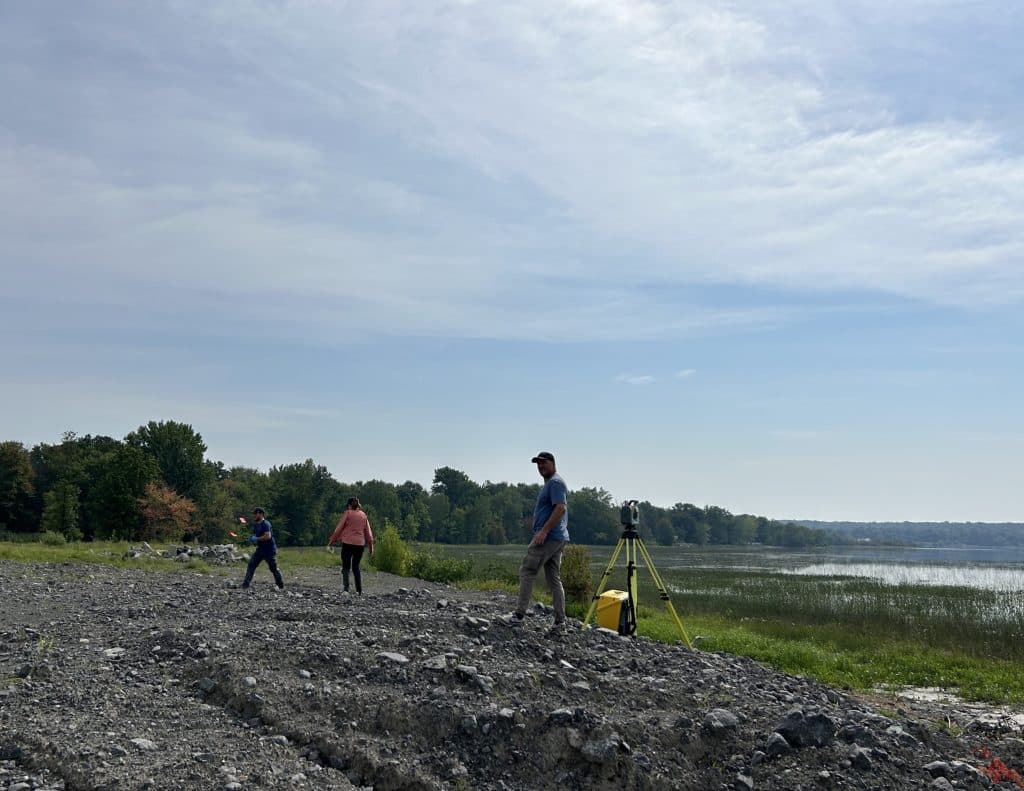
Shortly after The Rover’s investigation was published, the Sûreté du Québec teamed up with conservation officers to launch Operation Gravier on June 11. The investigation culminated in a week of testing soil, water and air quality on six sites along the lake in August.
Earlier this summer, there were hundreds of trucks descending on the territory from construction sites in and around Montreal every day. But last week’s injunction request almost exclusively focuses on Mohawk land owners and two small time excavation companies. The Crown alleges that some used the contaminated soil to create waterfront land so they could build cannabis shops and a casino by Route 344.
One of the people targeted by the request, Robert Gabriel, is also the co-owner of G&R Recycling — a company that had its permit revoked by Quebec in 2020 for allowing over 370,000 cubic meters of construction waste to be dumped illegally on Mohawk territory. Gabriel admitted to dumping “about 20 loads” of gravel into a fish habitat so he could build High Times, a cannabis dispensary on the property of a former council chief.
This is illegal under both federal and provincial law.
Much of the evidence that led the Quebec government to take action was provided by Mohawk whistleblowers who fought for years to end the scheme. When contacted by The Rover, two of them said they were glad to see movement on the file but lamented that it has taken years and a series of embarrassing news articles to be taken seriously.
“About fucking time,” one source said. “Now go after the big companies instead of focusing on these small fish. We put our lives on the line to get this information out there. These are dangerous people involved, there’s a lot of money changing hands. It’s not easy to stand up against that. It feels lonely as hell.”
Sources who spoke out against dumping and those suspected of collaborating with journalists often faced threats and harassment from people involved in the dumping.
In the court filing, Quebec’s lawyers argue that dealing with political factions inside Mohawk territory slowed down the process and the jurisdictional complications of dealing with the federal government since so much of Kanesatake is on Crown land. Some of Quebec’s foremost experts in the disposal of soil warned Quebec’s Environment Minister of the persistent problem of illegal dumping two years ago, offering a series of recommendations to help end the practice. The minister did not heed their advice.
In June, the Environment Ministry sent letters to dozens of Montreal-area construction firms, reminding them there are no provincially-sanctioned dumping sites in Kanesatake. On July 15, after citizens groups and Mohawks threatened to start blockading roads, the Sûreté du Québec started pulling over truckers driving onto the territory and inspecting their vehicles.
But because the SQ doesn’t have the expertise to do soil tests, no one was prevented from dumping that day. Instead, the cops handed out one ticket and three written warnings to truckers whose vehicles weren’t up to code.
There are roughly 1 million tonnes of contaminated soil disposed of illegally in Quebec every year, according to the province’s own estimates.
Author

Related Articles
Guns, Cash and Cannabis a Deadly Mix on Mohawk Territory
Pot shops, casinos and alleged gun-runners are wearing out their welcome in Kanesatake after another fatal shooting rocks the territory.

‘Everybody Who’s on the Stage Is Part of Your Community’: Ctrl+Alt Festival Returns for a Third Edition
Free festival stacked with queer, local performers to take over the Place du Village July 24-26.

Moving Day: A “Desperate” Struggle for a Growing Number of Montrealers
July 1 is now a race against time for families facing homelessness once their lease expires.
Comments (0)
There are no comments on this article.