
The High Toll of Hate in Canada
As Israel’s war against Hamas rages on in Gaza, Canadians are grappling with a rise in antisemitism and Islamophobia. This is the latest instance in a long history of blaming and scapegoating.
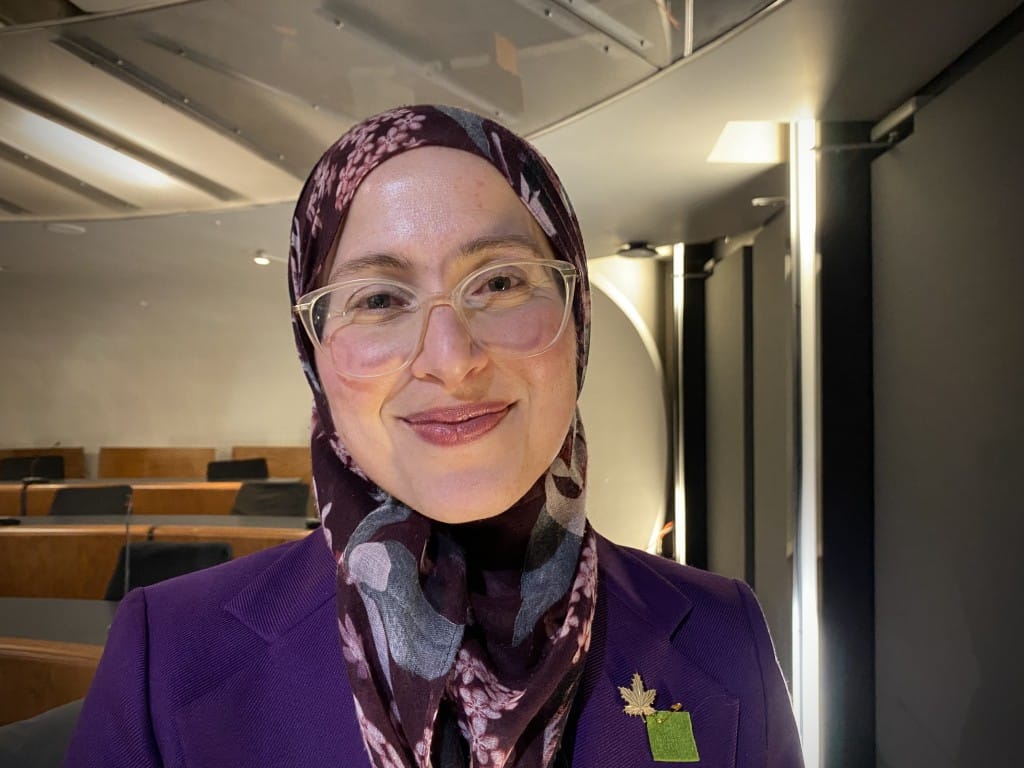
Amira Elghawaby, Canada’s Special Representative to Combat Islamophobia, gave a speech at McGill University in Montreal on Wednesday, Jan. 31. PHOTO: Christopher Curtis
Editor’s note: This article is part of an ongoing series about how the war on Gaza is affecting Canadians. Next week we will report on the rise of antisemitism across the country.
As a child, Amira Elghawaby didn’t know what it meant to be hated for her faith.
She remembers sitting in her mother’s lap on the second floor of the Ottawa Mosque, waiting for Friday prayers as the other kids played.
Her family came to Canada from Egypt and settled in the capital when Elghawaby was just a few months old. Elghawaby’s father got a job with the federal government and though the kids were basically the only Muslims in school, no one seemed to make a big deal out of it.
“We didn’t worry about our safety back then,” said Elghawaby, Canada’s Special Representative to Combat Islamophobia, during a speech at McGill University. “The idea that we could be attacked for our faith was unimaginable.”
A few days before that speech, Elghawaby was in Quebec City to meet with families who lost someone in the 2017 mosque shooting.
Their experience couldn’t be further from those warm childhood memories Elghawaby shared. They told her about the mix of fear, anger and helplessness that still weighs on them. But mostly they spoke of how odd it felt that, even in the holiest of places, Muslims can be murdered for the simple fact that they are Muslims.
“To this day, people will enter a place of worship and check where the exit doors are,” Elghawaby said. “They’ll stand a bit closer to their children in case a shooter was to walk in. That way, they can protect them with their bodies. That fear haunts the lives of those who realized how suddenly hate can steal away their loved ones.”
Elghawaby says that, for Muslims of her generation, there was life before 9/11 and life after 9/11.
In the pre-9/11 years, Elghawaby said she “drank the uniquely Canadian Kool-Aid” of multiculturalism. She remembers the principal at Orleans Wood Elementary School inviting the handful of Muslim kids to make a presentation on Islam during an assembly in the gymnasium.
“We did speeches with cue cards, we had a microphone and everything,” Elghawaby said.
In the early days of the War on Terror, Muslims who spent their entire lives in Canada saw their civil liberties suspended and their loyalties questioned.
Within weeks of the terrorist attack, Ontario Premier Mike Harris announced the formation of a special police force to track down and deport potential terrorists. Roughly half of Canadians polled said they were in favour of racial profiling. Data from police forces across the country shows a sharp rise in Arab and Muslim youth being targeted for street checks in the years following 9/11.
Support Independent Journalism.
Meanwhile, a media ecosystem that had mostly ignored them now published incendiary columns about the existential threat Islam posed to the West.
And it seemed that every time there was a global event involving Islam — the Arab Spring and the Syrian refugee crisis to the emergence of MAGA-inspired hatred — Muslims in Canada came under fire.
And indeed after police searched the Quebec City shooter’s laptop, they found evidence of someone who was obsessed with Donald Trump. The killer entered the former president’s name into Google 337 times during the weeks leading up to the massacre.
He seemed particularly fixated on Trump’s failed proposal to ban immigration from majority Muslim countries.
“The killer viewed Muslims as a direct threat to himself and his family,” Elghawaby said. “Why would the killer be so consumed by the fear of Muslims that he would take it upon himself to do what he did?”
Hamas’ Oct. 7 shock attack against Israel has once again put Canadian Muslims under a spotlight they never asked for.
In the three months following the brutal attack, there have been more hate crimes reported against Muslims in Montreal and Toronto than there were in all of 2022. From October to November, the National Council of Canadian Muslims saw a 1,300 per cent increase in Islamophobic incidents reported to them compared to the previous month. Protests against the war on Gaza have been called “pro-Hamas hate fests” by members of parliament and newspaper columnists while principals at elementary schools have ordered children not to wear or display the Palestinian flag, comparing it to a hate symbol.
“To have your identity as a Muslim conflated with terrorism is extremely alienating,” said Steven Zhou, spokesperson for the NCCM. “People who were born here suddenly don’t feel like they belong. Since Oct. 7, we’ve had hundreds of reports of people who’ve been mistreated or attacked. A child was suspended from school for saying ‘free Palestine’, a woman had her hijab pulled off and there have been countless threats of physical violence.
“One woman was waiting for a bus in Ottawa when the driver pointed to her hijab, shook his head and kept going. It’s a scary time to be visibly Muslim.”
For Sara*, a student at McGill’s faculty of law, the fallout from Oct. 7 has made it feel as though her world is shrinking.
Like all of her classmates, she was mortified to see images of the 1,200 Israelis killed and hundreds captured by Hamas. But when Sara stood up to denounce Israel’s bombing campaign in Gaza, the backlash was immediate.
“I have been to protests and I’m worried what might happen if someone takes my picture there,” said Sara, who did not want her real name published for fear of professional reprisals. “There’s a lot of law firms that have made it abundantly clear that they will not be hiring students who have expressed pro-Palestinian views. Of course, they’ll conflate that and say it’s “pro-Hamas” but in reality any kind of scrutiny towards Israel is seen as antisemitism.”
Sara was referring to a column in the Financial Post where a senior partner at Levitt Sheikh wrote that his firm would blacklist the 700 lawyers and law students who signed a pro-Palestinian petition. His reasoning? They signed a letter rejecting “the notion that it is antisemitic, hateful, or illegitimate to contextualize the Oct. 7, 2023 attack.”
The petition also refers to Israel as committing genocide — a claim Israel and its allies have vehemently rejected. Even so, the International Court of Justice ruled last month that it’s “plausible” Israel is committing or failing to prevent genocide in Gaza.
“It’s been made very clear to us, in a number of communications from the school that have called out certain Palestinian activist efforts. But no words of condemnation from organizations which support the IDF on campus,” Sara said. “Sometimes it feels like just by being visibly Muslim, just by wearing my hijab, it is presumed that I am an antisemite. Which hurts because we work closely with Jewish allies and friends to speak out against the war.”
The conflation of support for the Palestinian people with terrorism and antisemitism feels eerily similar to the post 9/11 crackdown on Islam in the West, Elghawaby said.
“My office has been closely monitoring the challenges to civil liberties of Canadian Muslims,” said Elghawaby. “Our communities are simply advocating for human rights, dignity and justice for innocent civilians. We’ve heard from campuses across Canada, from Muslim students who share their alarming concerns about attempts to limit their right to free expression, belief and association.”
Elghawaby has met with the Prime Minister, his cabinet as well as police chiefs and community leaders across the country, trying — often in vain — to build bridges. Her efforts have been undercut by members of Trudeau’s own caucus who have called on police to crack down on pro-Palestinian protests and repeatedly conflated criticism of Israel with antisemitism.
To be clear, there has been an alarming rise in antisemitism across Canada since Oct. 7. In the 48 hours following the attack, the use of antisemitic and Islamophobic slurs on online forums like 4chan increased by 770 per cent, according to research presented by Elghawaby on Wednesday.
And just as police in Canada’s major cities have reported more Islamophobic incidents in the past three months than in all of 2022, the number of antisemitic hate crimes has also exploded. Though it may be horrifying to be faced with this truth, these crimes are being denounced by Elghawaby, Zhou and other leaders in the Muslim communities.
Where some of the deepest divisions are forming isn’t between Jews and Muslims but between these communities and their elected representatives. Every year since the Quebec City mosque shooting, the NCCM has met with Justin Trudeau to discuss strategies to mitigate against Islamophobia.
But given the Trudeau government’s steadfast support of Israel’s war — a war that’s killed over 15,000 civilians in Gaza — and the spike in Islamophobic hate crimes, the NCCM cancelled its meeting with the prime minister last week.
“It’s become clear that we only get a sliver of policy reform when our lives, or our safety, is destroyed,” said NCCM chief executive Stephen Brown, during a press conference Monday. “We’re interested in the government taking real, tangible action to reduce Islamophobia in this country and taking real tangible action to end hostilities in the Middle East.
“We no longer think it’s productive to meet with this Prime Minister.”
***
Sara is too young to know what Canada was like for Muslims before 9/11.
All she has known, in her short time on this earth, is a country that has — at times — viewed her community with suspicion and a province that’s suspended her civil rights.
In Quebec, it’s illegal under Bill 21 for Sara to wear her hijab and represent the government in court. Though the government presents this as a necessary step to preserve the religious neutrality of the state, Sara sees a law that would force her to abandon some of her deepest-held convictions.
“Every time election season rolls around, we brace ourselves,” Sara said. “What will they come for next? Will they expand Bill 21 to other jobs? Will girls be allowed to wear the hijab at school? These are all questions we ask ourselves.”
Sara is holding out hope that a legal challenge of the 2019 law will prevail in federal court.
The push for French-style secularism in Quebec was very much a product of the post-9/11 political climate. In 2007, after the village of Hérouxville adopted a municipal charter that associated Muslim immigrants with stoning women and undermining democratic values, Quebecers were thrown into a debate about Islam that still rages today.
This was, in no small way, bolstered by media outlets that became obsessed with Muslims. One study found that Journal de Montréal columnist Richard Martineau wrote a staggering 438 articles on Islam between 2006 and 2014. The study suggests Martineau’s fixation on the hijab as a symbol of oppression and on some Muslims as fundamentally incompatible with Quebec values, the columnist fuelled a climate of Islamophobia in the province. And he was just one of many prominent columnists who fixated on the subject.
Even after the horrors of the mosque shooting, shock jockeys on Quebec City’s Radio X joked about hate crimes against Muslims and continued to deride the community on its airwaves.
But this, of course, is not limited to Quebec.
After all, it was Conservative Prime Minister Stephen Harper who, during the 2015 federal election, sought to create a hotline for Canadians to snitch on their neighbours for “barbaric cultural practices.” The proposed snitch line was an obvious Islamophobic dog whistle. To this day, polls indicate that as many as one in three Canadians wants to see fewer Muslims immigrate to Canada. The 2022 Freedom Convoy was led, in part, by Alberta separatists who endorse the great replacement theory.
Faced with such hostility, it would be easy for Elghawaby to give up.
But instead, her mind goes back to Quebec City and the strength of the widows who lost their husbands on the cold night in January, 2017.
“They wanted me to share a message with you today,” Elghawaby told the audience. “They said, ‘Please tell everyone not to forget what happened. Because while we have incredible faith in fellow Canadians, in fellow Quebecers who will stand with us, we also know that if we forget, we risk seeing that hate come forward again.’”
Author
Related Articles

Blainville Teenager Takes Stablex Fight International
After concluding that local avenues had been exhausted, a 14-year-old Blainville resident has brought the fight over the Stablex hazardous waste expansion before the CEC, an international environmental body established by Canada, the United States, and Mexico.
Stripper Strike Provokes Internal Discord, Media Circus — and Worker Mobilization
While the majority of strippers did not strike on May 23, sex workers report feeling motivated to continue the fight for labour rights.
Murder in Mohawk Territory: Sources Say Organized Crime Ramping up Violence Around Cannabis Shops
A 24-year-old was shot, killed and had his body dumped in a hole in Kanesatake last week.
Comments (0)
There are no comments on this article.