
Moving Day: A “Desperate” Struggle for a Growing Number of Montrealers
July 1 is now a race against time for families facing homelessness once their lease expires.

Canada Day in Montreal conjures scenes of pure chaos.
Rented U-Hauls double-parked on a one-way street, oversized couches teetering up spiral staircases and city sidewalks littered with dead appliances.
A majority of new leases in Quebec begin on July 1, meaning that — while most of the country eats hot dogs from the safety of a lawn chair — tens of thousands of households across the province move into their new apartments.
Leases expire in the summer here to avoid evictions during the harsh winter months. Because evictions — just like cheap pizza and stale beer — are part of Quebec’s moving day tradition.
Some seven years ago, before the real estate market really took off in the province, there were about 700 people across Quebec facing homelessness on July 1. This year, more than 2,000 households did not have a new lease once their old one expired on Canada Day. Until they can find a place to live, hundreds among them will sleep in motels, city shelters, or just couchsurf.
On the morning of July 1, two community organizers in Montreal’s Sud-Ouest borough patrolled the streets and laneways in a borrowed car, looking for people who didn’t have a place to stay that night.
“It’s never been this bad. We’ve never had to do this before, to go around looking for people in crisis on moving day,” said Flav Choquette-Giguère, who works with the POPIR housing committee. “At our offices, we have an inflatable mattress ready in case one of the families we work with doesn’t have a place to sleep.
“This is worse than last year, worse than five years ago and worse than 10 years ago. It truly is unprecedented.”
Support your local indie journalists

Average rents in Montreal went from $761 a month in 2016 to $1,291 last year, according to the Canadian Mortgage and Housing Corporation. Another report found that asking rents in the city have doubled since 2019.
The crisis we see today took off with the rise of renovictions, a practice where landlords — often through a numbered corporation — buy a building, evict its tenants for “major renovations” and then put the apartments back on the market with massive rent increases. This allowed landlords to circumvent Quebec’s rent-control mechanisms and triggered a wave of real estate speculation across the province.
It also led boroughs throughout Montreal to outlaw these sorts of evictions. In 2024, the Quebec government imposed a three-year moratorium on renovictions for change in use, major renovations, subdivisions or expansions. But repossessions, when a landlord evicts tenants in order to house an immediate family member in the unit, are still allowed. As a result, some landlords have resorted to fraudulent repossessions to evict tenants and raise rents.
In one such case, documented by the Journal de Montréal, the owner of an apartment building evicted his tenants from their home of 10 years so his daughter could have a place to stay.
But less than 10 days after they moved out, the tenants saw their apartment back on the market with a $500 rent increase. The owner, Ghislain Brodeur, was ultimately forced to pay the couple $17,000 for the fraudulent eviction, but this is hardly an isolated example. Repossession evictions have tripled in Quebec over the past 12 years, according to a study by the Regroupement des comités logement et associations de locataires du Québec (RCLALQ).
The net effect of this legislative game of cat and mouse is that provincial and municipal governments have allowed the rental market to spiral out of control, said Choquette-Giguère. In the most extreme cases, they say landlords will simply make their units unlivable by refusing to make basic repairs on the apartment.
On July 1, as Choquette-Giguère patrolled the Sud-Ouest in a pockmarked Toyota, they came across their neighbour whose apartment had recently been flooded. The neighbour, James, said his landlords haven’t done anything to decontaminate his apartment since the flood roughly one month ago.
“I looked up ‘breathing in mould’ on Google, and it listed six different symptoms. I have them all,” said James, who has lived in the same rent-controlled apartment for decades. “I don’t have a cold but my throat is killing me, my voice is all raspy. (The landlord) doesn’t give a shit about me.”
James asked Choquette-Giguère to start the process of forcing his landlord to maintain the building, but until that work gets done, he worries he won’t be able to sleep much and says he still struggles to hold down a meal.
“When I breathe, all I taste is mould,” he said.
With Choquette-Giguère behind the wheel, their colleague Malika Fortin took to a megaphone and invited the neighbourhood to a protest in the East End.
“Are you tired of your landlord? Are you tired of your apartment costing a fortune? Join us at 11 a.m. outside métro L’Assomption. We’re fighting against expensive housing! We’re fighting against gentrification! Fuck the condos, fuck the landlords!”
Speaking into a microphone whose wires were held together by bumper stickers, the usually soft-spoken Fortin turned heads with their abrasive style. In the end, the two wound up at the protest alongside hundreds of folks from across Quebec.
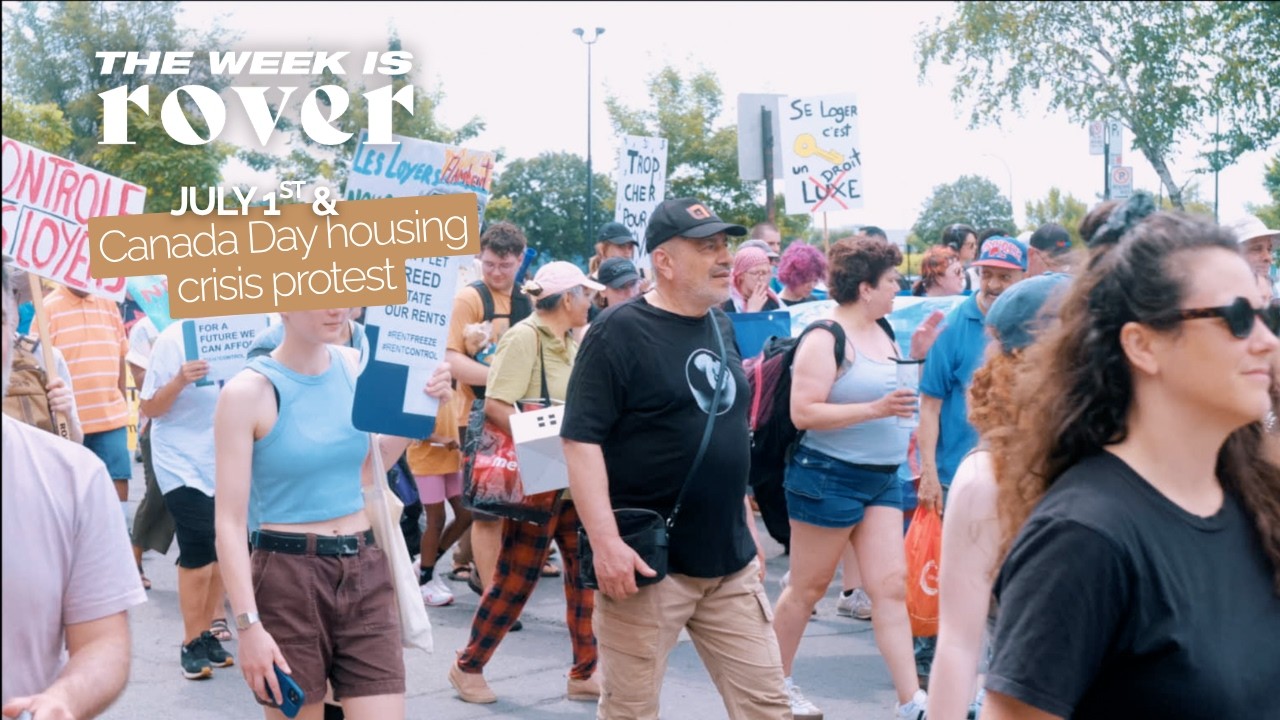
“This is the first year I know someone who doesn’t have a place to stay (on July 1),” said Debra Fogel, who works with a housing committee in Notre-Dame-de-Grâce. “She’s elderly, she has no money, the person she lived with died so she couldn’t afford her rent anymore. She can’t find anything she can afford because now all the available apartments are $1,500.
“She applied for welfare, she gets $800 a month. She can’t get anything. She’s 64 years old. Right now, she’s living in a student dorm. But if she can’t get anything in the next two months, it’s, like, sleeping on her cousin’s couch or sleeping on my couch.”
After spending its first mandate denying there was a housing crisis and even abandoning the AccèsLogis social housing construction program, the Coalition Avenir Québec government has been forced to play catch-up these past two years.
Rather than focus its energy on social housing — where rent is set as a percentage of the tenant’s monthly income — the CAQ has poured billions into what it calls “affordable housing.” Unlike social housing, affordable housing is tied to the market value of an apartment unit. But paying slightly below market rent is a challenge when the market has doubled in the past decade.
In some cases, the affordability measures put in place by the CAQ will only kick in between 15 and 20 years from now, according to a report by housing researchers.
Montreal Mayor Soraya Martinez Ferrada announced the city will invest $742,500 to create a bank that will lend tenants up to $5,000 each to help them keep up with rent. The interest-free loan will be available to 150 households and can be paid back over five years.
Critics say it does little to address the source of the problem and merely rewards landlords by putting more public money in their pockets. Martinez Ferrada, herself a landlord, once illegally charged her tenant a security deposit and was backed by the city’s biggest condo developers ahead of last year’s election.
But the mayor is also spearheading a partnership that would see the city pay up to $15 million a year in mortgages for 2,500 social housing units to be built by at least three private developers.
Last week, the mayor also announced her administration is spending $540,000 to fast-track renovations on 45 housing units for vulnerable Montrealers.
“I know 45 units, it doesn’t seem like a lot, but it is a lot,” Martinez Ferrada said during a July 3 press conference. “Every unit that we can put in the market, it’s one person in the family or a senior that can get a home.” Some of these units, the mayor said, could be available by August.
But the city also announced last week that it would be cancelling the construction of 30 modular housing units in Outremont despite already pouring $1 million into the project. The site’s soil was badly contaminated and cleanup costs exceeded the project’s budget.
At the July 1 protest, advocates said the city’s measures are a case of too little, too late. The event culminated in a rally outside the headquarters of Quebec’s housing tribunal, the Tribunal administratif du logement (TAL).
With its housing law passed in 2024, the CAQ gave landlords the power to refuse lease transfers for any reason, and under its administration, the TAL changed the way rent increases are calculated so more of a building’s maintenance costs can be offloaded to tenants. The housing tribunal’s recommended rent increase of 3.1 per cent this year was the third-highest in the last 20 years, behind last year’s (5.9 per cent) and 2024’s increase of 4 per cent.
Most of these changes came under the stewardship of former housing minister France-Élaine Duranceau, a former real-estate investor. In June 2023, the ethics commissioner at the National Assembly admonished Duranceau for giving privileged access to her office to her former business partner, Annie Lemieux.
“We’re at our wits’ end,” said Lyn Lee, a community organizer with the Verdun housing committee, at the July 1 protest in front of the TAL.
“People who have worked their whole lives, all of a sudden, can’t pay rent. I’m here almost every week accompanying tenants to the housing tribunal. It’s underfunded, the waiting lists are super long, but even at the end of the day, if you get a hearing, you’re set up for failure regardless.
“At the end of the day, we have a state run by (real estate) speculators for speculators.”
As protesters marched towards the TAL on Sherbrooke St., a group of housing activists backed a moving truck into the building’s entrance and began piling furniture outside. Within minutes, the pile included an old stove, couches, coffee tables and chairs scattered along the pavement.
“It’s really desperate,” Lee said. “I work for a non-profit, we do what we can to help tenants through the court proceedings and all that. But honestly, what’s more effective is grassroots organizing. Nothing that achieves systemic change will happen through this system. So we gotta organize.”
Author

Comments (1)
Leave a comment
Related Articles

‘Everybody Who’s on the Stage Is Part of Your Community’: Ctrl+Alt Festival Returns for a Third Edition
Free festival stacked with queer, local performers to take over the Place du Village July 24-26.

Quebec Workers Experienced a “Counter Revolution” Under Jean Boulet: Experts
The outgoing labour minister leaves behind a legacy of attacking the Constitutional right to strike.

« Combien de mères avez-vous fait pleurer? »
À Montréal-Nord, la communauté se soulève contre la brutalité policière et le profilage racial.
Really greatly informative article well-written, that can indeed be summed up by the concluding portion “At the end of the day, we have a state run by (real estate) speculators for speculators.”
The TAL is there to masquerade as defending tenant rights, and it surely makes examples of a handful of landlords who are too stupid and blatant in their attacks like Ghislain Brodeur, but in fact it’s there to serve the capitalists. There are thousands of landlords like Ghislain Brodeur that will not have to pay a single penny in fines, since the TAL keeps the power into their hands. It falls to tenants to do the detective work and bring solid proofs against landlords in exhausting proceedings that can take years. There’s even a need for non-profits to emerge to give these tenants a fighting chance. The TAL is a farce.