
Teesri Duniya Theatre is “Staging Freedom”
A political theatre in Montreal dedicates its season to work about Palestine as Palestinian art faces censorship across the country.
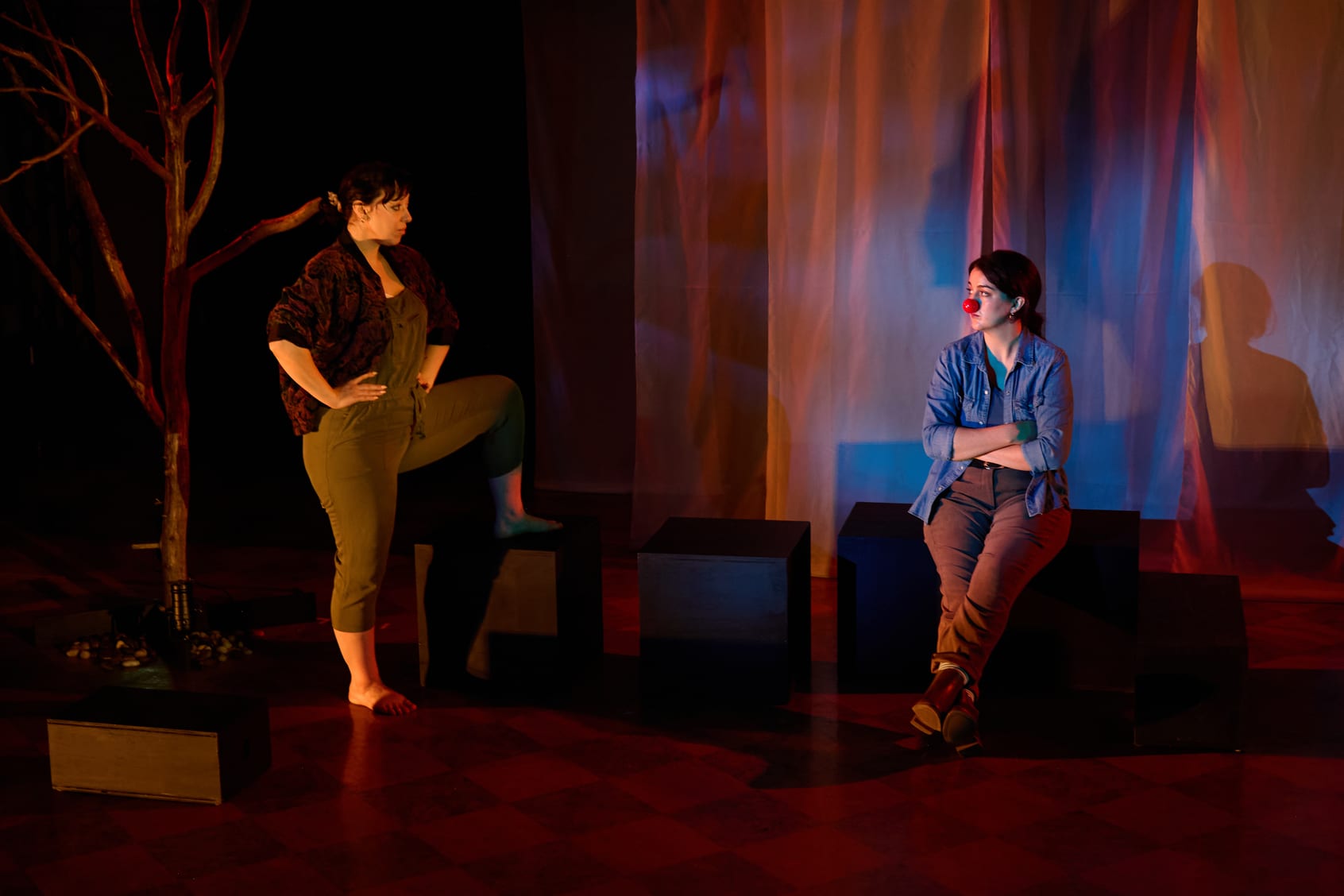
Dalia Charafeddine & Natasha Fagant play Rimah and Natasha in Two Birds One Stone, on at Teesri Duniya Theatre until November 5. PHOTO: Rania Lardjane
When Natasha visits the Palestinian city of Nablus for the first time in the play Two Birds One Stone, she is stunned by its beauty.
She sees stone buildings that line two mountains, shops with fashionable clothes, carts on the streets selling lemons and dates and olives; she hears the chatter of vendors and children running around. It’s hard not to see the contrast with the destruction and violence happening in Palestine today as she describes Nablus. She’s there during her birthright trip to Israel.
The other character in the play, Rimah, is a Palestinian from Nablus who moves away to study in Belgium. The play unfolds as these stories are told side by side, with monologues, vignettes of conversations with family members, and flashbacks to childhood memories. Two Birds One Stone is a product of the friendship between playwrights Natasha Greenblatt, a Jewish-Canadian, and Rimah Jabr, a Palestinian, who met through a mutual friend and began writing together.
The play had its opening night at Montreal’s Teesri Duniya theatre on Oct. 25 where it will be performed until November 5. It’s the first play to kick off Teesri Duniya’s season “Staging Freedom” completely dedicated to stories and conversations about Palestine.
Support your local troublemakers: become a Rover member today!
Teesri Duniya’s team cancelled their originally planned season to completely revise it to be content about Palestine. The theatre has already been engaging with the topic actively since last year. They were involved in organizing an art exhibit about children in Gaza and held stage readings of two plays about the topic including My Name is Rachel Corrie and Seven Jewish Children. But this is the first time Teesri Duniya is focusing an entire season on a specific global issue.
Making space for Palestine
Rahul Varma, co-founder of Teesri Duniya, says he was dismayed by the artistic community in Canada’s “mute response” to the war and felt the responsibility to do more. “Those who are committed to political theatre, without any hesitation, without any fear, are few compared to those who have used the terminology of social justice all the time, but have done work that falls short of that,” says Varma.
Many specifically in the theatre world stay away from programs that engage with controversial political topics because they often fear losing funding, according to Varma. There are some smaller theatres similar to Teesri Duniya that are unapologetically political including Aluna Theatre in Toronto and MT Space Theatre in Waterloo, but they are the outliers.
Another goal for the current season is to get the community to engage in conversations about Palestine and colonization. Along with the plays they are putting on this season (Two Birds One Stone and Keffiyeh Made in China), Teesri Duniya is also continuing its Gaza Monologues program — now called Monologue for Dialogue — in which people submit writings on themes including genocide, ceasefire, resistance and decolonization, read them out loud, and discuss them together as a group.
For Varma, activities like this are at the core of what theatre should be doing for the masses: pushing for social change. And so far, the reception for Two Birds One Stone has been hugely positive with audiences packing the theatre and participating in after-show talk-back sessions to discuss the play and its themes.
“Theatre generally has to be political; performances are for political change. The call for social justice, call for change is made by all theatres, but how do they actually express this? I think that we have very clearly believed that the conflicts in the world are across class, gender and race — and we have to critically present that,” says Varma.
When the team at Teesri Duniya read the script for Two Birds One Stone, they found it to be powerful in demystifying a lot of confusion that exists around Palestine. As it’s written by a Palestinian and a Jewish-Canadian together, Varma explains it symbolizes the fact that the conflict is not just the problem of Palestinians, but it is the problem of everyone.
A pattern of censoring Palestinian art
Over the last year, there have been a handful of incidents where Palestinian artists or art about Palestine has been shut down or censored. Often, it’s been because someone in the community complained about the piece coming off as anti-semitic or divisive, and so to avoid controversy, the art is taken down. What this ultimately does is curb meaningful conversations about the genocide.
In Palestine, the Freedom Theatre in Jenin (which has been nominated for a Nobel Peace Prize) is a place that has been uplifting Palestinian voices for decades, but it’s been under attack for just as long. It’s been vandalized, raided by Israeli soldiers and its staff arrested and beaten. The ongoing violence on the theatre has been explicitly described as a cultural genocide.
Though not as explicitly violent, this pattern of silencing Palestinian voices is present in many forms throughout the world including in Canada. Censorship of art in particular has been increasingly prevalent over the last year. Galleries have closed exhibits, cultural events have been cancelled, and sometimes artists expressing their support for Palestine have even faced professional consequences.
An artist coalition in the United States even designed a map to track artists that have faced censorship — the majority of whom are those who have openly supported Palestine or questioned Zionist ideology.
In Montreal, Cinéma du Parc was scheduled to have a screening of the film From the River to the Sea about Palestinian narratives last year but cancelled the screenings at the last minute due to the “unease aroused in relation to the political content of [the] event,” said the board of directors. Many community activists protested with a sit-in about the censorship, and a local venue, La Sala Rossa reprogrammed the film at their venue.
Similarly, an exhibit titled Expressions of Critical Thought at the Aurora Cultural Centre in Ontario was shut down last month after a community member complained about anti-semitism concerning a few of the pieces which expressed phrases including “Free Palestine,” “Land back,” and “Intifada.”
Last November, when the Royal Ontario Museum (ROM) in Toronto had an exhibit on cultural rituals around death, they attempted to censor a Palestinian artist’s piece within the exhibit. Jenin Yaseen, a Palestinian-American artist, had a painting about sacred Islamic burials and the realities of death in Palestine alongside other pieces about traditional Islamic mourning rituals.
The ROM contacted a few artists in the exhibit including Yaseen about a censorship request. They wanted to crop out part of Yaseen’s painting, change the word “Palestine” to “West Bank” and remove the word “Exile.” The artists refused. But still, on the members’ opening night, Yaseen saw they had made many of the changes anyway, including cropping her piece.
When Yaseen and the other artists saw the changes, they were extremely upset. Yaseen remembers one of the contributors to the exhibit and an organizer, Malak Kanan, confronted the museum staff that night.
“We were all crying, we were all in tears. We were like, ‘Our people are dying. They’re being forced to be buried in the rubble. They can’t even come out of the rubble to be buried in a dignified way and we’re out here pleading with you just for our experience to be displayed in a death exhibit,’” says Yaseen.
The next day, Yaseen participated in an 18-hour sit-in protest at the museum, negotiating with the museum staff until they came to an agreement. They agreed to keep the piece as it is but put up a disclaimer next to the piece stating the artwork displays content about death in conflict which some may find disturbing and that they should walk past it if they prefer not to see it.
“It was a very violent experience,” says Yaseen. “We feel Zionist violence as Palestinians all the time and I think I really felt it at that moment seeing this threat of erasure — we’re out here dying, and they still won’t even let us have that small imagery of our experiences and our struggle.”
The question of political theatre
Initially, Jabr didn’t want Two Birds One Stone to be political — her focus was on humanizing Palestinians. It’s almost a joke at the start of the play when Rimah’s character announces, “This isn’t a political play.” To which the character of Natasha rolls her eyes and says “Yeah okay, sure.”
“For me, what is important is to present a human story, and that narrative by itself, is enough as a counter-narrative to what Israelis are trying to do now in terms of dehumanizing Palestinians, to make people see them as things,” says Jabr.
For both Jabr and Greenblatt, there was anxiety about what they were saying about the conflict in the play and if they were making enough of a statement about it. The play itself deals with this tension very openly.
There are moments when the characters break out of the play and question the theatrics of it (Should they do the accents, the characters ask. Does it feel uncomfortable?) Ultimately, the play doesn’t have a grand thesis but instead presents an important element to the conversation about the conflict: the perspective of a lived experience.
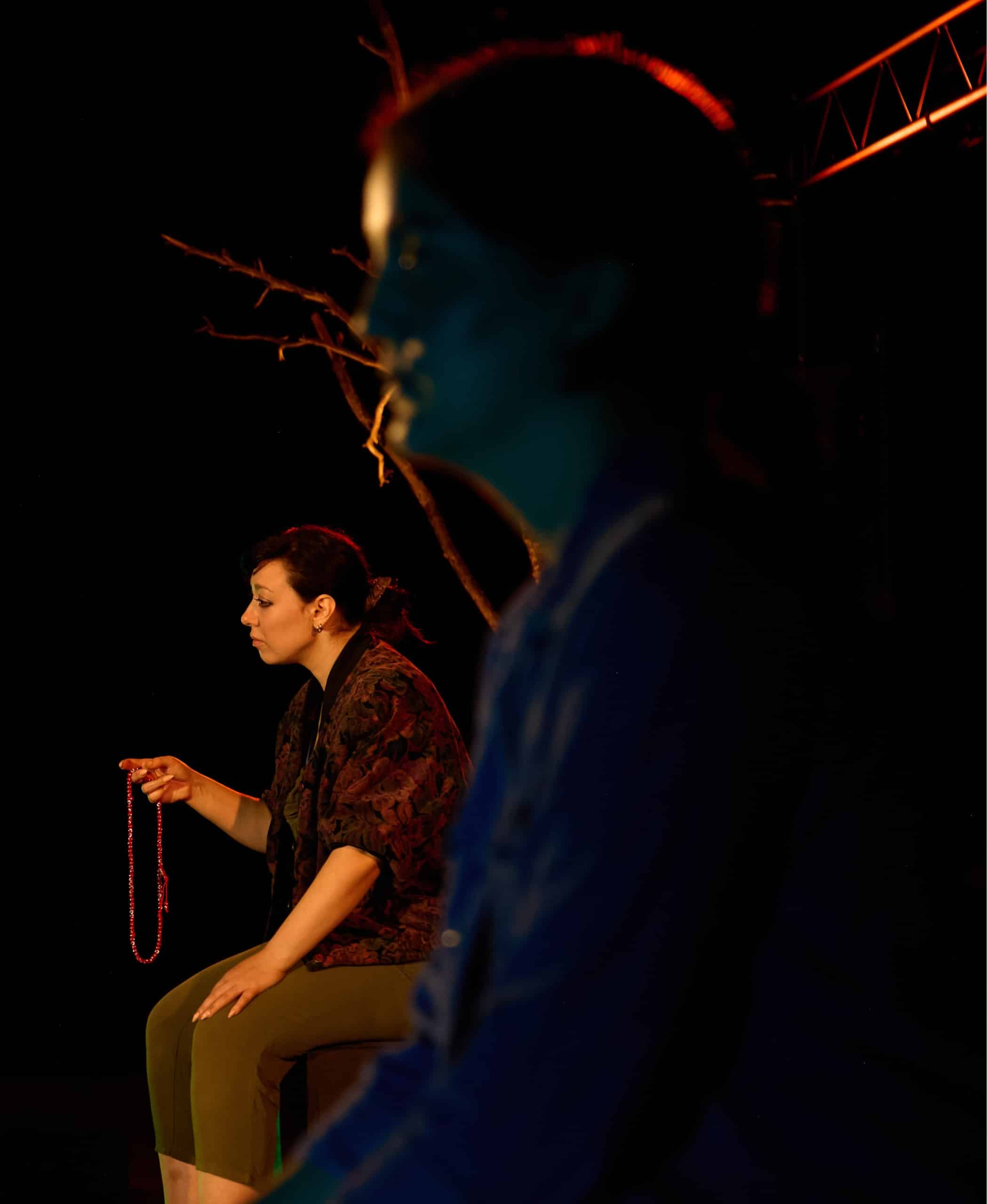
Dalia Charafeddine & Natasha Fagant play Rimah and Natasha in Two Birds One Stone, on at Teesri Duniya Theatre until November 5. PHOTO: Rania Lardjane
A big theme in the play is the personal learning that both characters go through, whether it’s about the reality of Palestinians or family history. And they bring audiences on this learning with them.
“I feel like working together and allowing for those moments of tension, whatever they are, is a very fruitful place that theatre has a space for,” says Greenblatt. “There’s so much subtext in theatre, so just by placing these two stories together, there’s a kind of resonance that doesn’t even have to be articulated — just by putting our bodies on stage and working together, there’s storytelling and possibility that just kind of lives in that act.”
Both Jabr and Greenblatt are members of Theatre Artists for Palestinian Voices, which advocates for and supports artists in Palestine. The group organized an event last year, From Turtle Island to Palestine, which brought together Indigenous and Palestinian artists to host a fundraiser for the Freedom Theatre in the Jenin refugee camp in Palestine’s West Bank.
The organization also makes space for Palestinian voices here in Canada to bring their storytelling to the forefront.
“If you say ‘Palestinian,’ people cannot really imagine a Palestinian artist or a Palestinian doctor or a Palestinian hairdresser, or they don’t have this in their mind when they think about it, they think about all Palestinians as Hamas and that’s it,” says Jabr. “I feel the urgency to really tell, talk and show with whatever I know, whatever I can do, because I’m not a fighter, I’m not an activist, I’m not a journalist, I’m an artist, and this is what I can do, so I must do something with what I know.”
There’s a scene in the play when Rimah’s character is at a former Israeli soldier’s house for dinner. She meets his wife and his son. And then she launches into this monologue to the audience as Natasha sings behind white curtains between blue and purple lights.
“Everything was okay, until they started reading from the Torah and singing in Hebrew.
For me, Hebrew means a soldier shouts at my father open the door.
Hebrew means they announce the curfew.
Hebrew means prison.
Hebrew means you can’t pass.
Hebrew means weapon.
Hebrew means hands up on your head.
Hebrew means shoes off, turn around.
Hebrew means those might be the last words you will hear.
How many Hebrew songs will I need to hear to get over it?”
Moments like these in the play are electrifying. They transport the viewer right into Rimah character’s point of view, into her memories, into a haunting moment. And for those brief moments, they can see and feel something they could never come close to otherwise.
“The way we practice art is we practice it by conveying truth. Our art is like our weapon to counter a lot of the lies that they’re trying to spew on our people,” says Yaseen, “Our art is what humanizes us, and our art is what connects us to one another, whether we’re in America or in Canada or refugee camps.”
Enjoyed this article? Share it with a friend!
Author
Comments (3)
Leave a comment
Related Articles
‘Everybody Who’s on the Stage Is Part of Your Community’: Ctrl+Alt Festival Returns for a Third Edition
Free festival stacked with queer, local performers to take over the Place du Village July 24-26.
Des travailleur·euses du sexe de Montréal feront la grève pendant le week-end de la F1
Cette dernière initiative de « whoreganization » s’inscrit dans le cadre de la lutte des travailleur·euses du sexe pour leurs droits du travail et la décriminalisation.
‘Society Is Built to Keep Us in the Gutter’: Sex Workers in Montreal to Strike During F1 Weekend
This latest “whoreganization” effort is part of sex workers’ fight for labour rights and decriminalization.
I really wonder if the Rover realizes that the Jewish people achieved perhaps the most successful Land Back project in human history, reclaiming freedom, safety, and sovereignty in (part of ) their historic homeland after 2000 years of persecution and massacres in exile.
Oh, who am I kidding, that’s actually colonization and genocide, right guys? /s
Thank you for this article Ms Chollangi and thanks too for the intrepid souls at Teesri Duniya Theatre for speaking their unique perspectives.
I too find the smothering of Palestinian voices around the world ominous. Official voices try to drown out and gaslight us when the truth of mass murder and genocide is on our screens every day with thousands of pictures of dead and mangled children.
There must be another way.
NABLUS HOME THE PALESTINIAN ISLAMIC JIHAD TERRORIST ORGANISATION LOOOOL THE ROVER IS RADICAL LEFTIST ACTIVISM NOT JOURNALISM